Krishna is celebrated as the eighth incarnation of Vishnu. He is at the heart of several myths, festivals and lived traditions. This article curates many themes surrounding him. It begins with his miraculous birth and tells stories of his divine leelas. Many devotional practices celebrate him and sacred geographies are developed around his life stories. Krishna inspires a wide spectrum of artistic expressions that make his divine qualities accessible to all.
The images collated are from photographs that I had clicked from the museums, places of worship and architectural sites I visited over the past few years. And a few, are scans from books.
Birth of Krishna
Birth of Krishna / Krishnajanma. This unique sculpture depicts Devaki feeding her newbon baby, Krishna. Devaki, the wife of Vasudeva during imprisonment at Mathura gave birth to Krishna. As the eighth son whas destined to kill evel king Kansa, he had held the couple hostage during the child’s birth. In this depiction, the guards are depicted behind them holding wepons. Krishna was born and the prison doors magically opened for Vasudeva to take him to his foster parents Nanda and Yashodha.
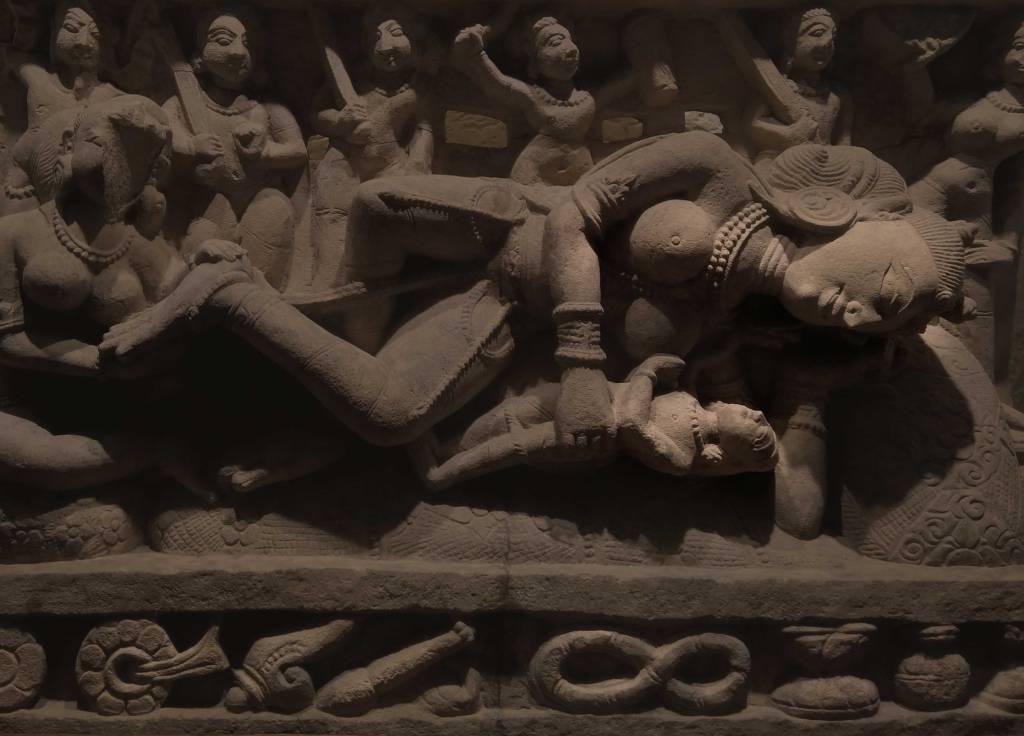
This unique sculpture depicts Devaki feeding her newborn baby, Krishna. Devaki, the wife of Vasudeva during imprisonment at Mathura, gave birth to Krishna. In this depiction, the guards are shown behind them holding weapons. Krishna, being an incarnation of Lord Vishnu, has his attributes depicted in the lower register of the sculpture. This sculpture has been placed in the Archaeological Museum at Gwalior Fort.
When Krishna, their eighth child, was born at midnight, divine intervention opened the prison doors and Vasudeva carried Krishna out. Krishna was born, and the prison doors magically opened for Vasudeva to take him to his foster parents Nanda and Yashodha.
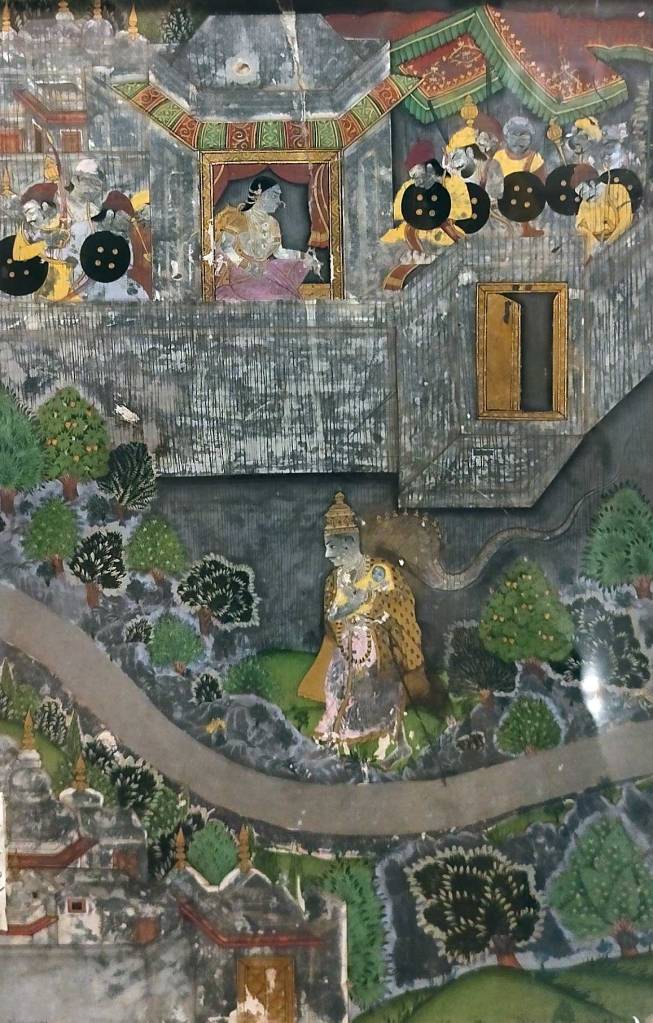
This is an Indian Miniature Painting from the Salar Jung Museum. It belongs to the Deccani School of miniature painting, specifically tagged as Shorapur style, from a region in modern-day Karnataka by that name. It shows Devaki being guarded by Kamsa’s prison security, a door shown ajar which miraculously opened to let Vasudeva out, and him approaching the River Yamuna with baby Krishna.
The River Yamuna flooded and facilitated Krishna’s journey across the river, while Shesha Naga sheltered him under his hood. Krishna was safely transported to Gokul.
The child found in the prison by Kamsa took the form of Goddess Durga, who warned him about Krishna, divinely deported from prison, and destined to slay him to fulfill the prophecy.
Celebration of Krishna’s Birth
Janmashtami
This festival is also known as Krishna Janma or Krishna Janmashtami, and a separate day (especially in Maharashtra) is reserved for a participatory celebration of Dahi Handi. The birth of Krishna occurred in the months of August or September, and every Ashtami of Krishna Paksha in the Bhadrapada month his birth is celebrated. Footprints are also drawn, symbolizing the baby steps of Krishna entering one’s home. Owing to Krishna’s birth at midnight, devotees celebrate through the night. Much like Christmas, Janmashtami marks midnight celebrations of Krishna’s birth. Kerala sees the dance-drama Krishnanattam, which chronicles the tales of Krishna. The Assamese perform the Sattriya and Ankia Naat, dance-dramas that depict Krishna’s leelas. Bhajans and kirtans are common during this occasion, especially until midnight.
Balakrishna and Dahi Handi
At Krishnajanmashtami, many vibrant performances are seen. The most popular among them in Maharashtra is Dahi Handi. Here, human pyramids are made to break the pot of curd that is hung on a rope at a height. This emulates the mischievous childhood of Krishna. Dahi Handi commemorates Krishna’s mischievous childhood as maakhan-chor.
Krishna relished milk products, and it is fabled that he would visit homes to drink milk and gobble cream, butter, and other dairy edibles. Krishna is sometimes also known as Laddugopala or Balgopala.
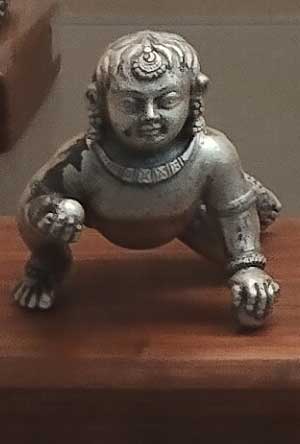
The little idol you see here is of Balkrishna. It is a part of the Salar Jung Museum’s collection (accession number CS-IV-246). It is a 20th-century work of Indian origin.
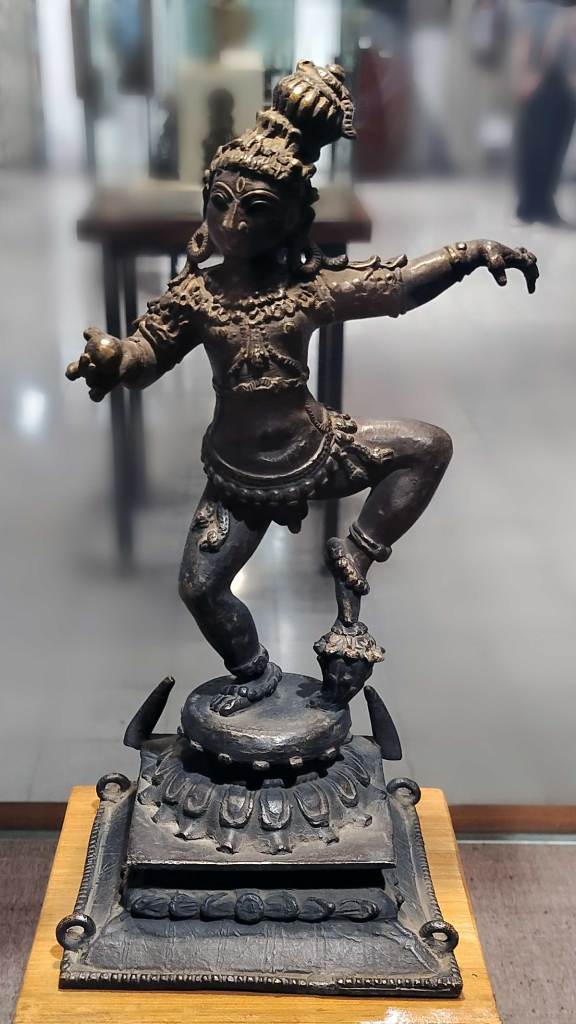
This Balgopal from Andhra Pradesh is cast in bronze, it is from the Medieval Period. It is in the collection of the Chandigarh State Museum (accession number 5018A). It shows Krishna in child-form, holding a ball of makkhan, standing on a single foot, in tribhanga (three-bend) posture. He is bejeweled with a crown, armlets, anklets, and a waistband. Again, though he is just a little boy, he is always portrayed as divine. This cast bronze craft depicts the mischievous maakhan-chor gracefully poised upon a pedestal, and is part of the devotional art of southern India.
Jhoolna Utsav
Devotional music, fasting, and re-enactments of Krishna’s childhood take place each year. People fast through the day, and at midnight an idol of Krishna is installed in a jhoola or cradle and rocked, after which fasts are broken. The jhulana utsav symbolizes the baby Krishna’s birth.
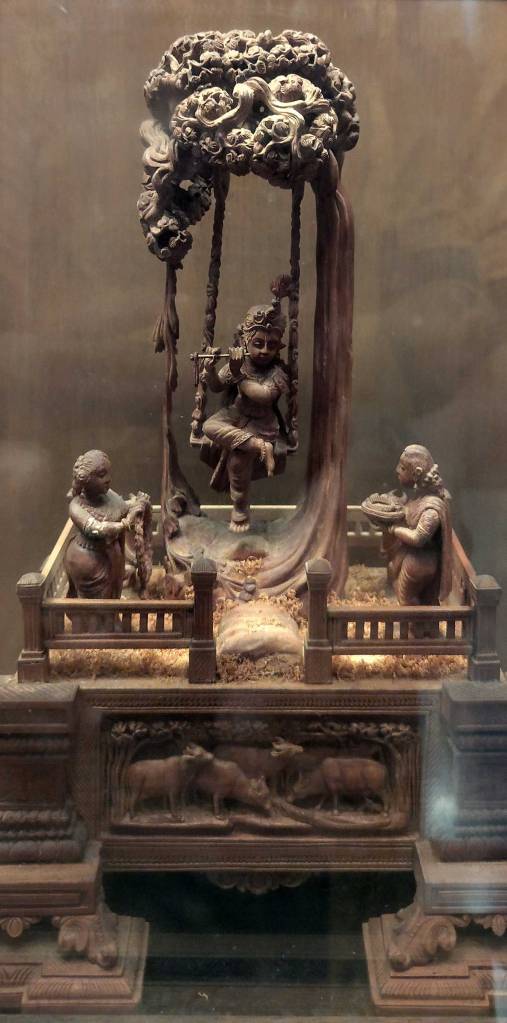
This is an object from the collection of the Salar Jung Museum. Here, a flute-playing Balgopal is depicted seated on a swing or jhoola, under the canopy of a dense tree with its roots/branches forming the swing-suspenders. There are two ladies who are either his attendants or devotees, making offerings to the little child. The panel at the base of the carved wooden piece shows cows and trees, symbolizing Krishna’s being part of the cowherd community of Gokul. The pastoral life, the idyllic time in the grove of devotion, is gracefully depicted through this artistic expression. This is also a young form of Venugopala, or the cowherd-boy with a flute. Just the way this graceful woodcarving, the tradition of placing Krishna in the crib, paalnaa, cradle, or jhoola too imbibes Krishna’s childlike divine play.
Chikhal Kalo
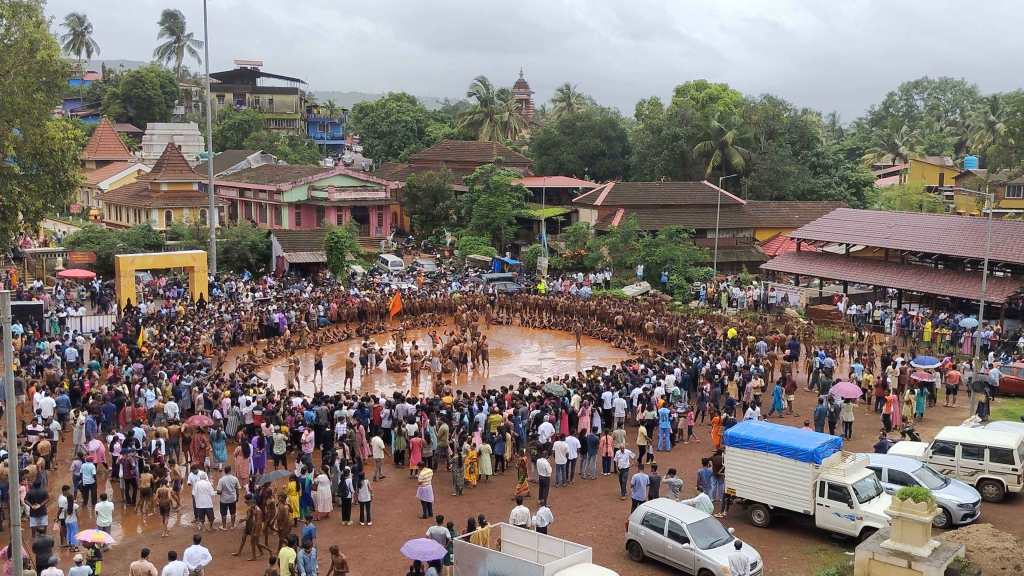
This is a festival specific to a little village in Goa. At Marcel, in the red soil of a large ground in front of the Shree Devaki Krishna Temple, a huge crowd of people gathers at the advent of monsoon. Chikhal Kalo, or Mud Bath, is an agrarian festival that is both a celebration of Krishna’s playful childhood and a symbol of gratitude to Mother Earth.
All who come to mimic Balkrishna play in the wet, monsoon soil and get the muddy earth coated on their bodies, throw balls of squishy earth at one another, and play traditional games.
This also shows the deep connect of the community towards the fertility and nourishment that the monsoon earth gives.
Narakachaturdashi and Burning of Narakasur
Narakasur was a demon. He was the son of Bhudevi, or the Earth Goddess, and the Varaha Avatar of Vishnu. Through his penance, he had attained a boon that he would not be killed by anyone, and only his mother could kill him. He caused havoc in heaven and earth. He conquered Indra’s lands, and he imprisoned 16,000 women from Indra’s kingdom. He also stole Aditi’s jewels. Aditi is the mother of the solar god Surya.
People called Krishna for help. His wife, Satyabhama, was a reincarnation of Bhudevi. Thus, she was an eligible candidate to kill him. Both Krishna and Satyabhama were taken by Garuda on his back to the fort of Narakasura, and Satyabhama killed him with an arrow. He was defeated by Krishna and his wife Satyabhama, thus restoring Aditi’s jewels.
During Diwali, on Naraka Chaturdashi, large statues of Narakasura are erected and burnt in Goa. A bitter fruit (kareet) is stamped under the foot as a symbol of killing the inner ego, malice, falsehood, wrath, and ignorance.
Gowardhan Puja and Chappan Bhog
Indra was always at odds with Krishna; you will see this through other stories too. Due to this, he sent torrential rains over Krishna’s Braj folks. To shelter his people, plants, animals, and the cows, Krishna lifted an entire hill on his little finger. This hill was called Govardhan.
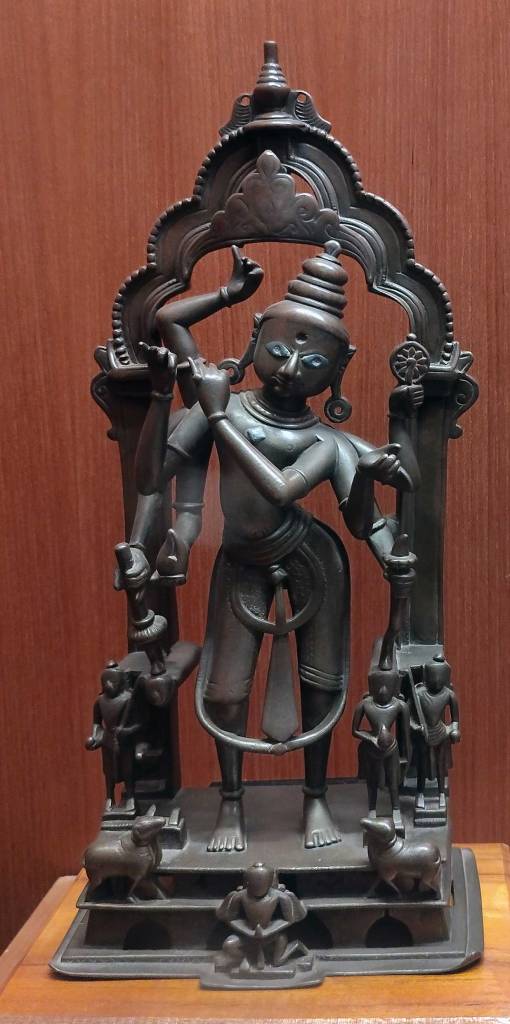
This western Indian bronze of the 13th–14th century shows Govardhanagiridhari Krishna, playing his flute while lifting up the mountain with one hand and holding the Vishnu discus in the other. There are little cows looking up to him and other devotee figures flanking him, and one with knees bent in a namaskara mudra at his foot. This beautifully crafted metal is from the Salar Jung Museum.
Govardhana comes from ‘go’ (cows or senses) and ‘vardhana’ (nourishment), meaning “nourisher of cows.” As Krishna lifts up the hill of senses, he is also known as Giridhar, or “uplifter of the senses.” This belief further reinforces the meaning of the word Govardhana itself.
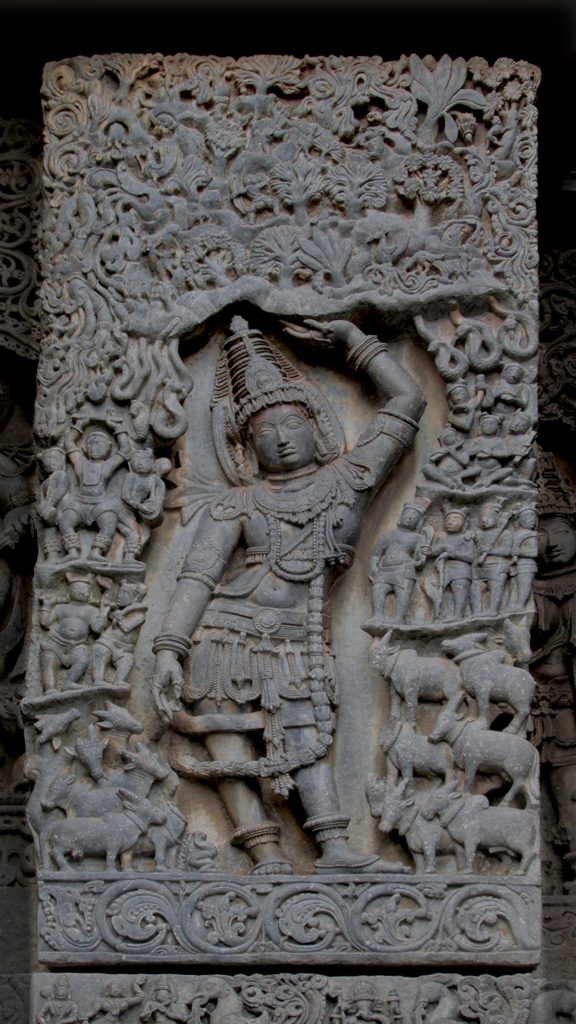
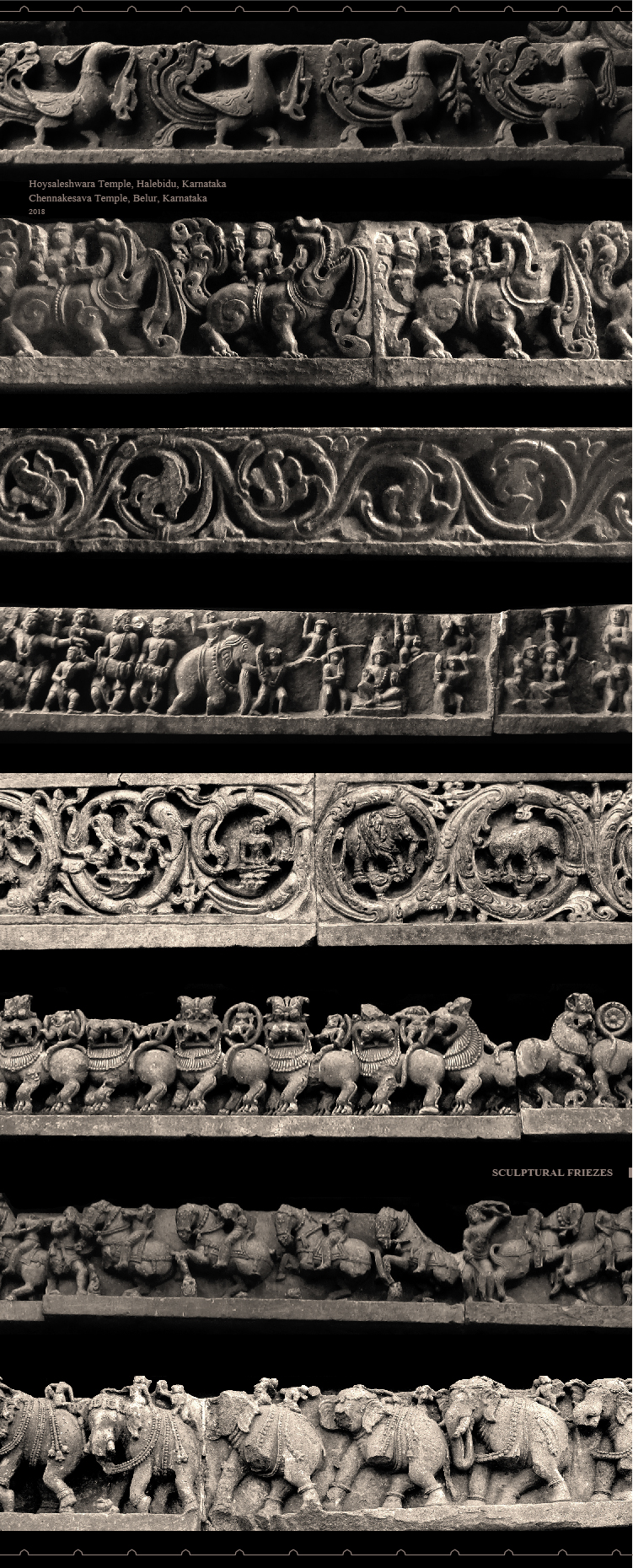
At the Hoysaleshwara Temple at Halebeedu in Karnataka, Krishna is depicted lifting the Govardhana Mountain effortlessly with a finger of his left hand. Rows of devotees, people, and cows seek refuge under the shade of the mountain.
The landscape over the mountain is stylized, featuring snakes and other motifs. He stands at ease, in the graceful tribhanga posture—the triple-bent position, being bent in the neck, waist, and knee. The atmosphere is stormy, and sculptural lines show the fury of the rainclouds and the trees being swayed by it.
Those seeking refuge are shown with various expressions: those of being alarmed, to those of feeling safely protected, to the emotion of awe, respect, and devotion that they feel towards their saviour.
Devotees consider this to mean “increased attraction to Krishna,” and to commemorate this episode and reinforce its spiritual meaning, they perform the Govardhan Puja.
As a symbol of their gratitude towards Krishna, the devotees prepare and offer food. This food is called Chappan Bhog. The festive food too has its origin in the story of Krishna lifting the Govardhan Parvat. This act of lifting up the mountain took place for seven days. During these seven days, Krishna did not eat or drink anything. He missed his regular eight meals of each day. Thus, in total, he missed (7 × 8) 56 meals.
As a symbol of these 56 meals, 56 or chappan items are prepared, maintaining sattvic purity, in ghee, and without onions or garlic. Hence, this feast is called Chappan Bhog, or a meal made of 56 items.
Worship and Sacred Geography
Especially during Krishna Janma, devotees make pilgrimage to the Shri Krishna Janmabhoomi Temple at Mathura, said to be the very place where Krishna was born. The garbhagriha or sanctum of the temple is the prison cell of Devaki and Vasudeva during their captivity by Kamsa, and the chamber where Krishna was born. There is a ghat at Kashi/Benaras by the name Keshi Ghat, that is the site at which, as per legends, Krishna slayed the evil demon Keshi. This story is mentioned a little ahead.
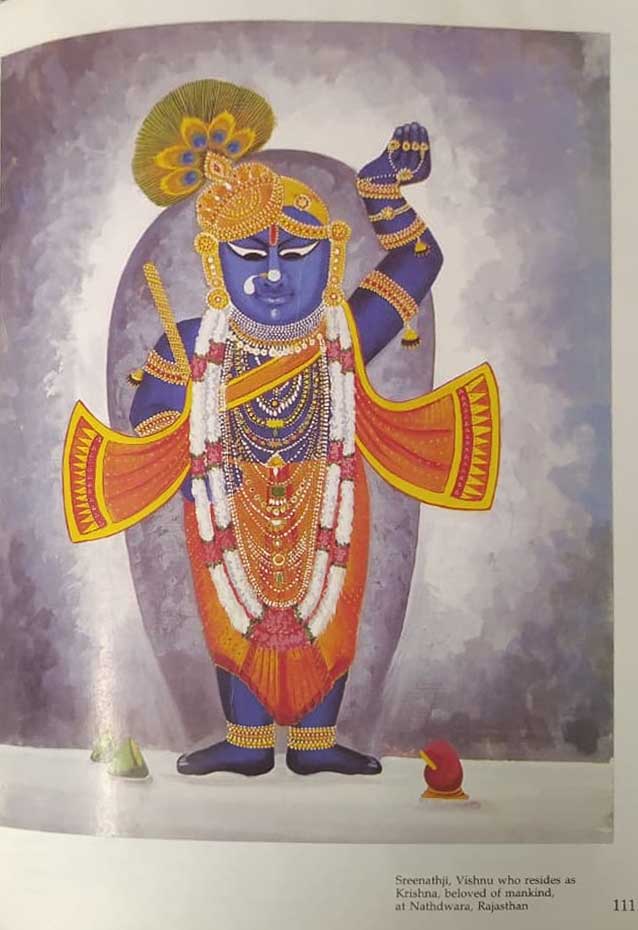
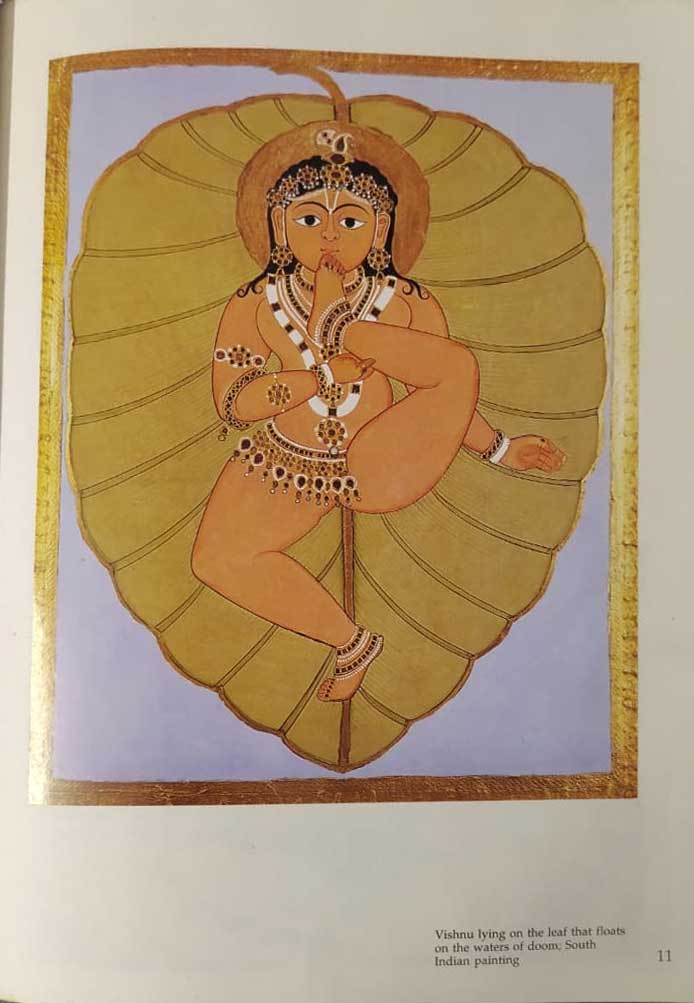
In visual art, Pichwai paintings from Nathdwara in Rajasthan depict the life and aspects of Krishna. Cows are seen abundantly, surrounding Shreenathji (a name for Krishna). Sanjhi is a popular art in the Mathura/Vrindavan region, featuring complex paper-cutting. Stencils are delicately cut to depict scenes and symbols associated with Krishna. Wall murals, known as jhanki, depict the journey of Krishna to Gokul dramatically. Pattachitra and Madhubani paintings depict colorful scenes of Krishna’s birth, found in Odisha and Bihar.
Mother and Child
At the (same) Shree Devaki Krishna Temple, Marcel, Goa (where Chikhal Kalo is celebrated), one finds a unique mother-child imagery in its sanctum sanctorum. This also resembles the imagery of Mary holding Infant Jesus. Here, Krishna is portrayed with his biological mother, Devaki. She is the central idol in the composition, along with two images of Krishna—one in her arms and the other standing in front of her. Both these Krishna figures are seen in child-form and hold balls of makkhan in their hands.
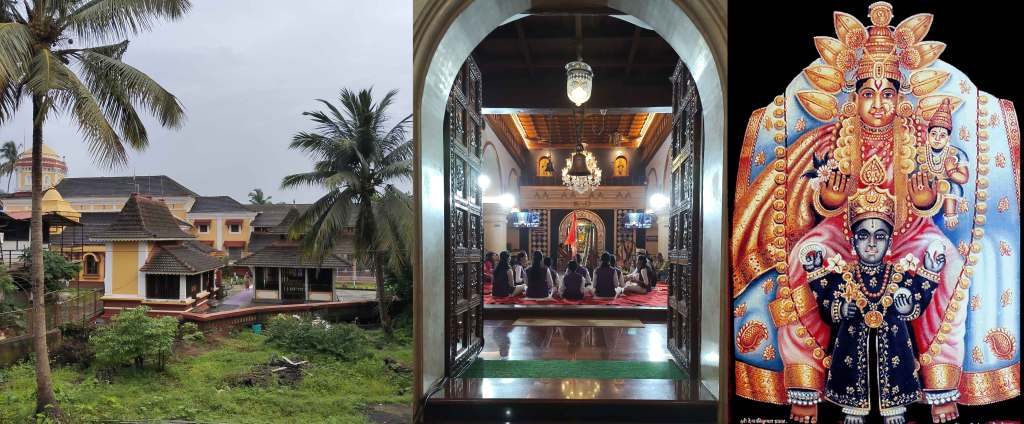
Other places where Krishna Janma is celebrated on a large scale include Vrindavan, Dwaraka (Krishna’s kingdom), Manipur and Assam (through Raasleela), and the Krishna temples at Udupi.
Childhood Leelas
Leela means Divine Play. And Krishna’s life has an abundance of these.
The Putana Story
Krishna’s maternal uncle, Kamsa, sent demoness Putana to kill baby Krishna. This demoness was a shape-shifter, and she took the form of a beautiful woman.
On meeting Balgopal, she picked the infant from his crib and began breastfeeding him. She was to feed poison to Krishna through her milk. Krishna, though only a baby at the time, was still an avatar of Vishnu. He instantly knew the identity of this devious woman and in one tight, long suckle, bit Putana so hard that it took the breath out of her.
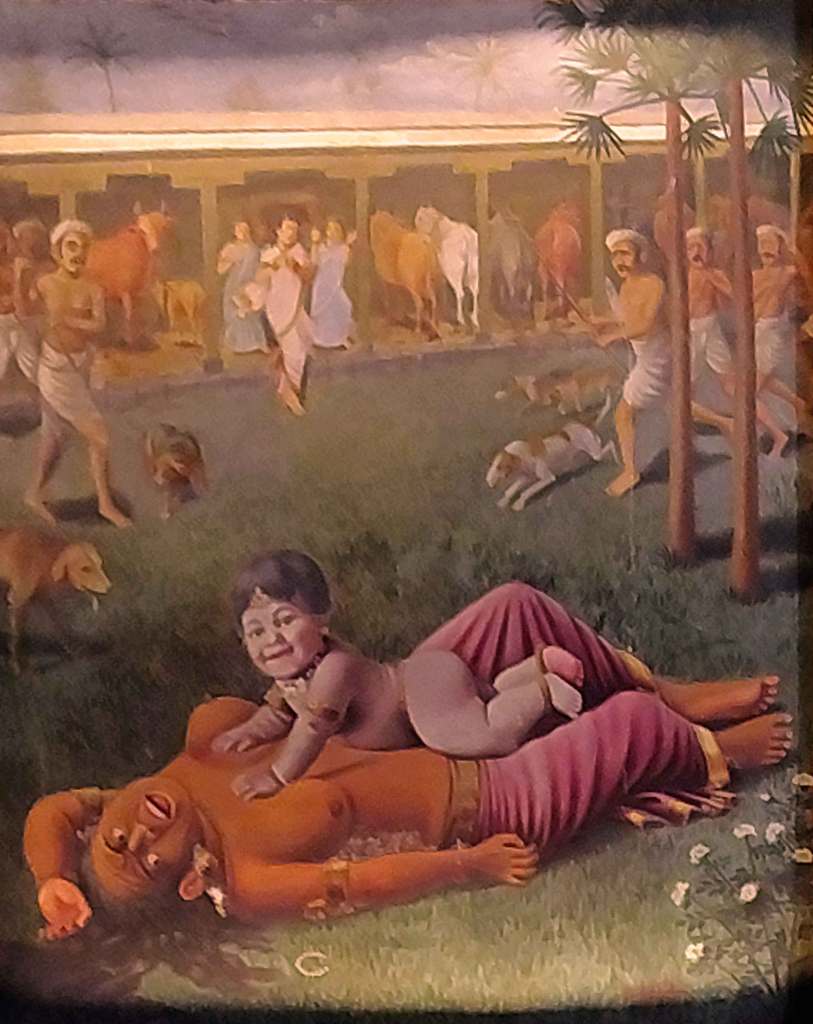
As soon as this happened, the beautiful form of the woman disappeared and the large body of the demoness became visible to all the onlookers. She fell to the ground, and Krishna innocently (and triumphantly) began to play on her lifeless body.
The painting you see here is from Ambabai Mandir, in Aundh-Satara. This temple has some of the most beautiful paintings from Indian mythology framed in the sabhamandapam. It is said that these are an extension of the collection of the Shri Bhavani Museum and Library, Aundh, Satara.
Kaliyamardan
Once, a venomous snake lived in the waters of the River Yamuna (known earlier as Kalindi). This snake, Kaliya, made the water toxic. The population of the cowherds and the agrarian communities were fed up with this. Their plants and animals were dying. They approached Krishna for help.
Krishna then plunged into the waters of Kalindi to combat Kaliya. Kaliya coiled around the body of young Krishna. This was when Krishna enlarged in form, broke free from Kaliya, and began to dance over the serpent’s many hoods. This episode is also known as Kaliyamardan. It is widely portrayed in fine as well as performative arts, as a symbol of the conquest of good over evil.
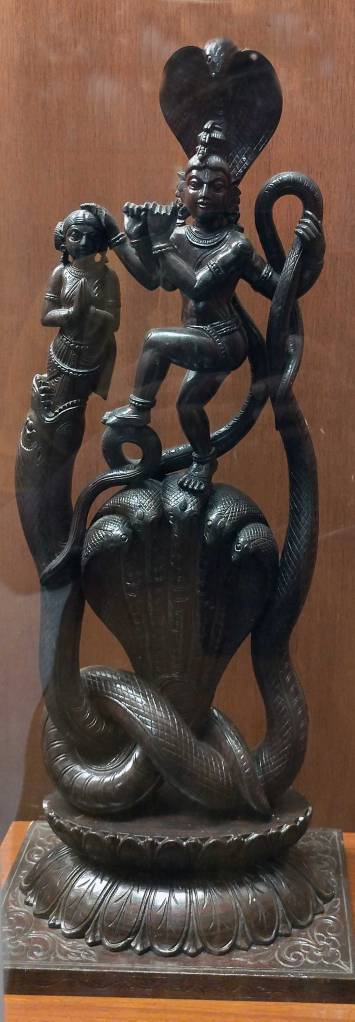
This depiction of Kaliyamardan is in wood and from the southern regions of India. Here, Krishna stands poised above tribhanga (three-bend) stance, a smaller devotee figure emerging out of a stalk. The snake is shown with hands folded in reverence and is being blessed by the hands of Krishna as the divine protector. The other hind-hand of Krishna wrangles the serpentine body of Kaliya, and the forehands are busy playing the divine flute.
The devotee in this figure could also be a depiction of the wife of Kaliya.
The story goes such that, when Krishna dances over the snakehood, Kaliya’s wives come before Krishna and pray to him. They plead to Krishna so that he may not kill their husband and let him go.
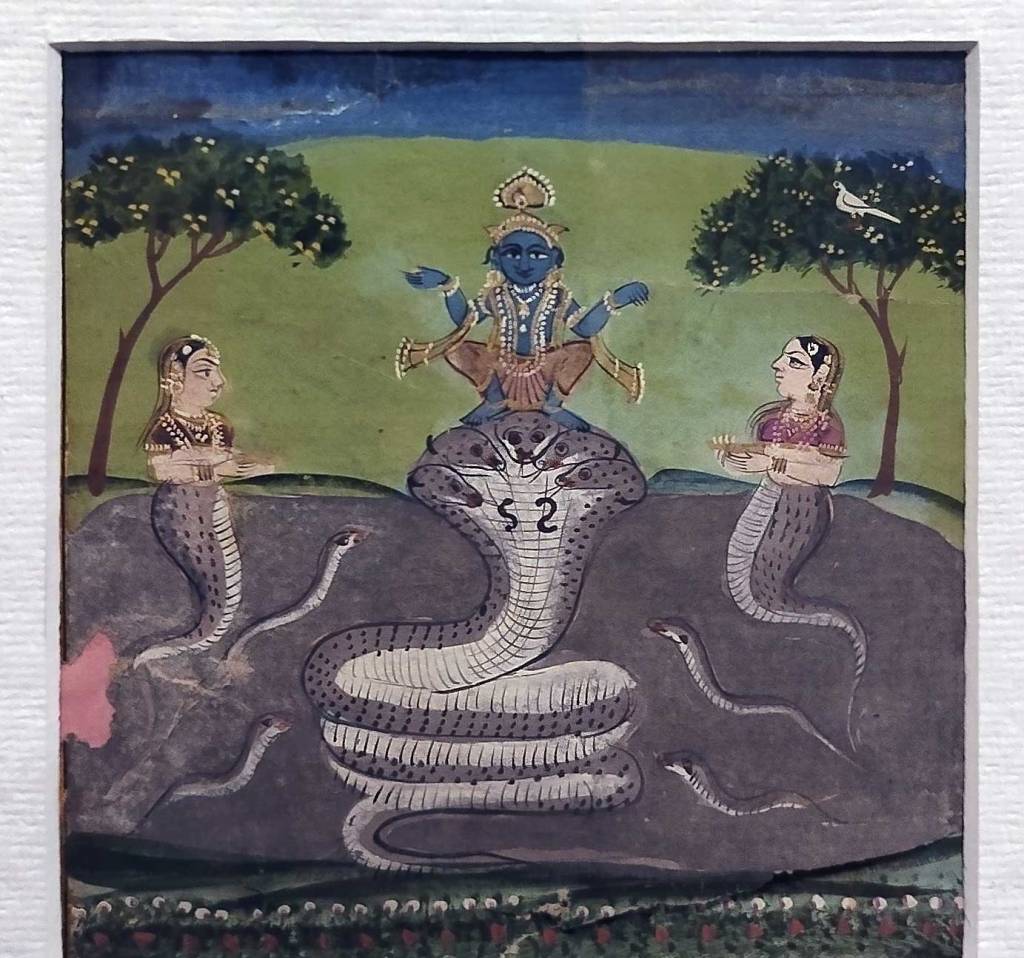
This painting depicts the wives of Kaliya flanking the central icon of Kaliyamardan. Krishna grants them their request, at one important condition: Kaliya was to leave the waters of River Kalindi forever, never to return.
This painting of Kaliyamardan Krishna (Salar Jung Museum accession number 86.95) is a Miniature Painting from the Deccan school. It is 11.0 × 11.0 cm and belongs to the 19th century AD.
Kaliya is forced to do so, and the toxicity of the river fades away, leaving the community happy and grateful to Krishna for this.
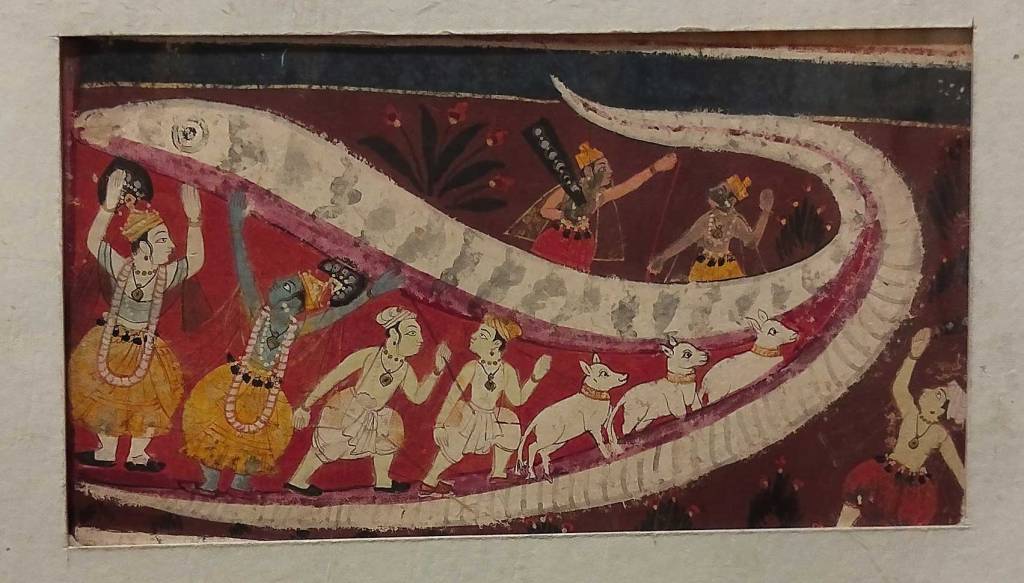
While most accounts state that Krishna alone came to the rescue, the folio of paintings from the Mahanbhagvat states that Balarama (who too is considered one of the Dashavatara of Vishnu), Krishna’s elder brother, also joined in to rescue the cows and the cowherds from Kaliya. In this 18th-century AD painting (12.9 × 20.4 cm from Salar Jung Museum, accession number 74.59), the painters from the Malwa school of miniature painting depict both brothers in an act of heroism, saving the Braj community.
The word Gopal literally means protector of cows. Cows are considered holy in the Hindu tradition, and protecting a cow is equivalent to protecting Dharma.
The Defeat of Bakasura
There once was a huge demon-crane. He was sent to Krishna by Kamsa. The name of this demon was Bakasura. This demon had a large appetite and would pick upon humans and swallow them entirely. As Kamsa’s agent, he was on a mission to kill Krishna. Apart from this brief, he had his personal agenda—that of the grief of his sister Putana’s death by Krishna.
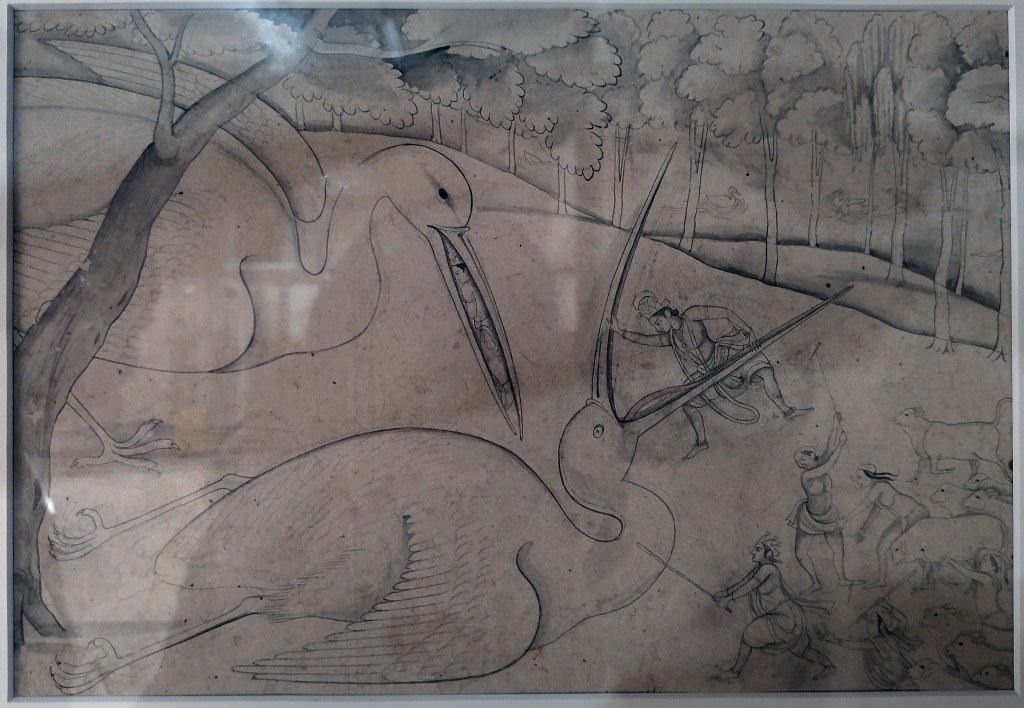
Bakasura found Krishna grazing his cattle, and he attacked. Krishna grabbed him by his beak and stretched it wide open. This tinted drawing on paper, from State Chandigarh Museum (accession number 471), shows this scene beautifully. Miniature painter Guler, belonging to the Pahari tradition of the 1700s, has shown the giant demon being conquered by little Krishna. There are two figures of the same crane in the drawing. The first figure shows him with Krishna entering his body through the beak. On reaching inside his throat, Krishna turns red, hot. When this heat became unbearable, he spits Krishna out. That’s when he grasps his beak and opens it wide, and through his beak itself, rips him apart—thus killing one more demon.
The symbolism in this story goes such: a crane or a stork appears to be in deep meditation but is always watchful of the fishes that run deep underwater. When unaware, the stork grabs the fish in a snap of a second. The name Bakasura comes from the word baka, which comes from the term baka-vritti, also meaning hypocrisy, hidden malice, fake piety, or falsely showing a spiritual attitude. This falsehood and deception is exactly what Krishna absolves by burning it away within the throat of this demon-crane with a large appetite, and tearing him apart to restore absolute truth.
Keshi and Krishna as Keshav
Keshi Ghat, the place at Benaras where this leela of Krishna is said to have occurred. A horrific and huge horse, with whose galloping hooves could shatter the earth and the skies, Keshi the horse-demon came before Krishna to kill him. He kills the demon with the thrusts of his elbow inside his throat.
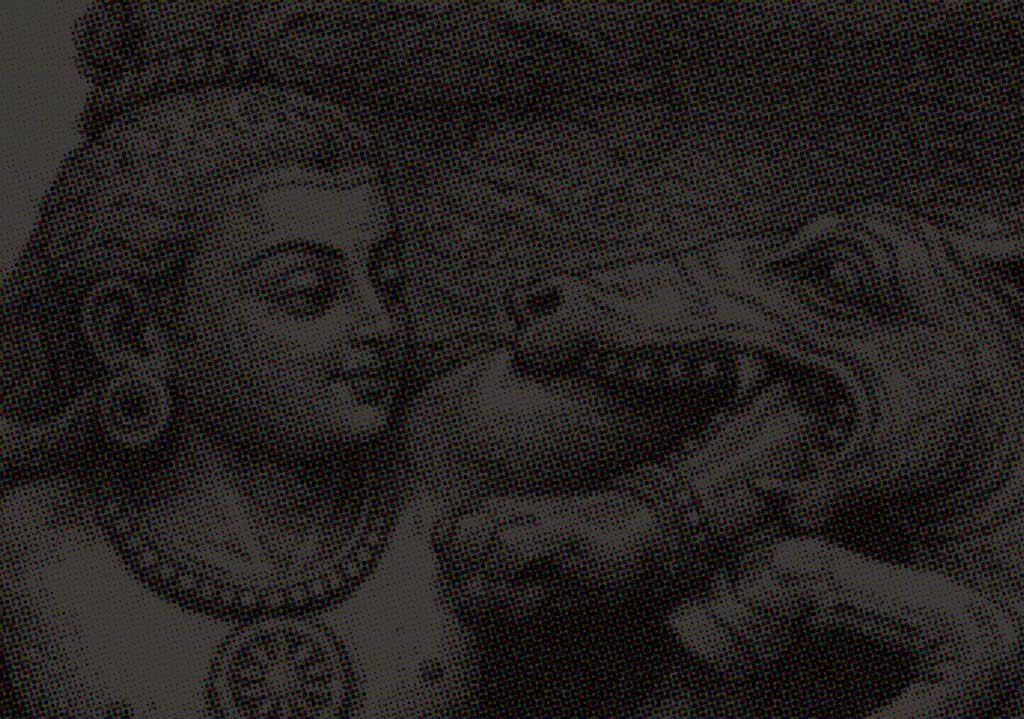
Krishna’s elbow became enlarged inside his jaw, the demon’s throat turned dry, and he was choked. The beast died, and as Krishna slayed Keshi he was also called Keshav, or the slayer of Keshi. This horse-demon was a servant of Lord Indra. Keshi could have been sent by Inda to kill Krishna, due to ongoing personal conflict. The demon’s untamed anger of this beast is altered, and his power is slayed. His ego is choked by Krishna until he fully surrenders to Krishna.
Nara and Narayana
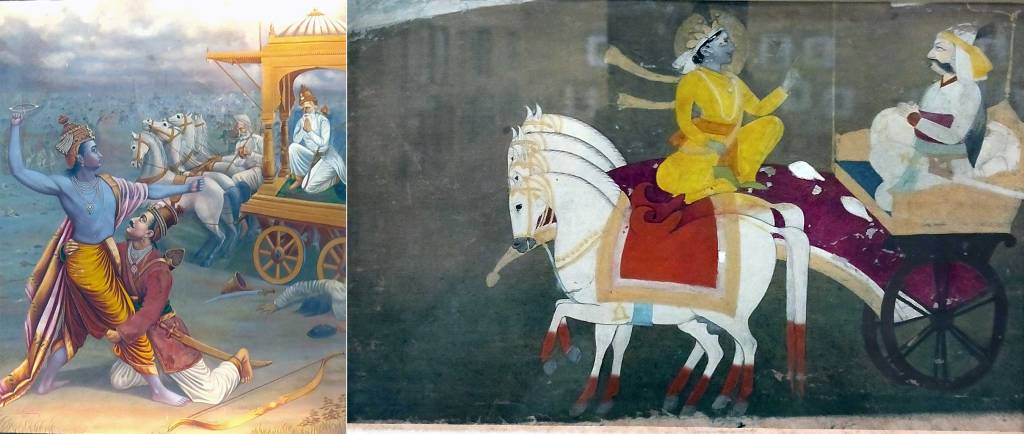
Krishna, in the Mahabharata, plays Arjuna’s charioteer. Partha (another name for Arjuna) and Parthasarathi (charioteer of Partha); the former the traveler, and the latter his guide.
They are popularly known as Nara and Narayana, and in this form, they are almost inseparable. They are believed to be twin brothers—a joint avatar of Vishnu. They are together assigned the job and the duty of upholding righteousness and preserving the cosmic order. In this joint form, Nara is the human aspect and Narayana is the eternal and Divine aspect. Together, they function as a single unit, body and soul. In the battle of Kurukshetra, they are the dynamic duo, who function as one on the physical, intellectual, and spiritual levels.
These two paintings depict scenes from the Mahabharata war. One is from the Ambabai Mandir, in Aundh-Satara, and the other is an 1800 AD painting of the Pahari Style from the Salar Jung Museum.
Raas Leelas
The popular Raslila, or Dance of Divine Play, is a playful dance of Krishna with Radha and the Gopis. This is particularly common in the region of Mathura and Vrindavan. A different version of the Raas Leela is played during Holi. It is called the Lathmar Holi. In this celebration of Krishna and Radha’s playfulness, the women mischievously hit the men with laathi sticks, and the men try their best to shield themselves from it. This is especially played in the Braj region.
The Raas Leela in Northeast India and the Manipuri Raas Leela are festivals comprising dance-drama, music, traditional theater shows, and masked performances. Maha Raas and Vasanta Raas are festivals performed during full moons, with dancers in splendid costumes performing graceful movements. This is a form of Bhakti, or devotion, towards Krishna. Kerala sees the dance-drama Krishnanattam, which chronicles the tales of Krishna. The Assamese perform the Sattriya and Ankia Naat, dance-dramas that depict Krishna’s leelas. Bhajans and kirtans are common during this occasion, especially until midnight.
Krishna’s Divine Flute
The flute is an important part of Krishna’s iconography. Flute-holding and flute-playing figures of Krishna are called Venugopala. Venu is the name of Krishna’s flute, and Gopala means “protector of cows.” Krishna is from the Braj cowherd community and time and again comes to the rescue of cows. A flute-playing Venugopala is often portrayed under the sacred Kadamba tree. The Kadamba tree is a symbol of Krishna in embroidery of the Himachal region of Chamba, known as the Chamba Rumal.
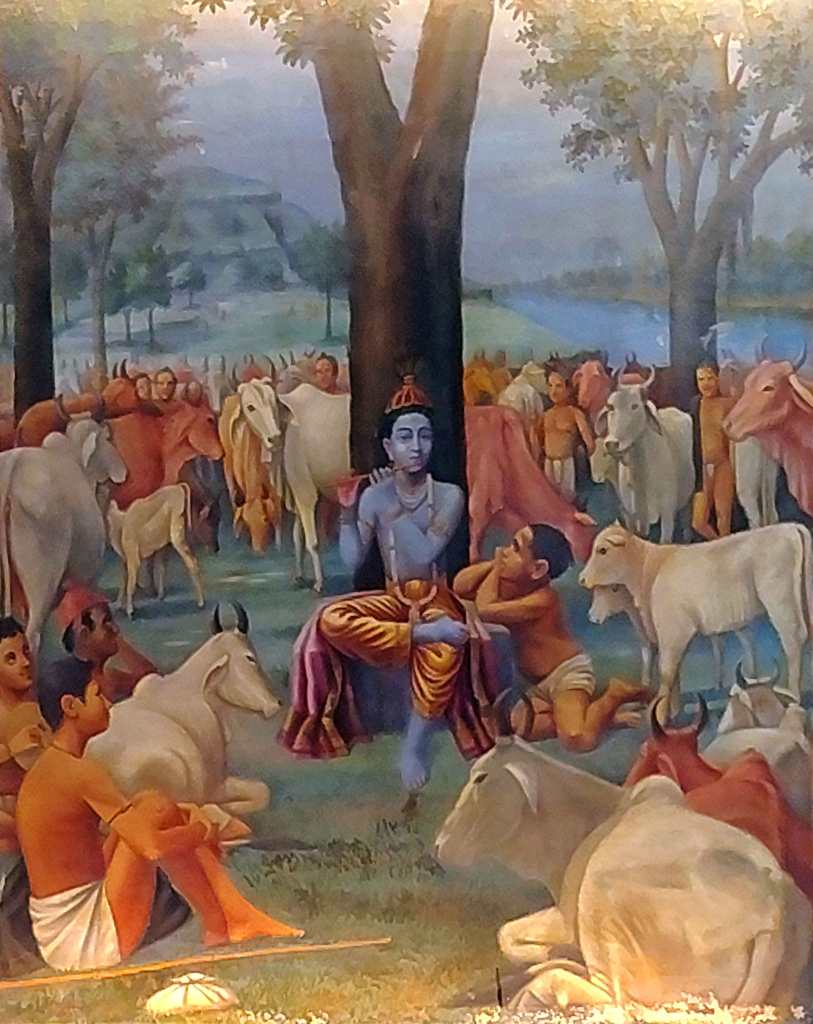
Just as seen in this beautiful painting, he is depicted widely as a cowherd or the person who tends the grazing cattle. And the cattle too are entranced with his playing of the flute. Common symbols for Krishna are the flute (bansuri), peacock feather (mayurpankh), yellow dhoti (pitambar), and cows around. This painting is from the Ambabai Mandir, in Aundh-Satara, and shows a quiet and peaceful morning by the riverbanks. Blue-bodied Krishna, playing the flute, has the entire crowd of cows and cowherd-folks soaked into the light of his divine flute sound.
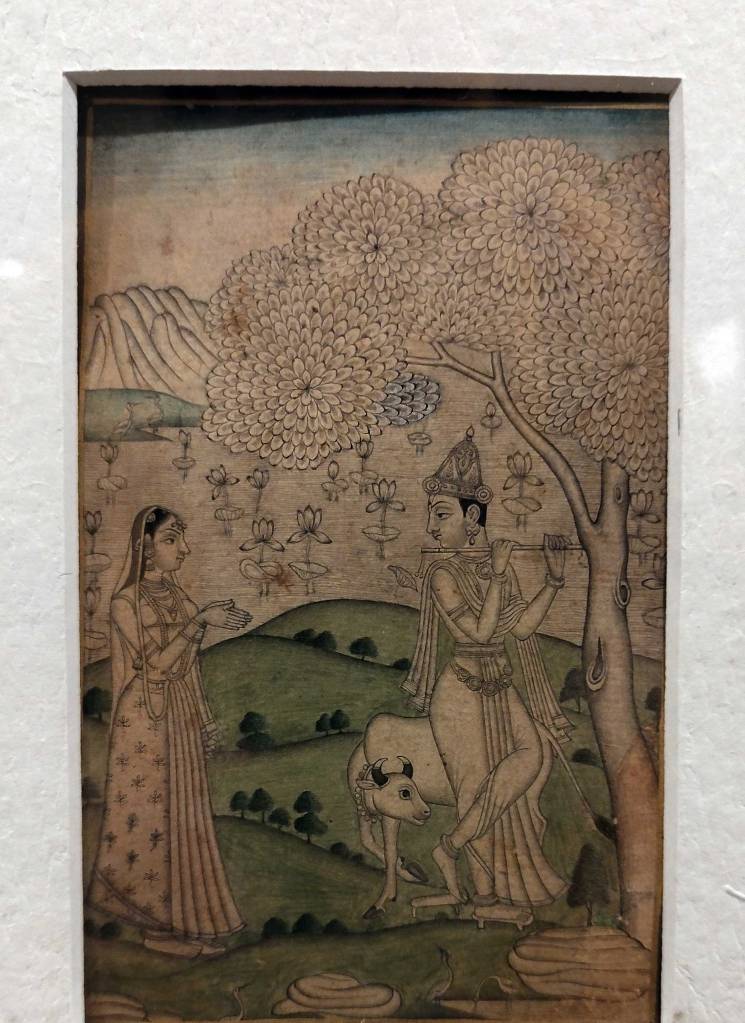
This picture, from the Solapur region, belongs to the Deccan School of Miniature Painting. It has Krishna standing under the Kadamba tree along with a cow and Radha by their side. The backdrop is of lotuses blooming, verdant fields, and distant mountains.
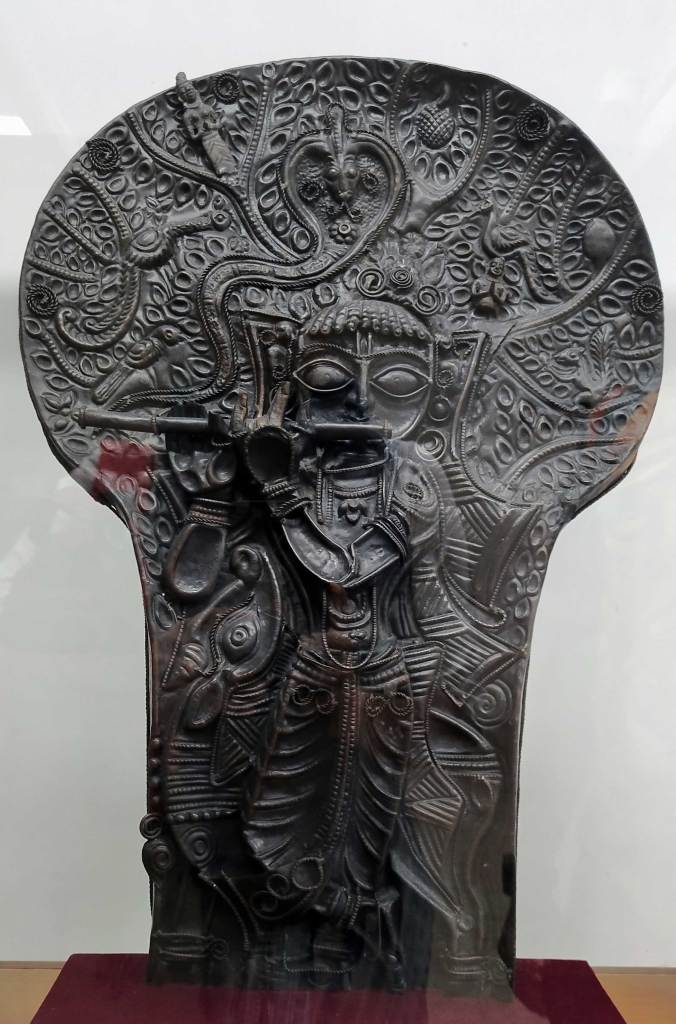
This depiction of Venugopala from 1977 is ascribed to S. G. Vidyashankar and is tooled upon a metal sheet. It is from the Chandigarh State Museum (accession number 3934). This one too shows the Kadamba tree in the backdrop (in fact, the object itself has the same profile). The figure of Krishna is sheltered by a snakehood and has a cow standing behind him, with its head upturned and gazing at Krishnavenu. There are tiny devotee figures and birds on the tree in the backdrop.
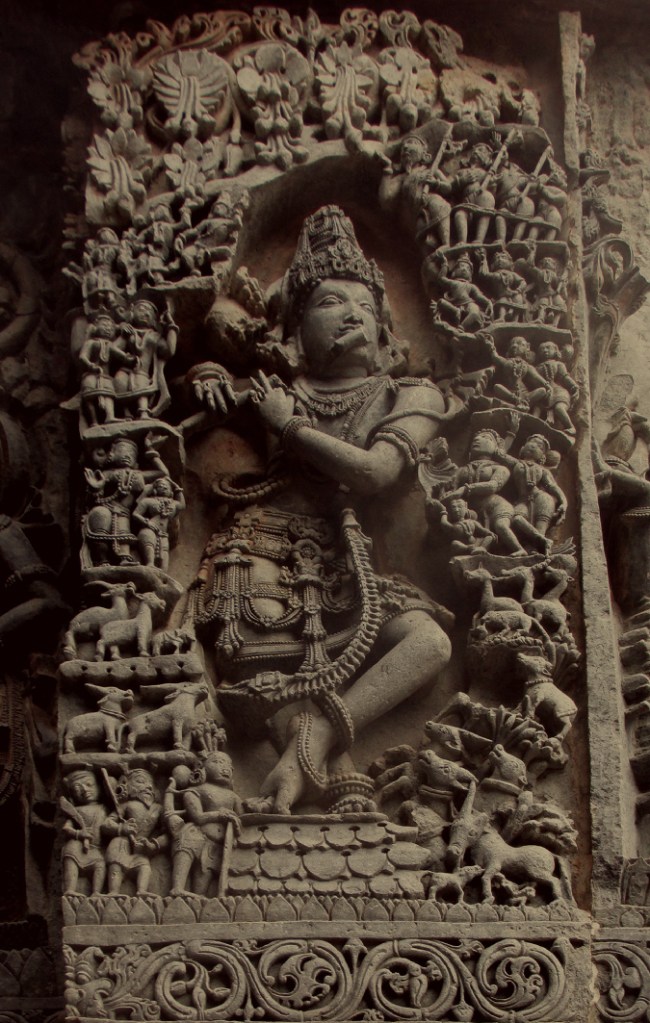
The flute is shown held to Krishna’s lips. He is often shown in the tribhanga (three-bend) pose, with one leg crossed over the other. He stands poised this way upon a lotus pedestal as devotees and cattle crowd in. The tree that he stands under is the Kadamba Tree. The Kadamba happens to be Krishna’s favorite tree and is portrayed as a canopy in several artistic depictions of Krishna. He wears a short dhoti, is ornately bejeweled, and wears a crown. In the Hoysala sculpture, he is depicted wearing a cross-band. This stone relief is from the Hoysaleshwara Temple at Halebeedu in Karnataka.
Radha-Krishna Leela
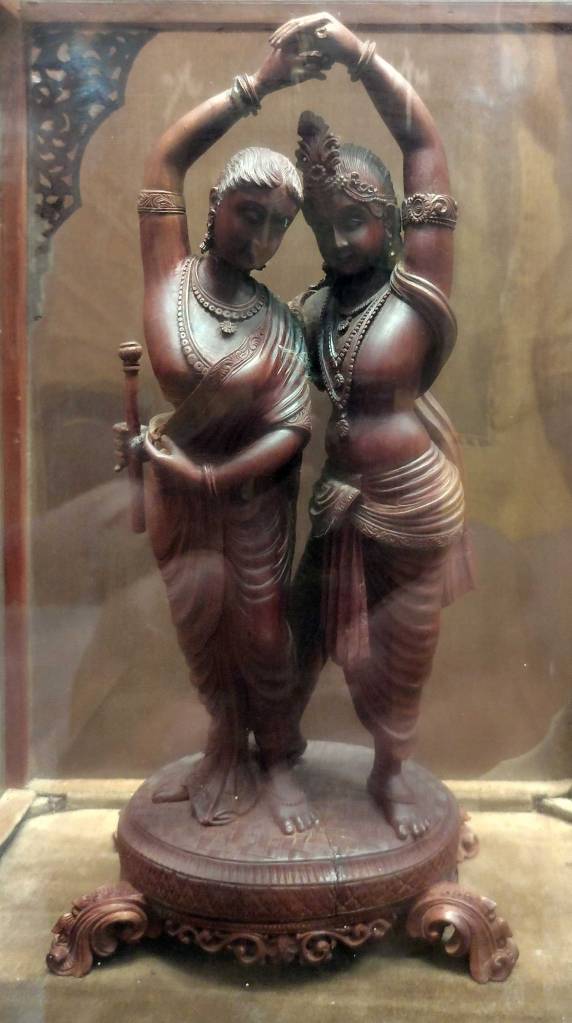
Radha-Krishna are the most popular muse of artists and craftsmen for ages together. This graceful image of them both stanced together, entranced in the dance of divine play, is from the Salar Jung Museum. It is carved in wood and has a beautiful smooth finish. The body of Radha and Krishna are depicted as though they are blossoming in the light of their own abundant love for one another.
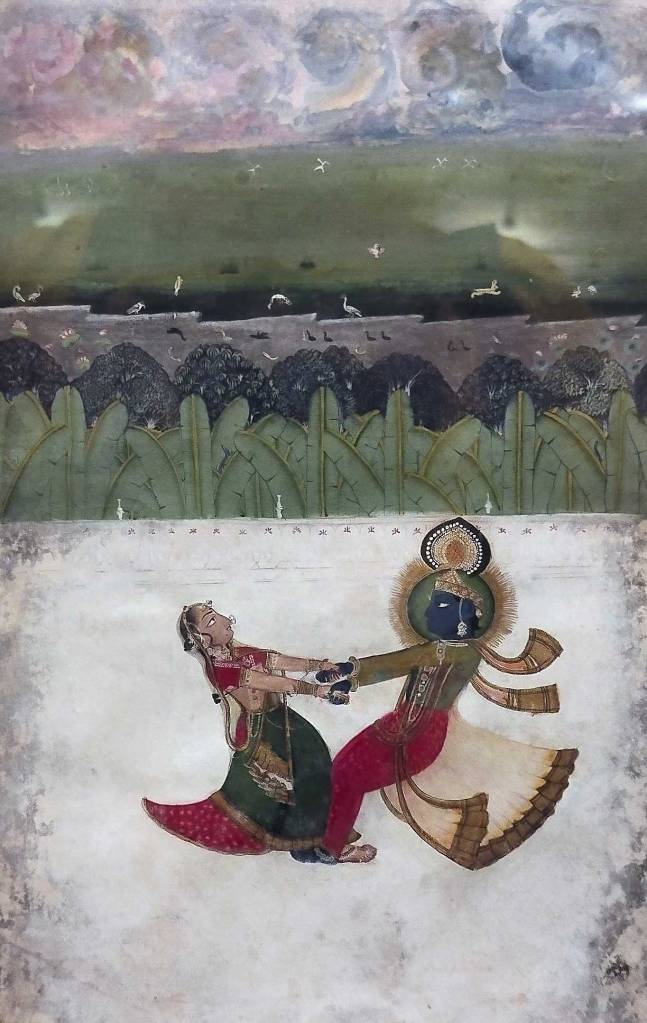
This image of Krishna and Radha is from mid-18th century Deogarh and is a part of the collection at the Salar Jung Museum. The dancing couple is shown enjoying their moment together as the evening skies whirl with them and the birds fly at a distance, some of them returning home. Krishna is shown with a peacock feather on his crown and with a shining halo that resembles a sun disc, as Krishna (who is an avatar of Vishnu) is from the solar lineage.
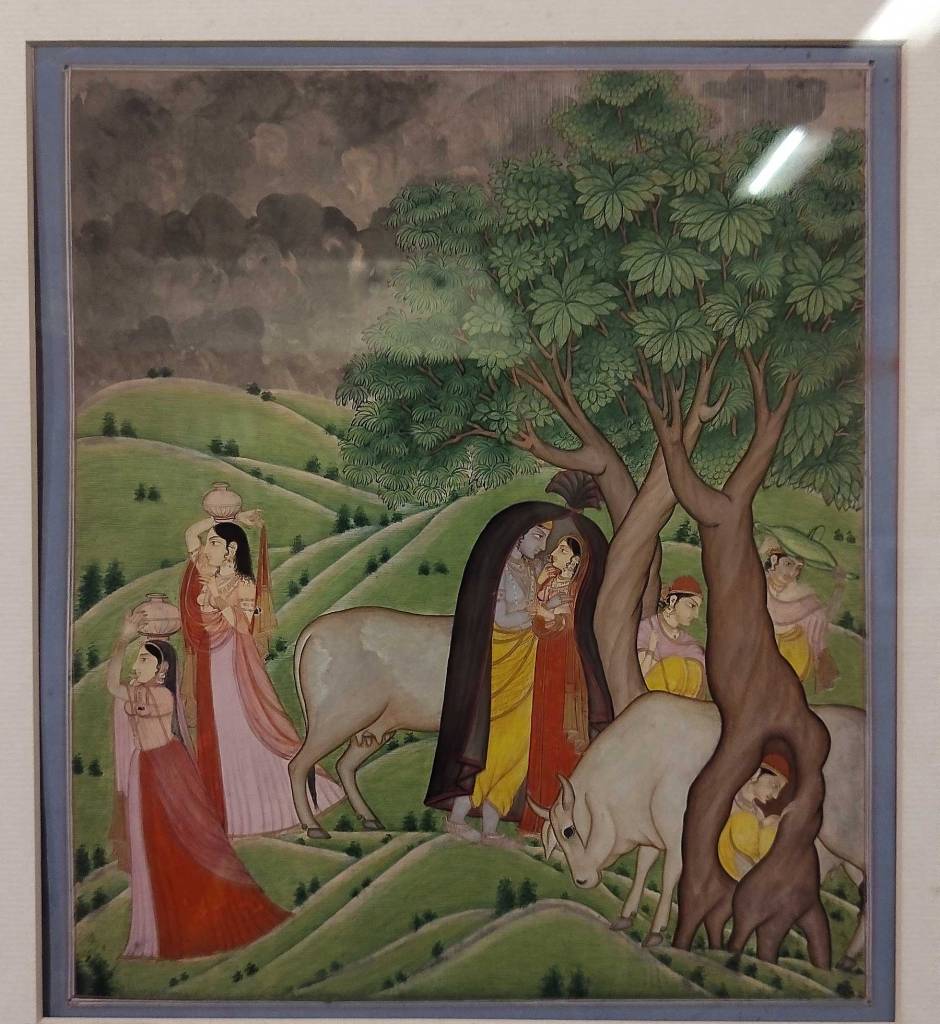
This Pahari Style painting shows Krishna and Radha hidden inside a cloak or a large fabric. While all the Gopis and the cowherds are around, the divine couple enjoy the game of hide-and-seek. They also enjoy close proximity to each other and are secretly sheltered as the rest of the folks are unaware of their presence. This image of both being clothed by a single garment or cloth signifies their oneness with each other. Surrendered to love and each other’s company, they are veiled from the outer world. They are lovers, exclusively in the presence of love alone.
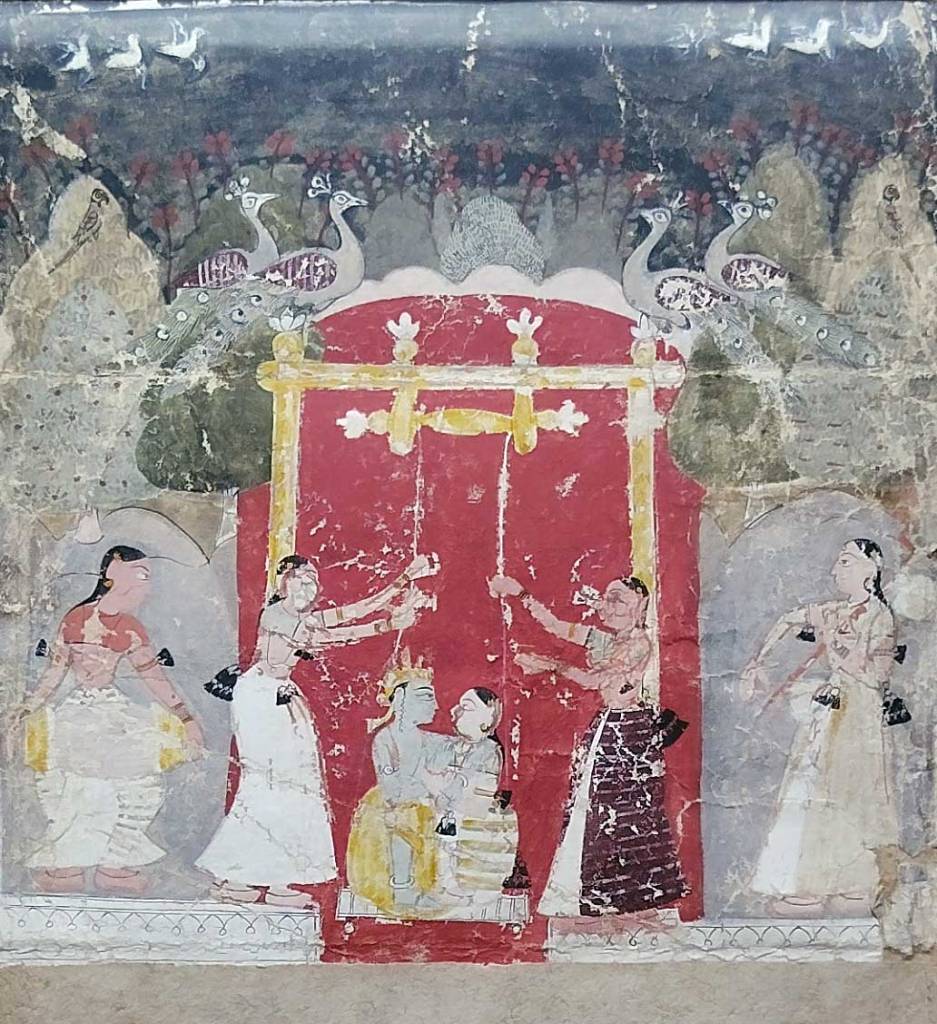
In a verdant grove, with blooming flowers, abundant trees, and peacocks and other birds all around, the Gopis play music and sway the swing as Krishna and Radha enjoy the colour of love, gazing into the eyes of their beloved. This is a 16th century AD artwork, depicting the Hindola Raga, or the raga representing the oscillating motion of the swing. This raga is full of joy and life. It is usually set within a lush grove. The swing that Radha and Krishna sit on is a symbol of their eternal love and divine leela.
Krishna, the Family Man
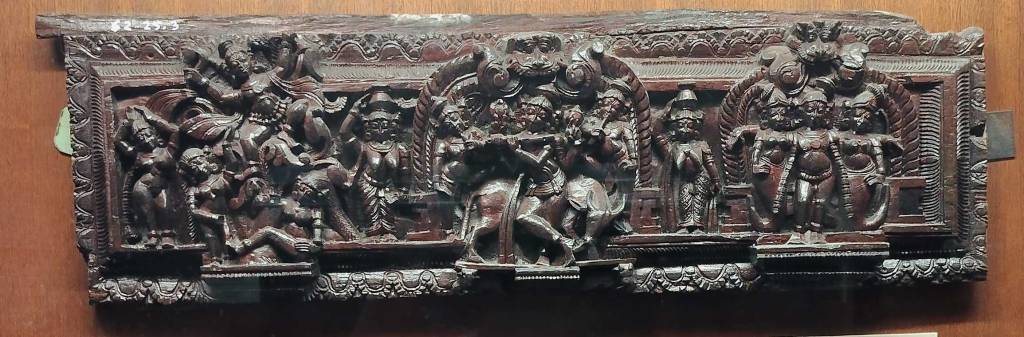
Krishna is also portrayed in art as a householder with his many wives. Two important ones are Rukmini and Satyabhama, both of whom were wedded to him on saving a precious jewel. This carved interior-architectural element, probably a part of a lintel or a larger narrative panel, shows three different scenes. One on the left shows Krishna being triumphant, the central one shows him as a flute-playing cowherd, and the third one on the right shows him flanked by his two wives.
The 16,000 women who Narakasura held captive from Indra’s kingdom were released by Krishna. As they had been held captive by a stranger, a man, their purity would be questioned. They would not be received as brides and wives by any other men. Thus, Krishna is said to have married them all too.
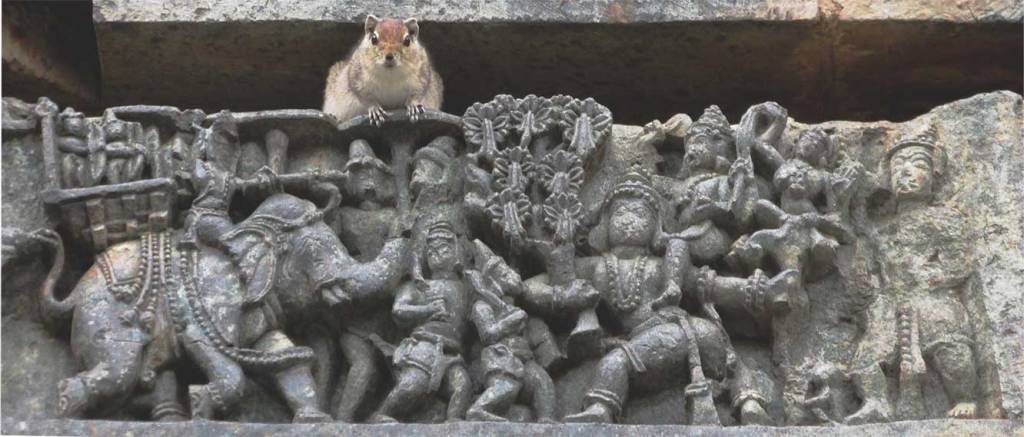
It is said that once, Satyabhama desired the Parijata tree from Indra’s celestial garden. Krishna, in order to fulfill his wife’s wish, stole it from Indra’s garden in Indralok. Angered by this, Indra waged war against Krishna.
The stone relief from the Hoysala temple at Halebidu shows Krishna stealing the Parijata tree and taking it by hand, and Indra on his vahana, Airavata, trying to stop him from taking the tree away to the earth.
The fight was so terrific that higher gods needed to intervene, and they let Krishna take it to the earth. Having secured the tree after the war with Indra, there was another fight that Krishna needed to resolve on the home front. It was between his two wives, Rukmini and Satyabhama.
Seeing the beautiful Parijata tree that was brought by Krishna to fulfill the wishes of Satyabhama, Rukmini felt jealous. But diplomatic Krishna brought about a smart solution to the problem. He planted the tree within the royal courtyard of Satyabhama, for whom he had originally brought the Parijata from Indralok. But the tree was planted in such a way that the flowers from the branches fell into the adjacent garden. This garden belonged to Rukmini. Though the tree was still with Satyabhama, Rukmini could enjoy the little fragrant white flowers with an orange center and stem.
Krishna as Rasaraja
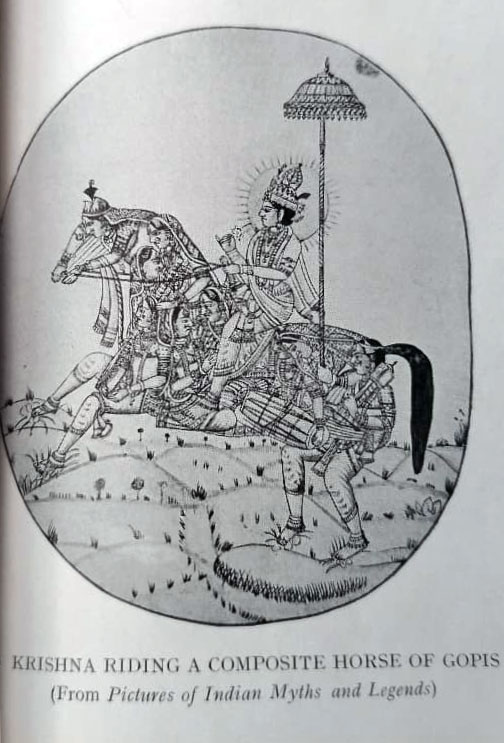
Another intriguing symbol is that of Nari Ashwa (at times also called Nari Turaga). The term literally means a horse (ashwa) composed of women (nari). This horse is often ridden by Krishna, and the women shown to compose the horse are his gopis. There is a version of this same kind, with the women composing an elephant. This is called Nari Kunjara. The one seen in this image is composed of nine women, thus called Nava Nari Ashwa. The horse depicted is believed to be the horse of Kamadeva, or the god of love. This Nava Nari Ashwa motif is a symbol of the nava-rasa of classical Indian tradition. And Krishna, being the rider, symbolizes him as a master of these nine rasa of Indian art, or Rasaraja.
Krishna emerges as one of the most relatable avatars of Vishnu, embodying the full spectrum of human and divine qualities—playful mischief as a child, tender romance as a lover, heroic strength as a protector, and profound wisdom as a guide. His presence resonates across dance, music, painting, sculpture, and devotional art, leaving an indelible mark on cultural memory. These timeless sacred expressions, born from myths and leelas, continue to inspire devotion and creativity through the ages.