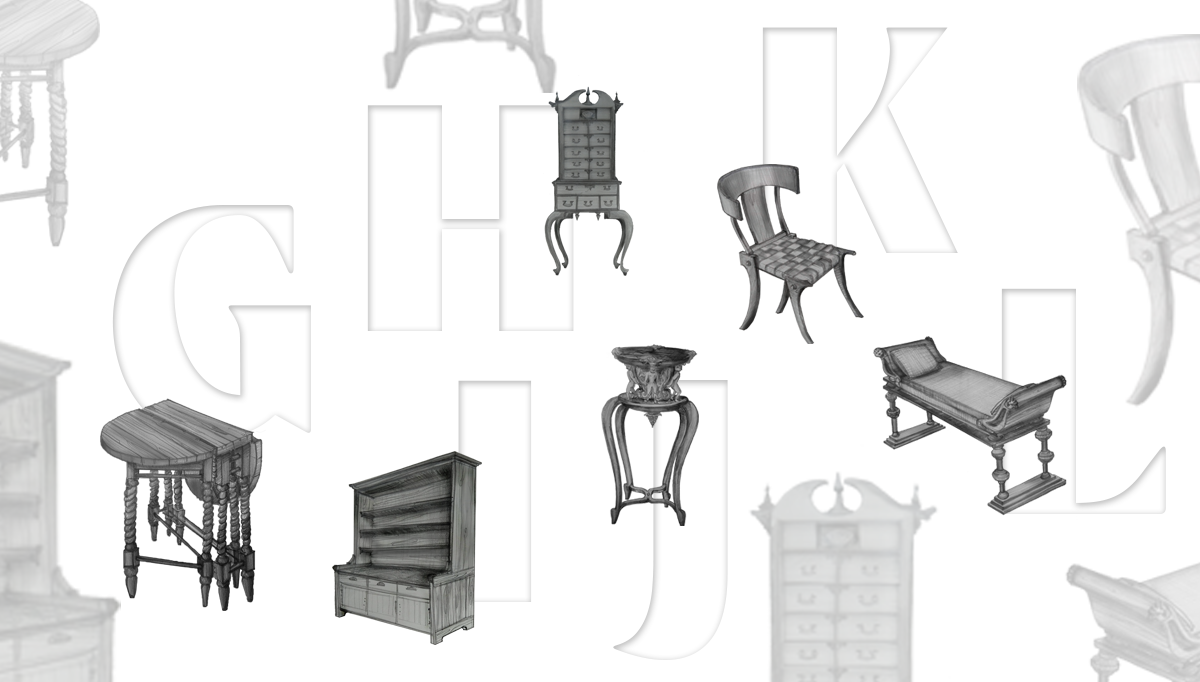
This is Part 2 of the visual Dictionary of Furniture.
Part 1 of this dictionary had been from A to F and this part has been segregated from G to L.
I hope to add more furniture to most of the alphabet-fields in future.  But first, I will complete one furniture item for each of the 26 alphabets and then co on to appending some of them.
(But, so much for now. I hope you find this read interesting.)
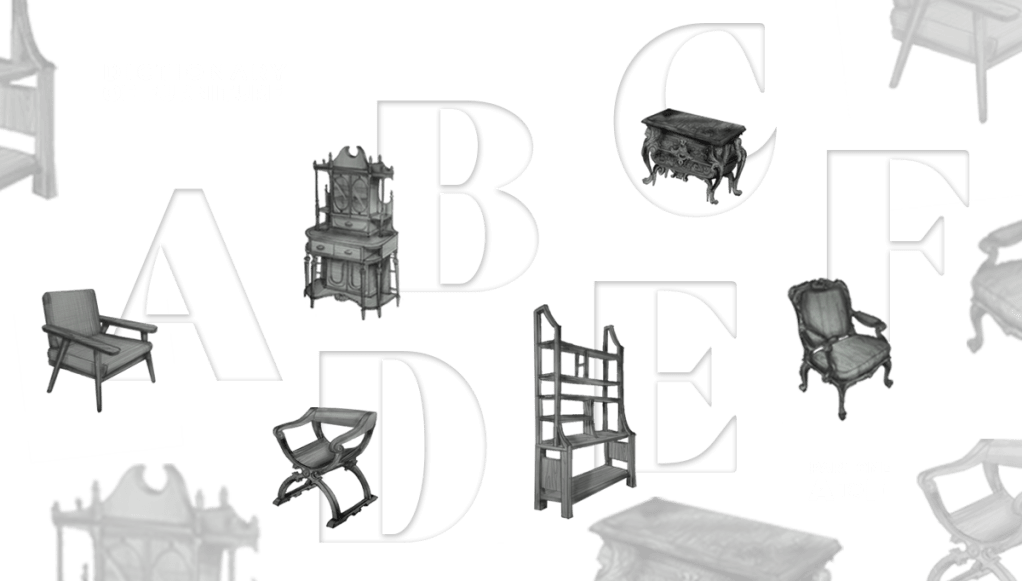
In case you have not already read, Part 1 of the Dictionary of Furniture :: A to F can be accessed here.
About this Visual DICTIONARY OF FURNITURE
This second section, in a series that catalogues furniture pieces by alphabetical order contains the next six letters of the 26 alphabet (namely, from G to L). As this is also a Visual Dictionary, it incudes sketches, each coupled with a succinct description, providing insights into each furniture item. The accompanying text encompasses descriptive, historical, emotional, technical, and stylistic aspects.
DICTIONARY OF FURNITURE :: PART TWO
GATELEG TABLE
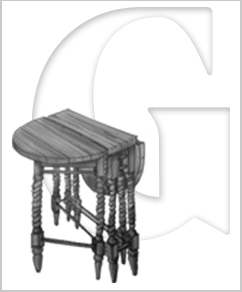
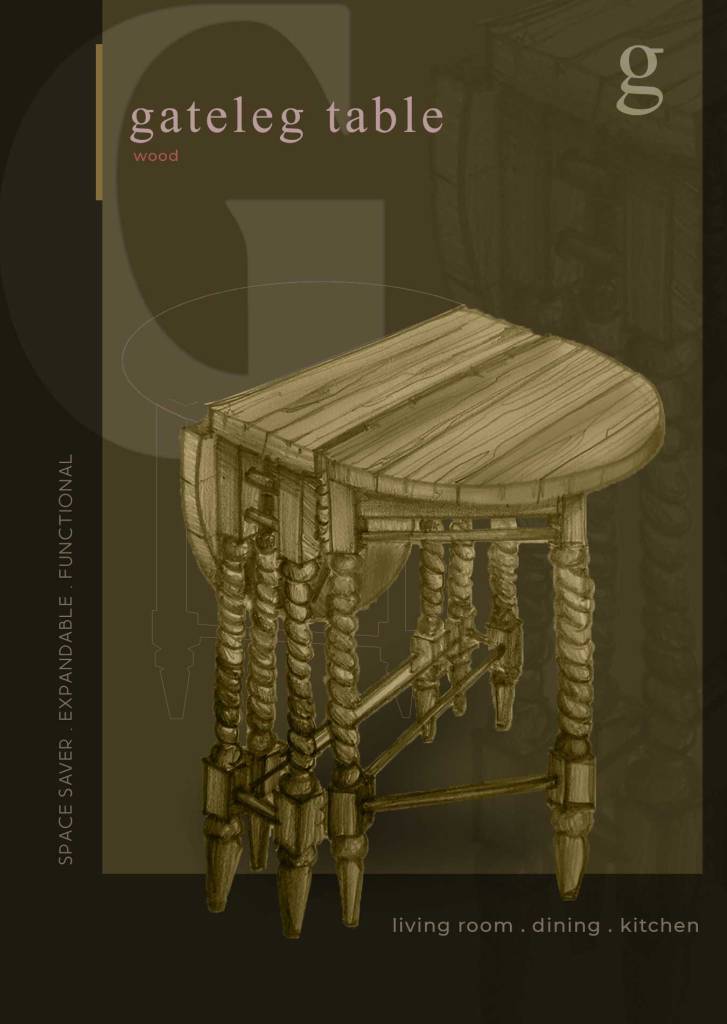
Gateleg tables, which originated in sixteenth century England, were constructed with a fixed part and one or two hinged leaves, supported by pivoting legs that allowed them to fold when not in use. These adaptable pieces were originally made of oak wood but have since been updated with new materials. Typically placed against a wall, they can be partially unfolded, as seen in the following drawing, or totally compacted into a sleek, box-like shape to save room.
The word 'gateleg' refers to the table's construction, which features two hinged legs on each side that expand like a gate to hold the extended leaves. The depicted table evolves from a compact rectangle when closed to a semi-circular form when half open, and finally to an elliptical surface when completely expanded. It has gracefully turned legs and thin, pointy feet. The core piece is supported by four closely spaced legs, with each hinged leg coupled with two more legs.
Modern renditions of gateleg tables have a minimalist appearance, without the elaborate legs and rustic, round tops of the past. When placed against a wall, these tables provide a sleek display surface; when half opened, they offer a cosy breakfast nook for two; and when completely expanded, they can fit a dining table for four. Some variants additionally have a compartment for folding chairs, which increases their usefulness as space-saving nature.
Furniture Type and Category: Table
Usual Materials: Wooden Boards, Turned Wooden Legs, Hinges
Places of Use: Living rooms, Dining rooms, Kitchen
HIGHBOY
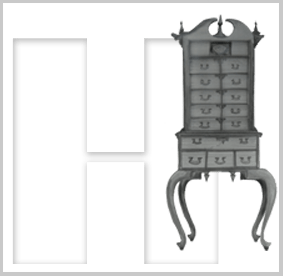
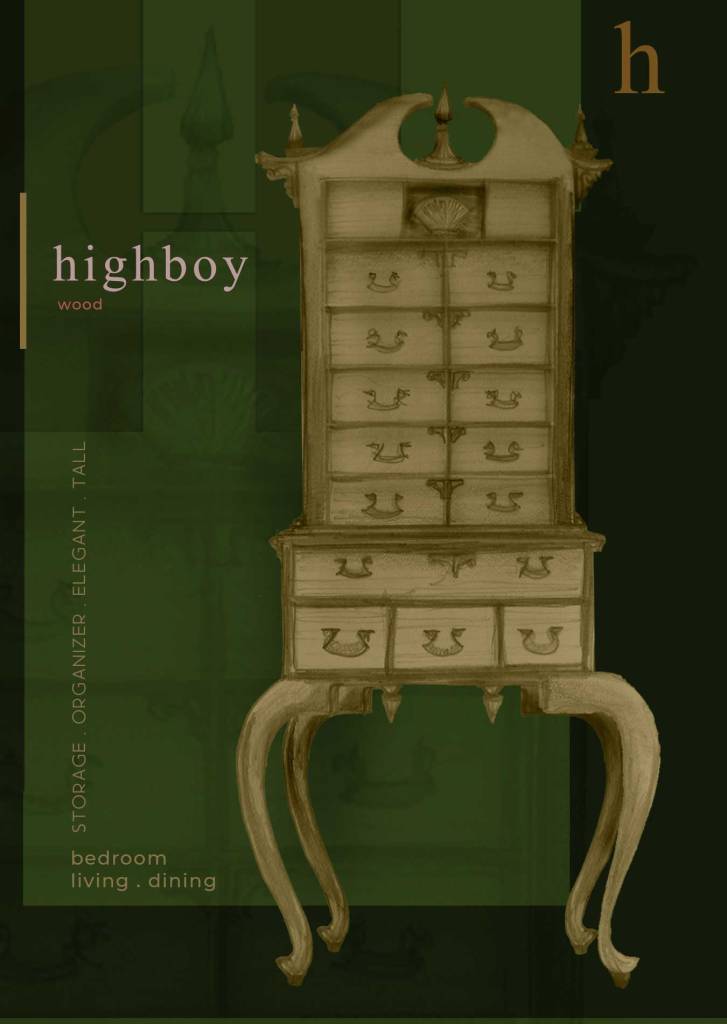
The highboy, a design akin to a chest of drawers but in a taller form, emerged in the latter half of the fifteenth century. This tall and elegant piece features beautifully curved cabriole legs supporting two tiers of drawers, designed for storing smaller objects in a neat and organized fashion. The lower section is wider yet shorter, while the upper section is taller and narrower, creating a harmonious balance.
The term 'highboy' is believed to have originated from the French word 'bois,' meaning wood. These pieces are also commonly referred to as 'tallboys.' Their counterpart, the 'lowboy,' is similar in design but slightly shorter, with fewer drawers.
The highboy depicted in the sketch is a fine example of Queen Anne's style. The cabriole legs, crafted using the lathe wood-turning technique, and has graceful feet on heels. The knees of the legs feature an elongated ogee curve, or an 'S' curve, which extends beyond the outer line of the unit, adding grace and stability. The piece is adorned with cornices and mouldings at various levels, embellished with decorative bronze mounts. The scallop-shell motif on the front piece harks back to the elegant Rococo style. The crowning glory of this highboy is the elegant swan-neck pediment, centred with a finial and flanked by two subsidiary ones, a design element popularized during the Baroque period.
Furniture Type and Category: Storage & Organizer
Usual Materials & Techniques: Wood, Bronze Mounts, and Handles
Places of Use: Bedroom, Dining rooms, Living rooms
IRISH DRESSER
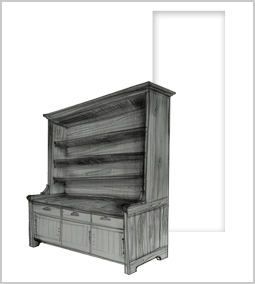
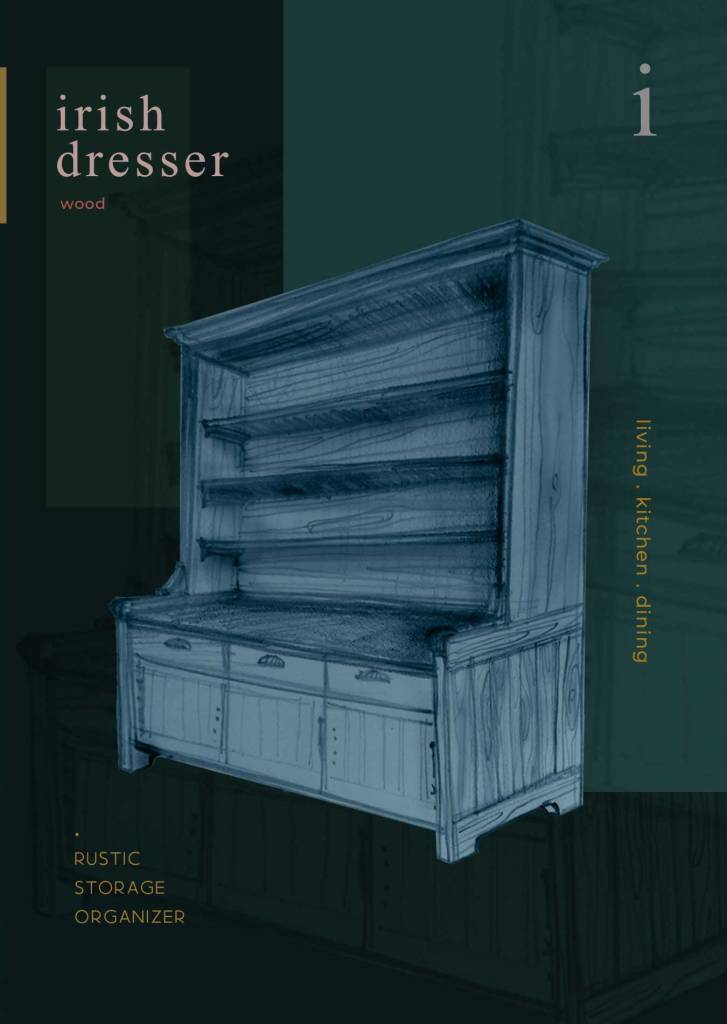
An Irish dresser is a functional piece that embodies the spirit of domestic life. A typical Irish dresser serves as both a storage solution and a display unit. The lower section usually consists of enclosed cabinets, providing ample space for storing household items, while an open shelving unit atop the worktop offers a stage for displaying ceramics, glassware, and other treasured possessions.
Crafted from wood, it features simple, clean lines that reflect regional styles and preferences. Often, the wood is painted or varnished, adding a layer of protection and charm.
The upper shelves are typically adorned with earthenware, plates, and bowls, showcasing the heritage and holdings of the family, as well as exuding warmth and hospitality. These holdings of sentimental value often serve as welcoming catalysts, sparking conversations about family history and shared experiences.
This simple, and sometimes austere furniture, serves as an extension of the owner's identity, a keeper of memories, and a useful companion all at the same time.
Furniture Type and Category: Display & Storage
Materials & Techniques seen here: Wooden Planks, Metal Handles and Hinges, Wooden cornices and shelves. Polished.
Places of Use: Living rooms,Dining rooms, Kitchen
jardinière
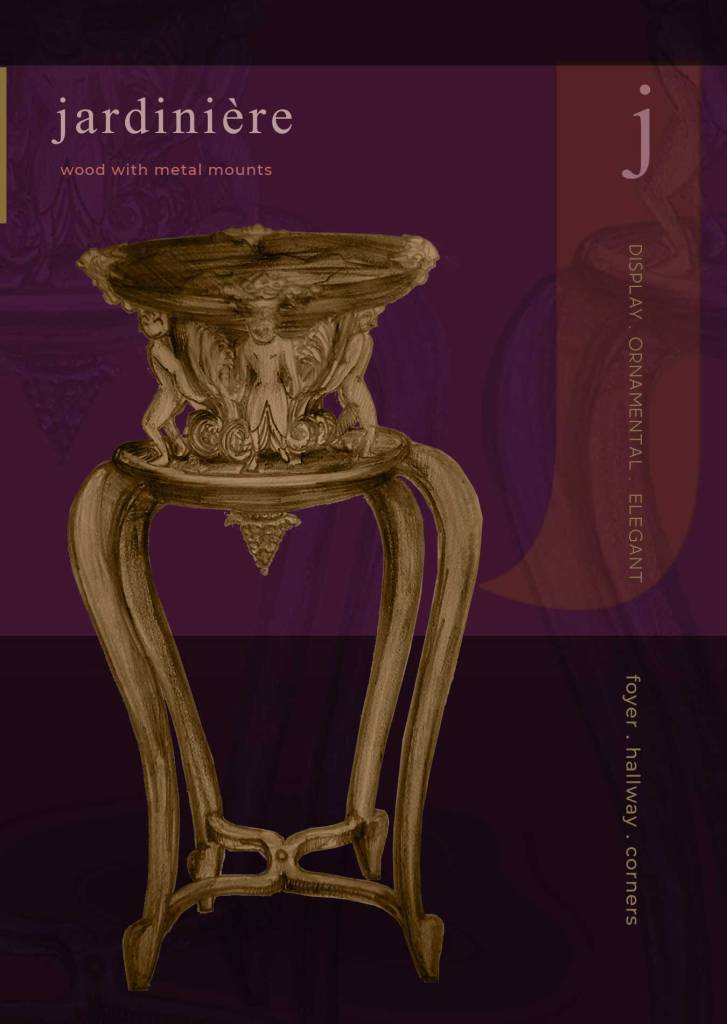
The term "jardinière" is related to the English word "garden" and refers to an ornamental stand for plants or flowers. This elegant piece can grace a foyer or adorn semi-open corridors and balconies. The design illustrated here has four sweeping tall legs supporting a decorative top. This top is adorned with four human figures standing on a platform, collectively hoisting a large vase-like element embellished with acanthus leaves. A marble slab rests atop their heads, secured by four ornate bronze mounts. At the base of this entire decorative assembly hangs intriguing bunch of grapes.
The etymology of "jardinière" traces back to ancient Germanic languages, where the word for "garden" morphed into the Old French "jardin." This evolution gave rise to several cognates, including "jardinier" for "gardener" and "jardinière" for "female gardener." Over time, "jardinière" also came to denote a sizable decorative flowerpot or plant stand in both French and English lexicons.
Typically, a jardinière would hold a vase filled with a delightful floral arrangement, a pot of a lush green plant, or an exquisite vine and creeper cascading around its silhouette from a delightful ceramic planter.
Furniture Type and Category: Display
Materials & Techniques: Carved wood, Marble top, Glitz bronze mounts and embelishments, Cabriole legs.
Places of Use: Living rooms, Corridors, Hallways, Balconies, Foyers, Salons, Parlors, Banquets

KLISMOS
Though few actual pieces of furniture have survived from the ancient world, Ancient Greek sculptural bas-reliefs and painted pottery provide numerous examples of furniture designs from the classical period. Light and portable pieces were abundant, each crafted with elegance and serving both domestic and religious purposes.
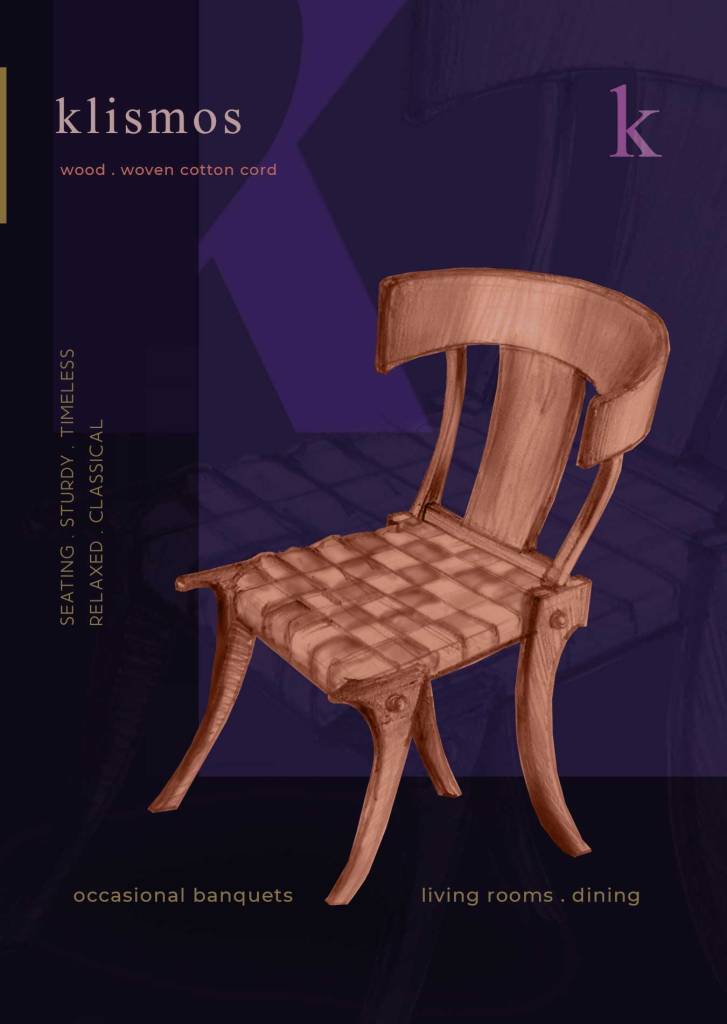
The Klismos chair is an emblem of ancient Greek furniture, believed to have been reserved for the women of the household. This design likely originated in the fourth or fifth century BC. The Klismos features outwardly curved wooden legs connected by tenon and mortise joints to the equally curved backrest and seat frames, all reinforced with wooden pegs. The seat itself is constructed from woven cotton cords or leather straps. A vertical slat provides lumbar support, while a curved horizontal wooden board hugs the mid-to-upper back. It is thought that the wood may have been shaped using steam bending techniques.
These chairs made a reappearance in the Neoclassical period, where they were adorned with the decorative motifs and materials characteristic of that era. This piece was modernized in later age of the Art Deco.
Furniture Type and Category: Seating
Materials & Techniques: Wood and woven seat with natural cotton cords or leather straps.
Places of Use: Living rooms, Dining areas
LECTUS
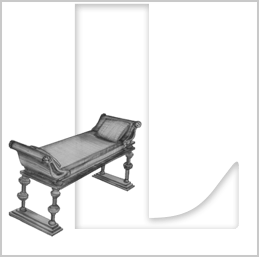
Wealthy Roman households had beds known as 'lectus cubicularis' for sleeping in bedrooms, and couches called 'lectus tricliniaris' for reclining during banquets in dining rooms. Indeed, Romans would recline and dine! They arranged these couches on three sides around a central table, leaving the third side open to serve as access for servants and slaves to provide a constant supply of food and wine.
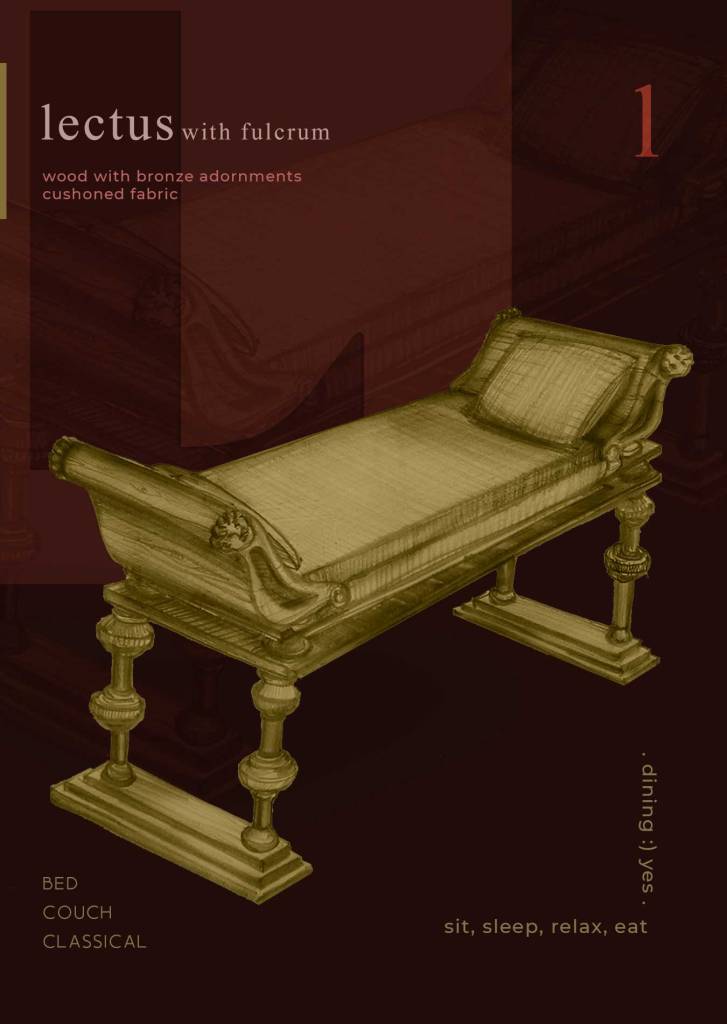
The 'lectus' was a simple, rectilinear piece of furniture with a framed structure. It typically had four legs, or two pairs of legs, connected to the horizontal frames of the seat, which supported a mattress stuffed with straw, wool, or feathers.
Lectus often featured a fulcrum, or fulcra, which were slanted end-structures that served as end-supports for pillows. These were usually ornately decorated, adorned with ivory, bronze, copper, gold, and silver, and sometimes featured decorative masks or animal heads. The fulcrum was sometimes placed on one side, making the couch-bed accessible from three sides, while at other times, with fulcra at both ends, the couch was accessible only from the front and back.
When lectus were made high, they were accompanied by footstools to assist the user in climbing onto them comfortably and to rest their feet while seated.
Remarkably, some actual pieces of such furniture have been preserved in the houses of Herculaneum and Pompeii. These two towns were destroyed by the volcanic eruption of Mount Vesuvius and were completely buried in lava. Consequently, the interiors of some of the structures in this areas have been timelessly preserved, and serve as a rich first-hand source for us to understand the lives in the ancient world.
Furniture Type and Category: Seating, Reclining, Sleeping
Materials & Techniques: Wood with Bronze adornments. Cushioned fabric.
Places of Use: Living rooms, Dining rooms, Bedrooms
Hoping to explore the next set of alphabets in the Visual Dictionary of Furniture soon!
Until then, you could flashback Part 1 of the Dictionary of Furniture :: A to F here.