
On the first Sunday of August, as all celebrate Friendship Day, I found myself pondering on the notions of ‘friendship’ and ‘friend’ within two diverse philosophical traditions: Buddhist & Sufi. I have briefly outlined the two concepts here. Despite their distinct approaches, paths, and methods, they intersect and align to some extent at various junctures.
[This blog has been written as a dialogue between the Buddhist and the Sufi Traditions.]
[Photographs on this page are from Spiti and Sangla Valley, Butan, Bombay and Gwalior]

Path and goals in the Buddhist & Sufi Traditions
In both these traditions, one approaches the ‘path’ in both these traditions and passes through many stations, stages, and rigorous ethical and psychological training. In Buddhist philosophy there is a wide and disciplined exposition of the eight-fold paths1 leading up to samadhi. Similarly, in Sufi Philosophy the path2 includes many transitory stages and permanent stations that lead up to annihilation and subsistence in, and unity with the divine reality.
Concept of ‘Friendship’ and ‘Friend’ in Buddhist & Sufi Traditions
Buddhist Philosophy suggests Four Divine Abodes (brahmavihārā). This is a four-fold meditation which functions as a psychological attitude that fosters peace in the mind as well as in society. These states thought and feelings are known as sublime moods. These four abodes in meditation are: mettā, karuṇā, muditā, and upekkhā. Mettā is the meditation on universal friendship. Mettā (in Pali) it is also understood as Maitri (in Sanskrit). Karuṇā is the meditation on universal piety. Muditā concentrates upon happiness in the prosperity and happiness of all. Lastly, upekkhā is the state where there is no ill-feeling towards anyone. The subject of this meditation is universal and includes oneself, one’s friends, even one’s enemies and the enemies of one’s friends or even a third-party too. The first stage is that of developing a loving kindness, benevolence. This itself loops too the second stage which is the abode of compassion. Thereafter one develops universal joy in the joy of others. This is also known as sympathetic joy. Lastly, all these lead to a sense of equanimity which leads up to higher stages of samadhi.
According to the Buddhist way, such feelings or states of mind can be only developed after eliminating the feelings of fear, jealousy, anger, vile intentions, spiteful actions, and bad deeds towards one and all. This feeling should extend beyond oneself and one’s close people. It should also extend to one’s friends, enemies, enemies of one’s friends, and unconnected third-party too.
This leads to uprooting the root causes of suffering, and one begins to habituate oneself toward this four-fold meditation. The point of origination for it all is that of developing active good-will towards all, loving kindness and universal friendship or mettā-bhavana.
Monk at Kaza, near the Key Monasary in the Spiti Valley at Himachal Pradesh.
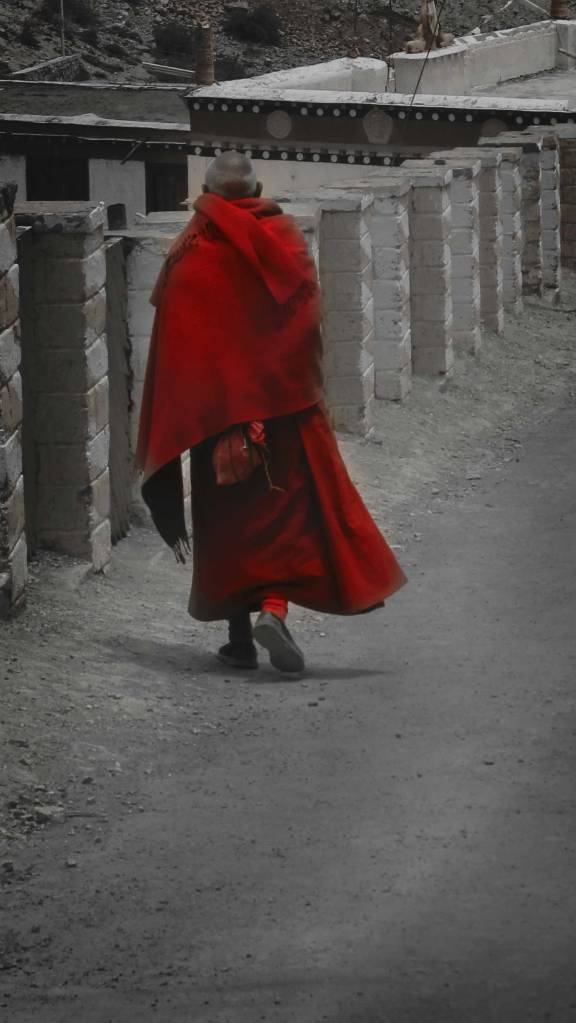
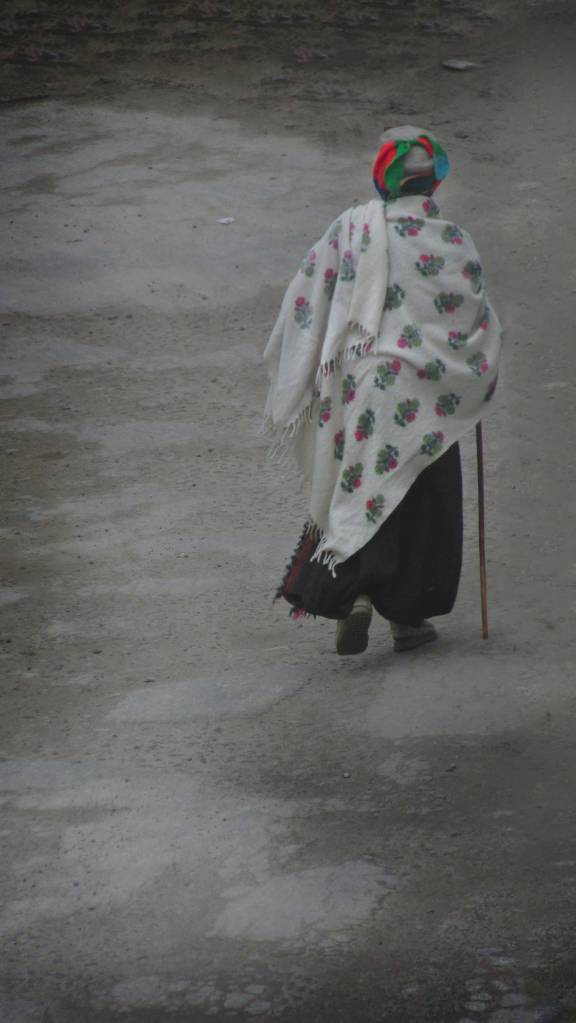
Sufism, places an emphasis on the inner spiritual journey rather than external religious actions. The name ‘Sufi’ is supposed to stem from ‘suf,’ (which refers to the coarse wollen cloth won by the Sufi mendicants) which represents the austerity and simplicity that practitioners cherish. These spiritual seekers, or wayfarers, follow a ‘path’ known as the Tariqa, which takes them through several phases of spiritual growth. This path is more than just a metaphor; it is a way of life that includes intense devotion, meditation, and the quest of divine love and wisdom.
Sufi Philosophy also has immense importance to the concept of love. This is not just the love between humans, but also extends to Divine Love.3 This journey from the microcosm to the entire cosmology takes place for a Sufi after being initiated on a path. The seeker, through rigorous inculcation of ethical and psychological discipline becomes an empty vessel. One needs to repent, abstain, and renounce the worldly elements that enthrals one falsely. By becoming empty and having nothing to cling to, one must commit oneself to the path fully, trust the eternal and be patient; thus, becoming ready to receive with gratitude the eternal truths and grace. This is the Real rapture.
This entire process reflects in the Three-Fold Attitude that Sufis need to embrace: Islām, Imān, and Iḥsān. Islam is the practice and stands for complete submission and complete surrender. It is the physical body of this attitude. Iman or faith stands for the mental and trusts upon all that is revealed to the mind. And lastly Ihsan, which is the very soul of the three-fold attitude, which dwells in the perfection of worship through spiritual cultivation. This is the very essence of the practice. Ihsan means doing beautiful things. It entails a form of worship where one worships God as though God is present before oneself. By imbibing this three-fold attitude one crosses the outward and the more physical stages and comes to the more inward and mystical stage. This is a stage of truth and a unitive stage where there is perfect equanimity and peace and there is just Oneness. This is the stage of divine rapture.4 The seeker receives spiritual grace or barkhat and this is when the seeker comes under special providence.
The word used for ‘someone who is under special protection’ or providence is walī. Walī literally means ‘friend.’ Such a person is maḥfūz under by the grace of God, and is a friend of the Divine. The too becomes the walī’s Friend. The walī is an embodiment of the three-fold attitude (Islām, Imān, and Iḥsān) and serves as a guiding light to the others too. Walī as a term, is also applied to God. In this use of the term God is believed to be the Friend of all believers. Such love is not just those who love the Divine but universally for all, as an ever-present being.
Walī is the one whose actions are led by Divine grace, and the one who performs worship and obedience. Awliyā (word whose root is also in walī) is one who looks inward an sees the more sublime benefits. The word ‘Awliyāʾ Allāh’ or the ‘friends of God’ has been mentioned in the Quran several times.: “Verily, the friends of God, no fear is upon them, nor are they sad.” 5.
When a group of monks approached Buddha owing to their fear of spirits in the forest, he helped them with a thought that became known as the Karaṇīyammettā sutta. The name literally means: “karaṇīyam” or “this is what should be done” towards development of mettā. This sutta speaks about the virtues of friendliness, loving kindness and goodwill for all. It underlines the moral conduct that is developed through purity and peace, and freeing oneself from deceit and ill will. It suggests method of wishing well for all, and encourages boundless love towards all beings. The sutta compares such a love to a mother’s love. Such is the emotion that Buddha encourages the troubled monks to imbibe. Reciting this karaṇīyammettā sutta helped in relieving the monks off their fears and insecurities that they felt towards the spirits, and peaceful meditation was restored for them.
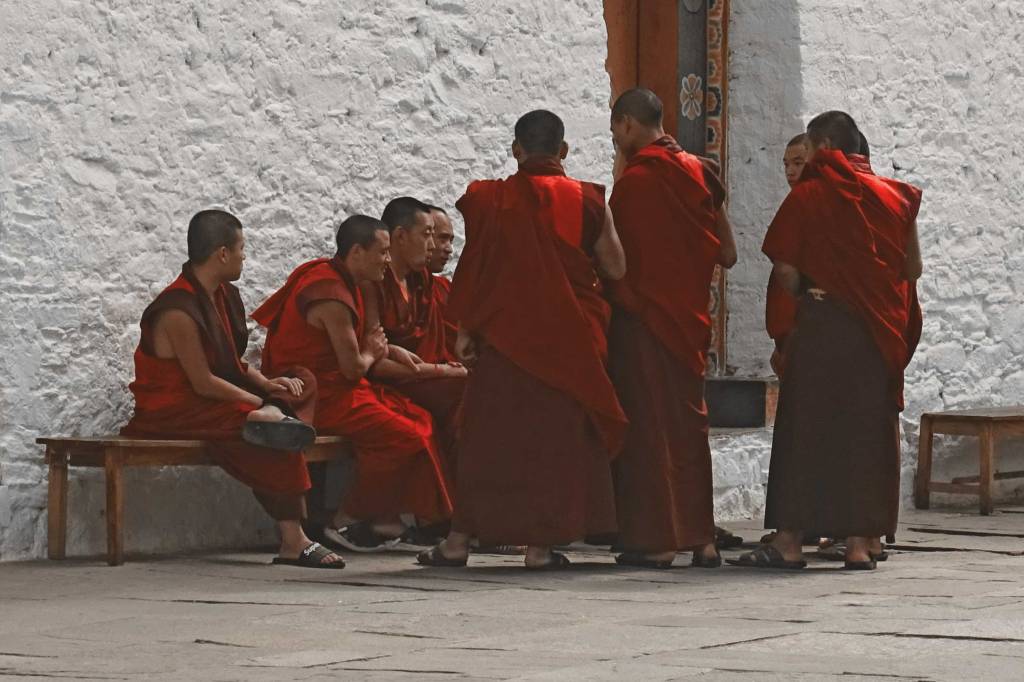
A group of monks at a Dzong in Bhutan.
Just as Buddha guides and comforts the monks in this story, walī also serves as a friend, philosopher, and guide to the seekers. Walī is a word that is used for those who are recognizable by their good deeds, the beauty of their speech, their refined manners, submission, and generosity.
Buddha, Dhamma, Saṅgha: the teacher, his teachings and the community of practitioners are the ti-ratana or three-jewels in the practice of the Buddhist faith6. The ti-ratana entail the wisdom, the reality, and the community of the ones with a luminous mind. The practicioner or sādhaka is required to take refuge within the three, commit oneself to the sādhanā with discipline and inculcate moral codes towards Enlightenment. Such an Enlightenment is believed to be for all beings, and the ti-ratana make this possible.
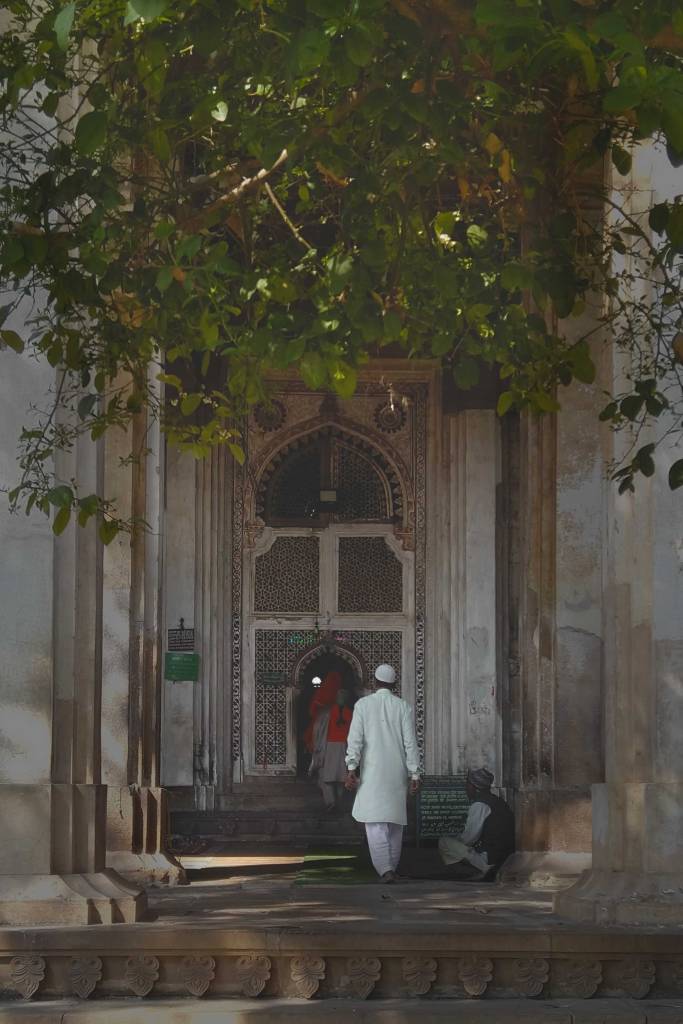
This ornate doorway leads to the resting place of Muhammad Ghaus, a prominent Sufi saint from sixteenth century Gwalior. Constructed during Emperor Akbar’s reign, his dargah is an architectural masterpiece that draws devotees, locals, and travellers alike. Tansen, Akbar’s court musician, was highly influenced by Ghaus and his tomb is right next to his mentor’s. The term ‘Ghaus’ also means ‘helper,’ which alludes to the Sufi being a Divine helper. Faqirs are frequently observed at the entrances of dargas, mirroring the tradition of dargahs and khanqahs, as a tribute to the Prophet Muhammad and his disciples, known as ‘ashab al-suffa,’ or ‘People of the Bench,’ who exemplify the Sufi’s intense commitment to asceticism and seeking ecstasy in the spiritual wealth.
Likewise, in Sufism, there is a long lineage of the teacher-disciple relation. The word Walī, or the friend of God is over centuries used for Sufi saints who are ideal Sufis and function as teachers. Some of these saints and Sufi masters (sheikhs7, pīrs8, hazrats9). Their khānaqāh10 (community, schools) guide seekers (murīd)11 on their spiritual paths. The sense of community, and the master-disciple relationship is of great importance in the Sufi path. This has led to the formation of various Sufi Orders (silsilahs12). Though they may have their variations and distinctions in methods, they move towards a common goal. The aim is to guide all towards tauhīd or Unity with that One Reality.
Buddha, of the Triratna, refers to not just the Buddha but the ideal of Buddhahood. This is said to be possible for all to attain, when sought through proper spiritual practice. Dhamma, the teachings of Buddha and understanding the true nature of reality is essential part of the practice. Sangha functions as a spiritual community and supports aspirants through friendship and guidance.
Just like the benevolence and mercy of Allah is bestowed upon all, Allah’s friends too, extend guidance and divine wisdom to all. Such a person becomes a vital centre of spiritual energy known as qutub13. Qutub, pole or pillar is the medium through which the Divine administers its affairs on the worldly plane. The well-being of the world depends on them. They are responsible for guiding everyone toward polishing the mirror of the soul and probing them towards lifting the veils of ignorance and understanding the Truth.
The purification of the heart, uprooting the causes of suffering, understanding the transitory nature of things and a constant attempt to deeper realization hold the key to attainment of Buddhahood.
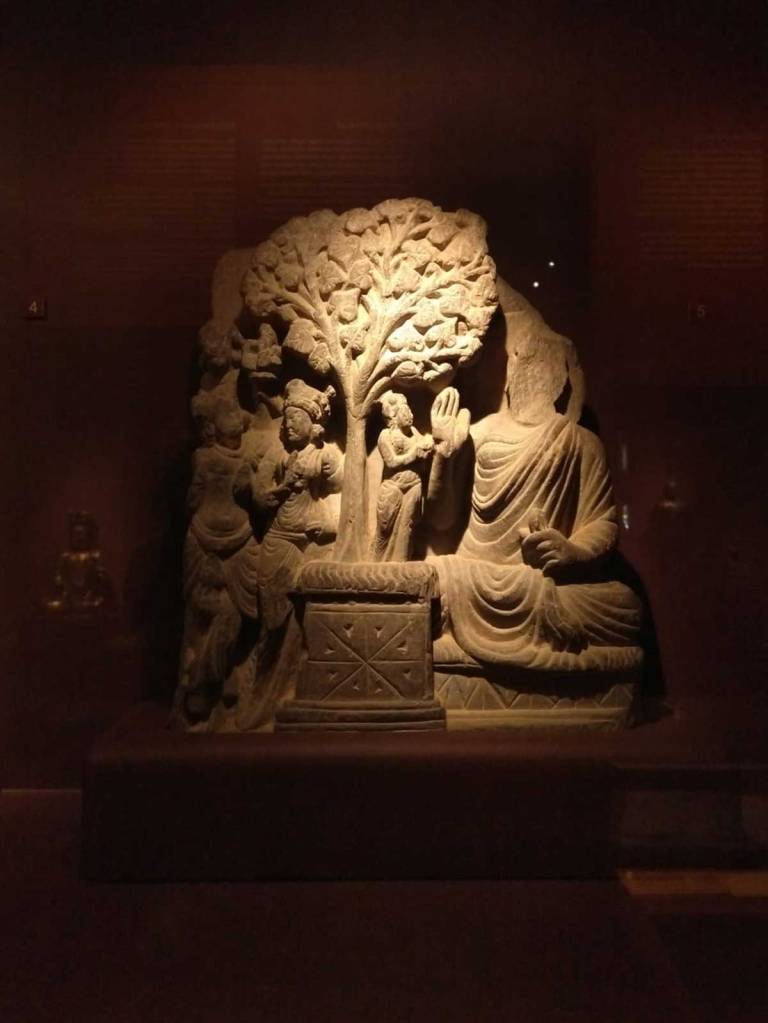
Buddha’s Enlightenment at the Bodhi Tree from The Museum, Mumbai

Geometric stone Jali from the Tomb of Muhammad Ghaus in Gwalior.
Being an embodiment of the Divine reality, walī is a Perfect Man (al-Insān al-Kāmil); one who has all Divine qualities, attributes, and virtues. A walī becomes a perfect mirror of Divine and exudes the beautiful qualities of God, a sense of benevolence, mercy, and love. Such beings rest in perfect tranquillity, eternally rooted in God.
Attainment of Buddhahood for all, is the key driving force for the people of the spiritual community in Buddhism.
The quest for Infinite Life in God, Eternal Union of the human and the Divine and the rapture of Love is what the soul yearns for. Such is a world where there would be ‘neither yours, nor mine.14’
“To achieve external disarmament, however, requires inner disarmament. That’s where ‘maitri’, loving-kindness, comes in.”
– His Holiness the Dalai Lama, at the Conference on the Concept of ‘Maitri’ or ‘Metta’ in Buddhism at the University of Mumbai in Mumbai, India15
universal Friend and universal friendship
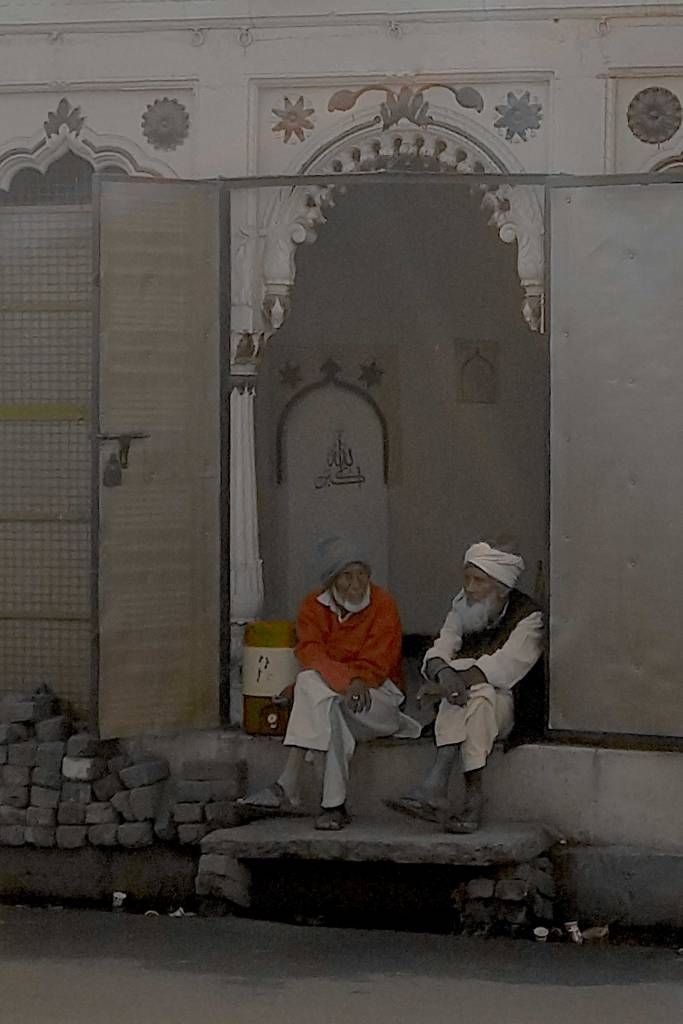
Friends of each other, Friends of the Divine. Flock at the dar (dor) of the Divine. The ‘People of the Door’ represent individuals who stand at the threshold between the material and spiritual worlds, expressing the Sufi ideal of being in the world yet not of it. This concept also explains the meaning of the term Dervish or Dervesh (also stemming from ‘dar’) which refer to the Sufis who are in rapture of the Divine.
In the spiritual tapestry, figures like walī, pīr, sheikh, or qutub stand as beacons of guidance, embodying the essence of Universal Friends. They not only lead the community on their inward journeys but also exemplify the importance of self-discovery as the starting point of such a quest. In this journey, the role of friendship is paramount; a true friend acts as a mirror, reflecting the qualities we need to foster within ourselves. They support us, challenge us, and accompany us as we strive towards a goal that is both One and Eternal, highlighting the interconnectedness of personal growth and communal harmony.
Embracing the essence of Universal Friendship, or mettā-bhāvana, is a journey that begins within oneself. It is a personal commitment to cultivate kindness and compassion, starting with self-acceptance and radiating outwards. This inner harmony creates a foundation for meaningful connections with others. In the role of a friend, one becomes a mirror of mettā, reflecting the qualities of empathy and support that are vital for mutual growth and liberation from suffering. Together, these bonds of friendship guide everyone along the path to Enlightenment.
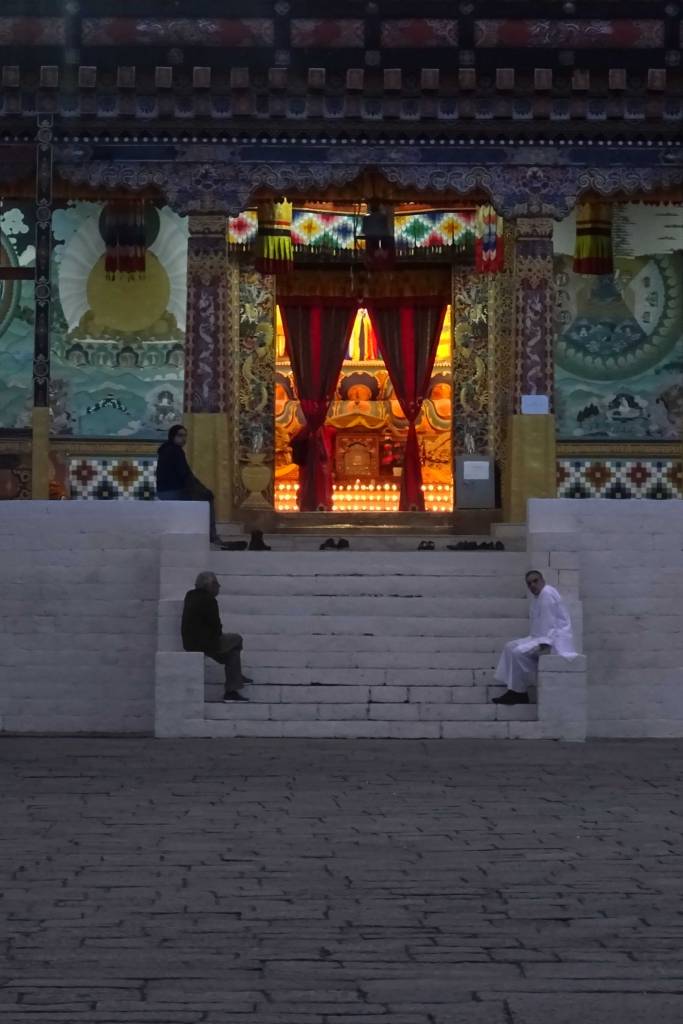
Evening. Tashichho Dzong, Thimpu, Bhutan.
from the individual to the universal
In Conclusion,
In both Buddhist and Sufi teachings, the journey to enlightenment starts with self. By fostering love and friendship within oneself, one can extend these virtues universally. The path involves self-reflection, moral perfection, and a commitment to virtuous living. These philosophies emphasize emptying oneself of preconceived notions that cause ignorance and factors that cause suffering. Great importance is given to the purification of the mind and purging of the transitory, destructible, and earthly emotions to reach states that are more permanent indestructible and eternal. This lays the path for the self to go beyond the level of the individual.
Such a mind would naturally emanate a feeling of universal friendship and love; and move towards serving humanity.
Bibliography & References :
- “Dictionary of Spiritual Terms,” n.d. http://www.dictionaryofspiritualterms.com/public/Glossaries/browse.aspx?CatID=3.
- “Three Jewels | The Buddhist Centre,” n.d. https://thebuddhistcentre.com/text/three-jewels.
- “Wikipedia, the free encyclopedia,” n.d. https://www.wikipedia.org/.
- Dasgupta, Surendranath. A History of Indian Philosophy. Motilal Banarsidas Publ.,2004.
- Lama, 14th Dalai. “His Holiness the 14th Dalai Lama.” The 14th Dalai Lama, February 20, 2018. https://www.dalailama.com/ “Inaugurating a Conference on the Concept of ‘Maitri’ or….” The 14th Dalai Lama, December 13, 2018. https://www.dalailama.com/news/2018/inaugurating-a-conference-on-the-concept-of-maitri-or-metta-in-buddhism.
- Safvi, Rana. In Search of the Divine. Hachette UK, 2022.
- Schimmel, Annemarie. Mystical Dimensions of Islam. Yoda Press, 2007.
- Zweig, Connie. A Moth to the Flame. Rowman & Littlefield, 2006.
Endnotes :
- The Eightfold Path consists of eight practicer. There are classified into prajñā (wisdom), shila (ethical conduct) and samādhi. Prajñā involves right view, right resolve, and right speech. Shila involves right action, right livelihood and right effort. Lastly, samādhi involves developing right mindfulness and right concentration. ↩︎
- The Sufi Path, consisits of several transitory states (hāl) and more permanent stations (maqām). The few transitory states are: Tauba or repentance, waraʿ or abstinence, zuhd or renunciation, tawwkkul or trust, faqr spiritual poverty, emptiness, non-connection to worldly materials, sabr or patience, shukr or gratitude and riḍā or contentment. These lead to ma’rifa or a deep understanding of the ultimate Truth transcends the temptations of the self and is absorbed in God. This is the moment when the more permanent stations or maqām manifest. These are: love or human & divine, fanāʾ or annihilation or passing away and baqāʾ or subsistence or permanency in the Divine Eternity. ↩︎
- Human love is called Ishq-e Majāzi and the Divine Love is called Ishq-e Haqīqi. Haqīqi stands for the one that is Real. The One, Divine and Eternal. ↩︎
- Divine Rapture is jadhba, this is when the infinite grace of God overpowers the lover’s heart, and pulls the lover towards him. In this state he becomes present with the Beloved. ↩︎
- Schimmel, Annemarie. Mystical Dimensions of Islam. Yoda Press, 2007. ↩︎
- Emanating from the Three Jewels, is a recitation in Pali. This is widely chanted: Buddham saranam gacchami. Dhammam saranam gacchami. Sangham saranam gacchami. This translates as: I take refuge in the Buddha. I take refuge in the Dharma. I take refuge in the Sangha. ↩︎
- Sheikh means master. Other names that are used are imams, sheikhs, and ulama. ↩︎
- Pīr stands for elder. ↩︎
- Hazrat: a title of honor, bestowed upon a person, especially a saint. It is a term associated with dignity and respect, as well as nearness. The word comes from Hazara, which means to be present. The root meaning of this word is “presence, appearance.” Hazrat would mean nearness or closeness in place or in relationship. It could also mean “Your Holiness” ↩︎
- Khānaqāh is a space for gathering the Sufi brethren. ↩︎
- Such a beginner pursues spiritual enlightenment through sulūk (traversing a path) with a spiritual guidance. ↩︎
- The term ‘silsilah’ literally means ‘chain’, and in Sufism it refers to the formal chain of spiritual descent. ↩︎
- Qutub (“pole, axis,” highest member in the hierarchy of the saints or the leader of the Sufi hierarchy. Qutub is the “pole” or “pivot” or ghauth, “help.” (oxford dictionary) ↩︎
- In the journey of spiritual growth, the sharīʿah represents the outward stage, where individuals adhere to the Knowledge of Religious Law, maintaining a clear distinction of personal boundaries with the principle of ‘yours is yours, mine is mine.’ As one progresses to the ṭarīqah, the inward stage of the Mystical Path unfolds, where possessiveness wanes, embracing the ethos of ‘yours is yours, mine is also yours.’ Ultimately, the quest culminates in the unitive state of ḥaqīqa, where the concept of individual ownership dissolves into the universal Truth. Here, the duality of ‘mine’ and ‘thine’ ceases to exist. ↩︎
- “Inaugurating a Conference on the Concept of ‘Maitri’ or….” The 14th Dalai Lama, December 13, 2018. https://www.dalailama.com/news/2018/inaugurating-a-conference-on-the-concept-of-maitri-or-metta-in-buddhism. ↩︎