Gwalior is a city in central India with a rich ancient past. It is located in northern Madhya Pradesh and has a long and dramatic history. The city is home to numerous royal palaces, havelis, temples, and other architectural gems. It also houses sculptural marvels, both in-situ and from neighbouring regions. The enormous Fort of Gwalior dominates the entire city that sprawls beneath its lofty plateau.
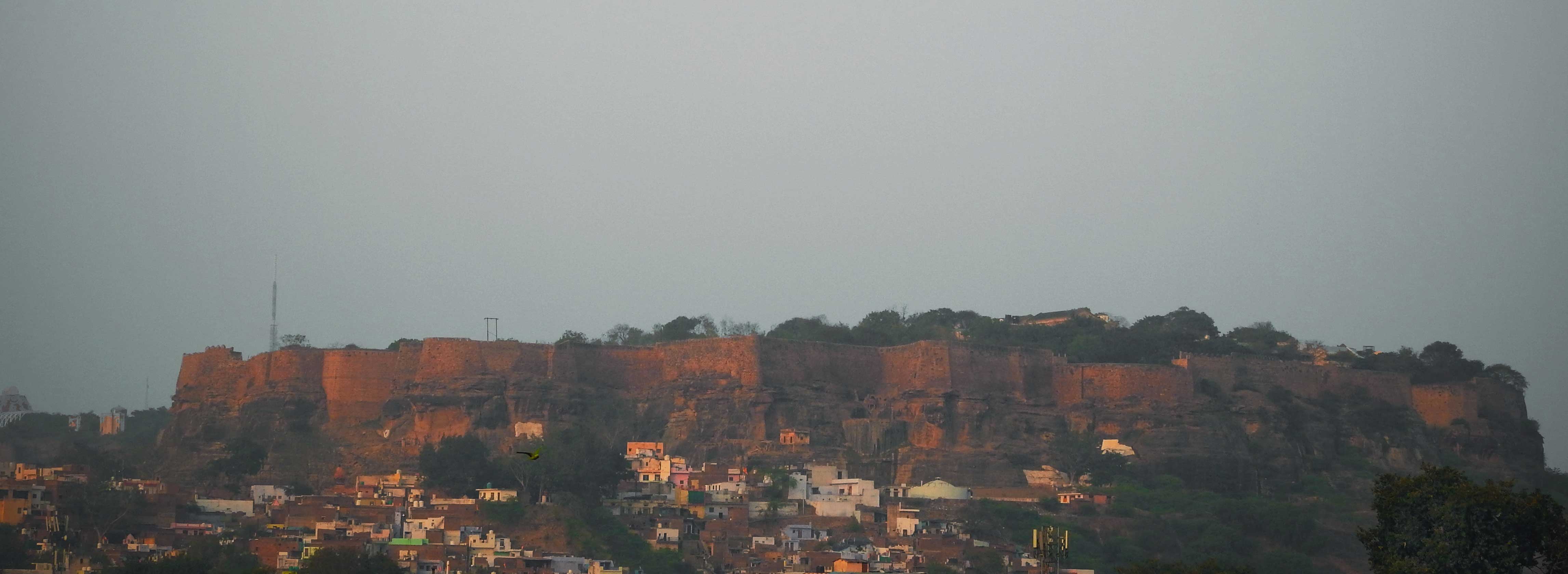
This page holds some visuals from Gwalior.
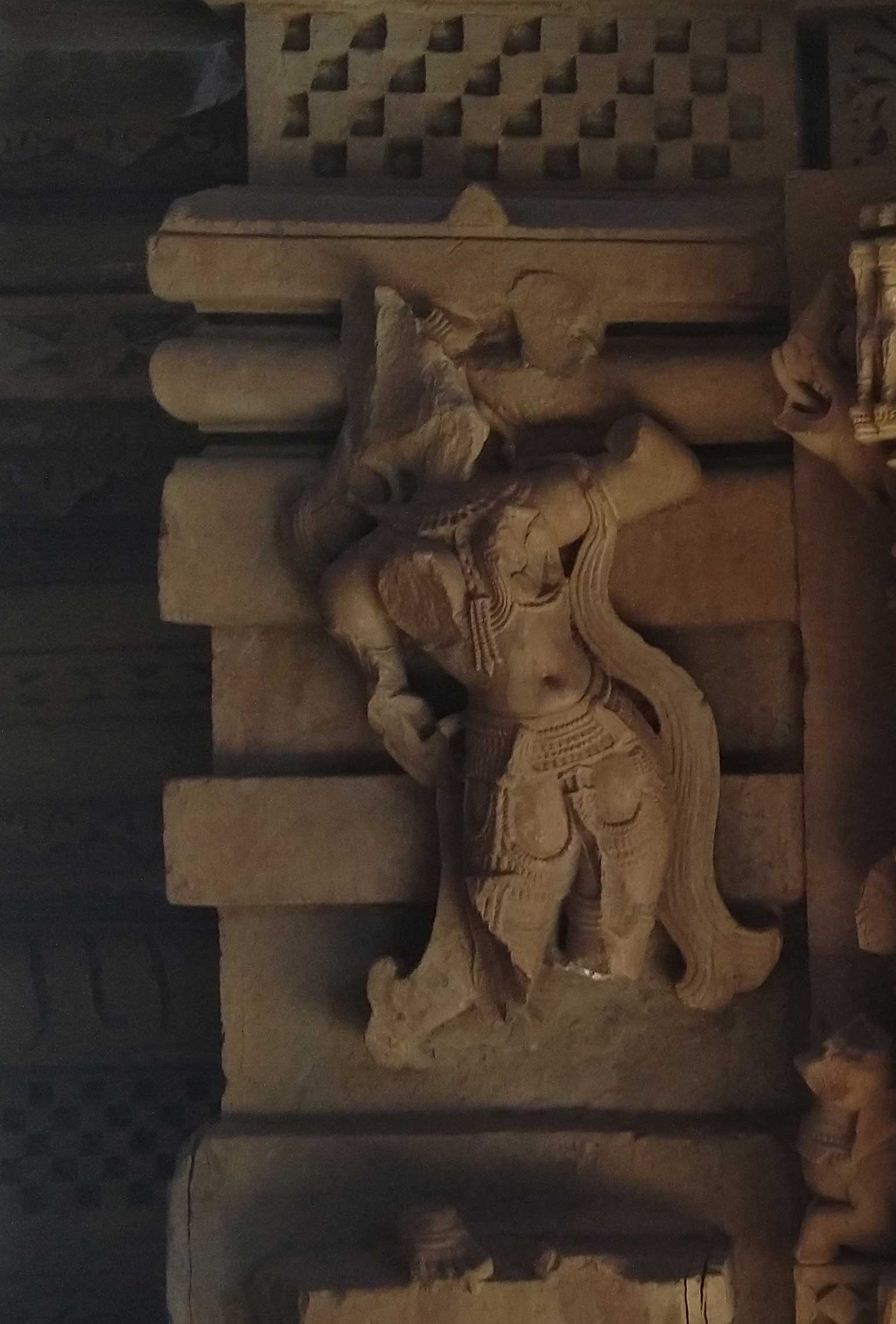
Sculptural figure from an internal pillar of the ninth century Saas-Bahu Temple dedicated to Lord Vishnu. This is a twin temple complex that is situated on the eastern side of the Gwalior Fort. It is profusely decorated and is studded with sculptural mastery, both on the inside and out. This little figure flanks an image of Vishnu within a canopy, so perhaps this figure is the attendant or a in position of a dwaarpaal for the main image on the column. Even though the image is of such little significance, it is so gracefully carved in the tribhanga pose. The figure is ornamented with royal jewellery and holds a long flowing drape. Though, many of the carvings and figures have been defaced, they still behold the grace that they might have originally had when sculpted.
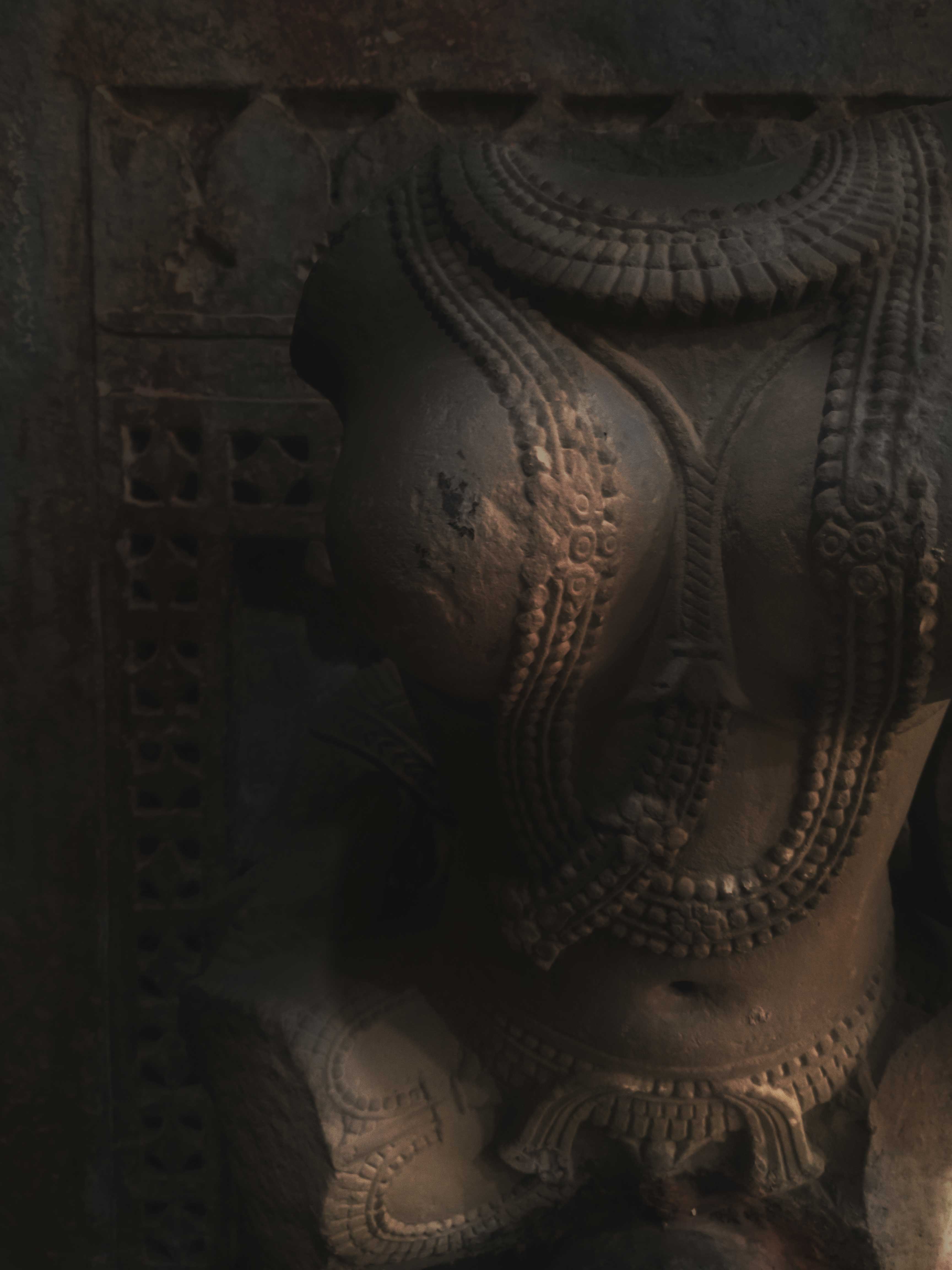
This is a thirteenth century sculpture titled by the museum as Vikaranya. It has been placed in room number fourteen at the Gujari Mahal Archaeological Museum at the Gwalior Fort dedicated to goddesses and female deities. This voluptuous, full breasted and bold, yet elegantly ornamented sculpture is originally from Naresar, in the Morena district of Madhya Pradesh. Naresar has about two dozens of monuments, many of which are temples that are built in the northern Indian Pratihara style.
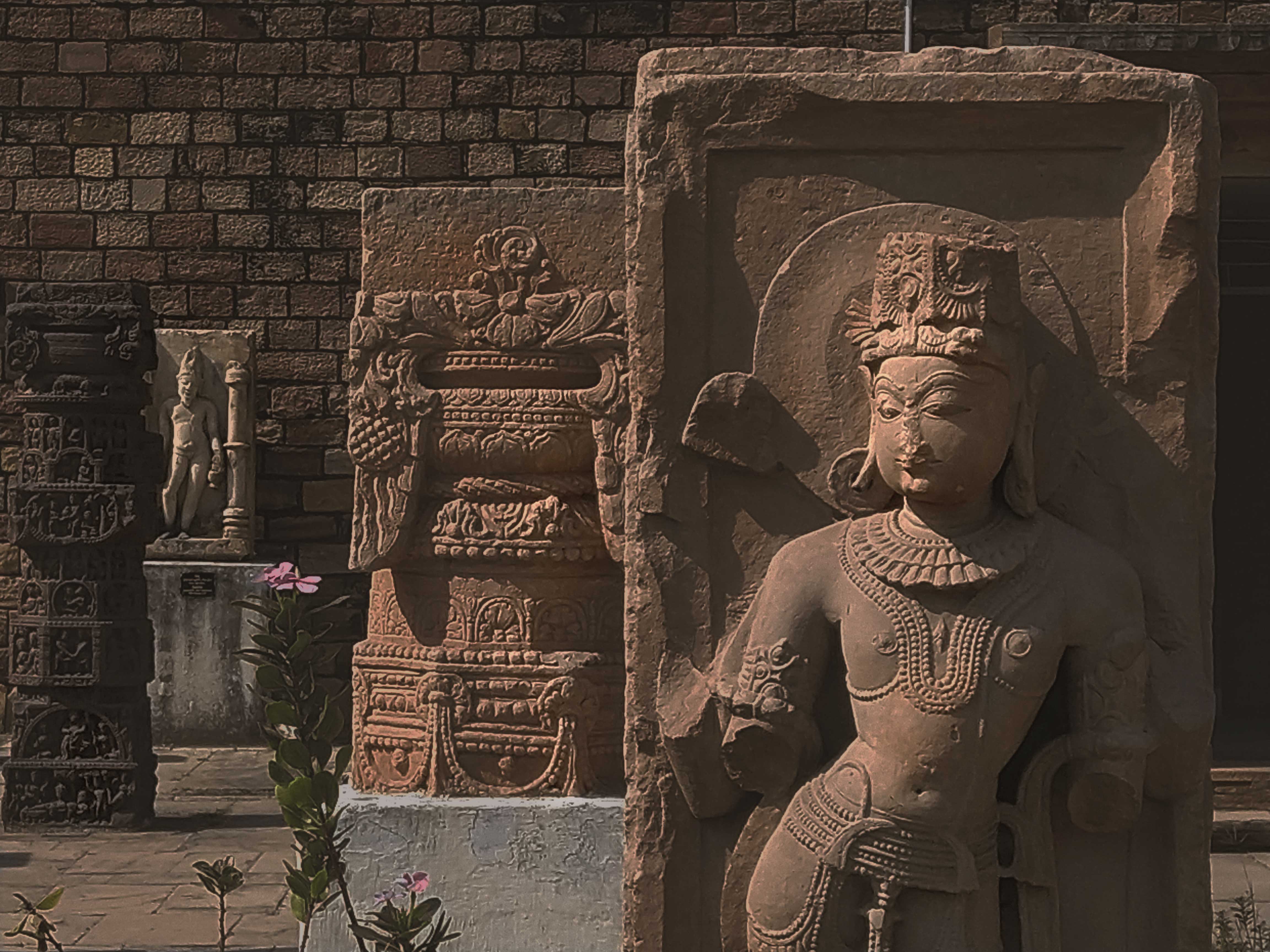
Sculptures in the open courtyard of the Gujari Mahal Archaeological Museum at the foothills of the Gwalior Fort. (R to L) Vishnu, a prosperous Ghata-Pallava motif, an ascetic (perhaps Agni), and an Octagonal Column with a ghata-pallava motif atop it.
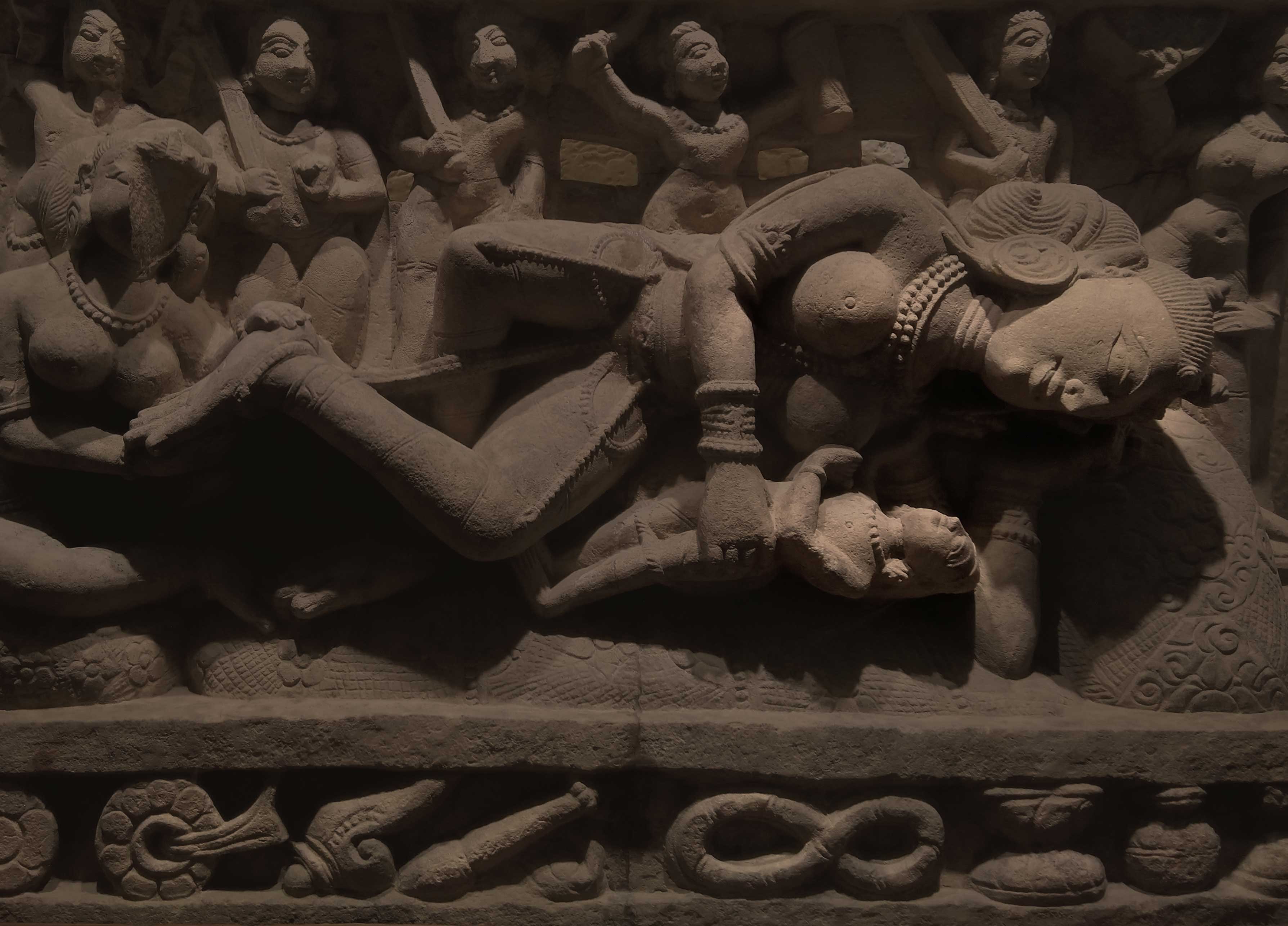
Birth of Krishna / Krishnajanma. This unique sculpture depicts Devaki feeding her newbon baby, Krishna. Devaki, the wife of Vasudeva during imprisonment at Mathura gave birth to Krishna. As the eighth son whas destined to kill evel king Kansa, he had held the couple hostage during the child’s birth. In this depiction, the guards are depicted behind them holding wepons. Krishna was born and the prison doors magically opened for Vasudeva to take him to his foster parents Nanda and Yashodha. Krishna, being an incarnation of Lord Vishnu, his attributes are depicted in the lower register of the sculpture. This sculpture has been placed in the Archeological Museum at Gwalior Fort.
Beauty and Grace

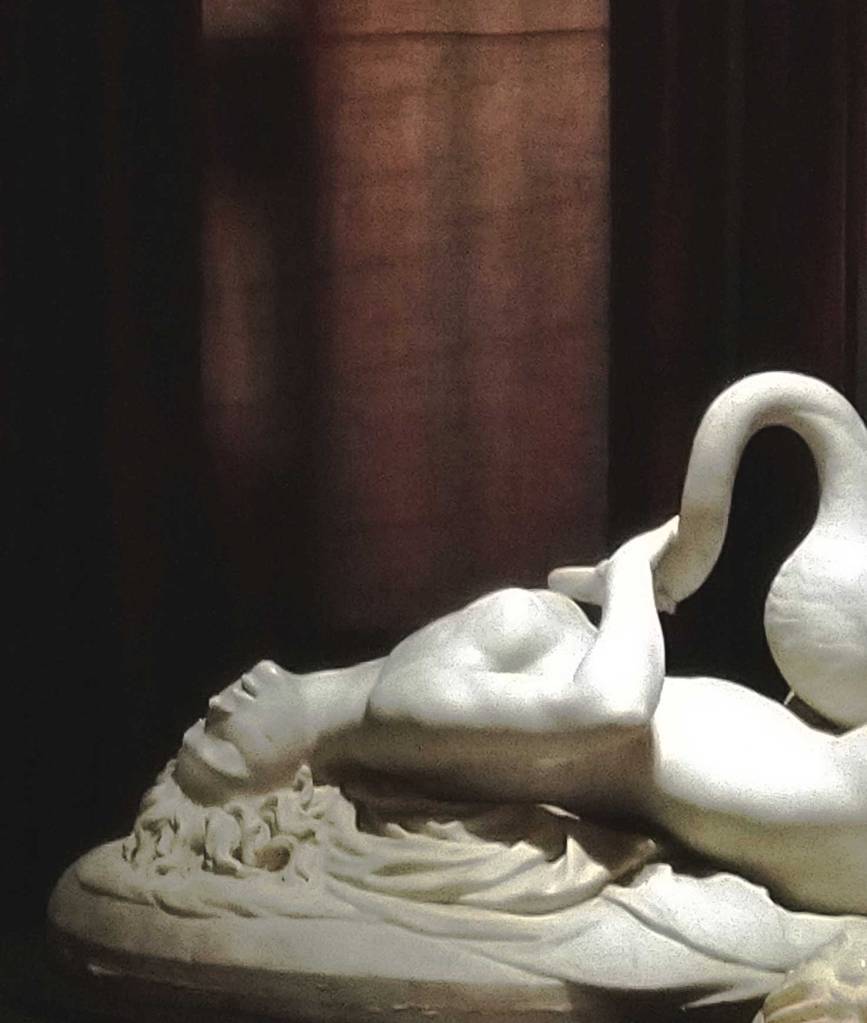
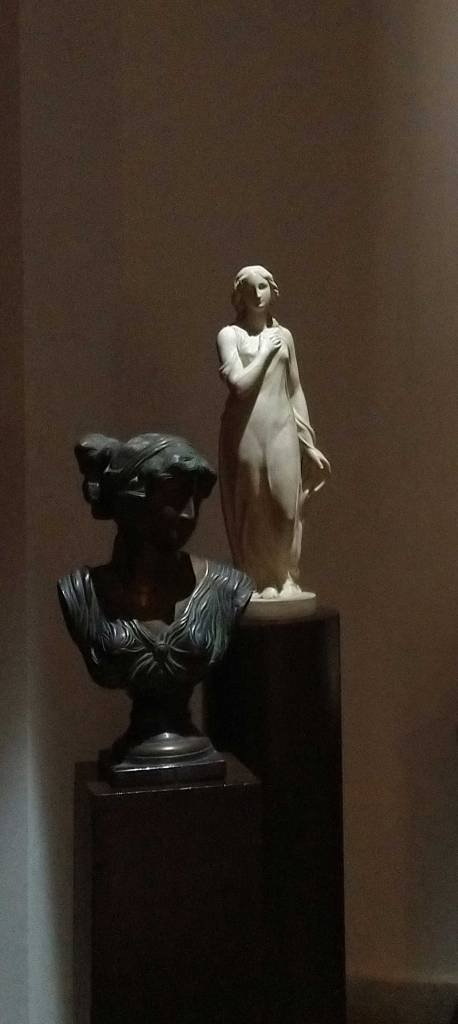
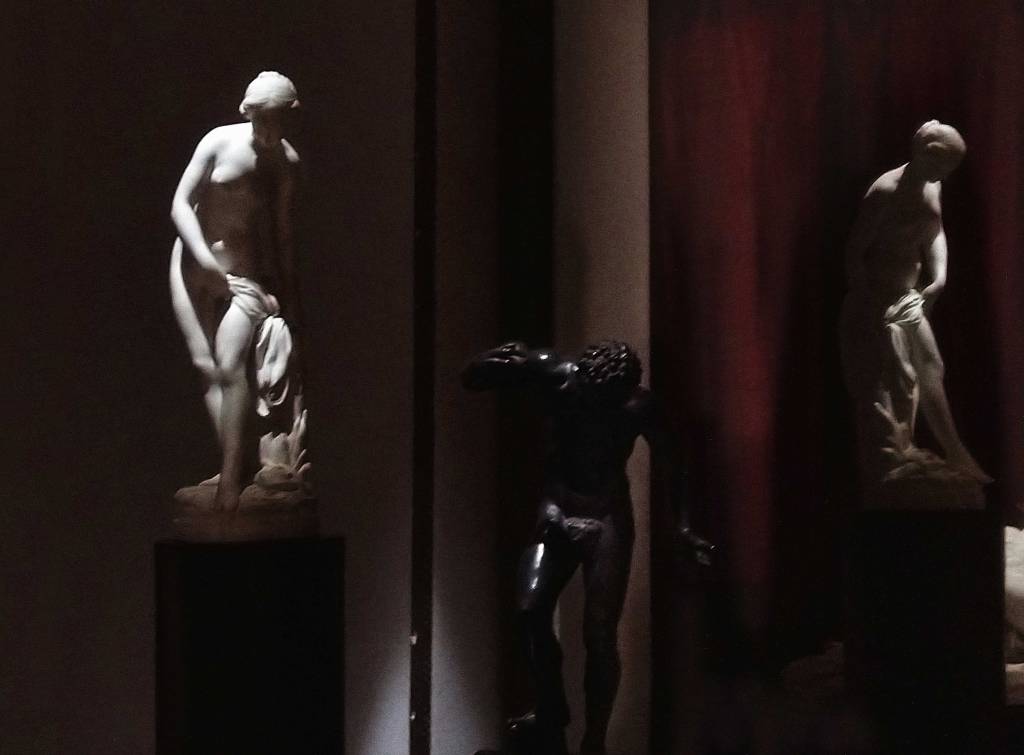
The grand Jai Vilas Palace (museum) holds dome of the finest pieces of furniture, period rooms, decor and acessories and these elegant and evocative sculptures. These set of sculptures are from the Neoclassical room. (Jai Vilas Palace buiding itself, is also a neoclassical style building). The sculptures here, are heavily influenced by the ancient Greco-Roman art and are a celebration of the beauty of the body in its ideal form. These figures are of the musician (standing, dark sculpture), the Beatrice (the lady in white, with her arm on her bosom), the statue of the Bathing Venus (the standing statue coming out of a pool), the Bust of a Lady (the dark statue in front of Beatrice’s), Leda and Swan (reclining nude with the bird atop her) and Cupid and Psyche (the kissing duo). Beatrice is Dante’s guide to divine truth in “The Divine Comedy.” Leda and the Swan is a Greek mythological story in which the god Zeus, disguised as a swan, seduces Leda, a Spartan queen. In another classic myth, Cupid falls for Psyche’s beauty, leading to trials, separations, and ultimately, an eternal union among the gods. Cupid is the son of Venus.
Furniture for Food
The Jai Vilas Palace has beautifully set period room containing antiques, furniture and furnishings owned by the royal Scindia family. Along with traditionally built furniture having local Indian influences, one sees a great amount of Western Influence. Originally a Maratha family, the Scindias were a ruling dynasty when the princely state of Gwalior was alingned itself to the British after the gradual decline of the Maratha empire. The royal family used some of these rooms for their private meals and also hosted dinners for dignitaries. As this palace is a live museum, some of these spaces are still in use.
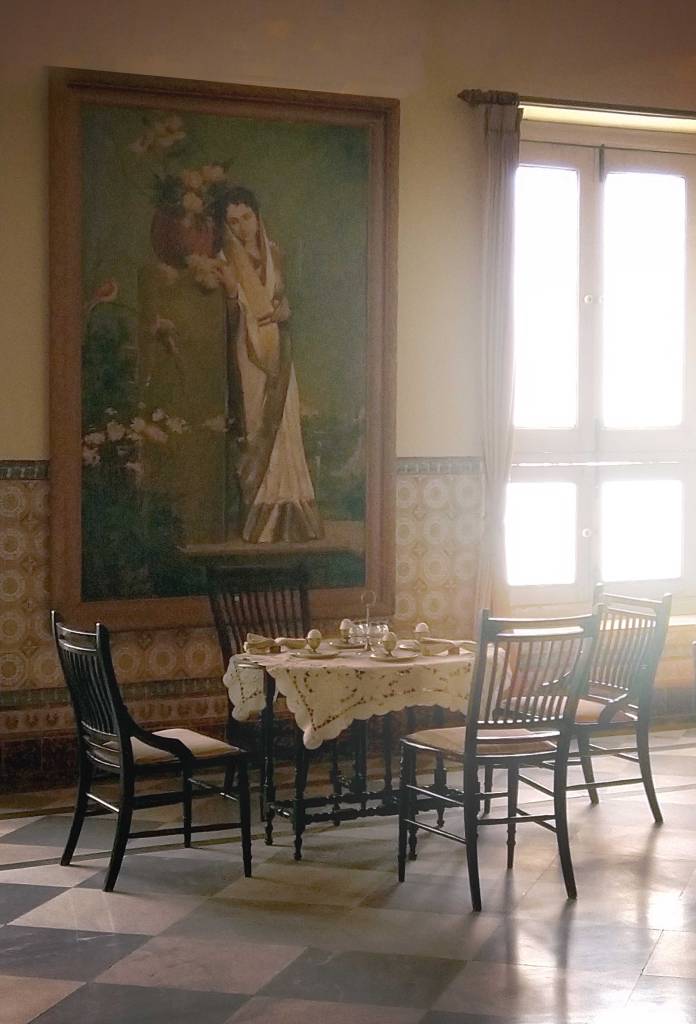
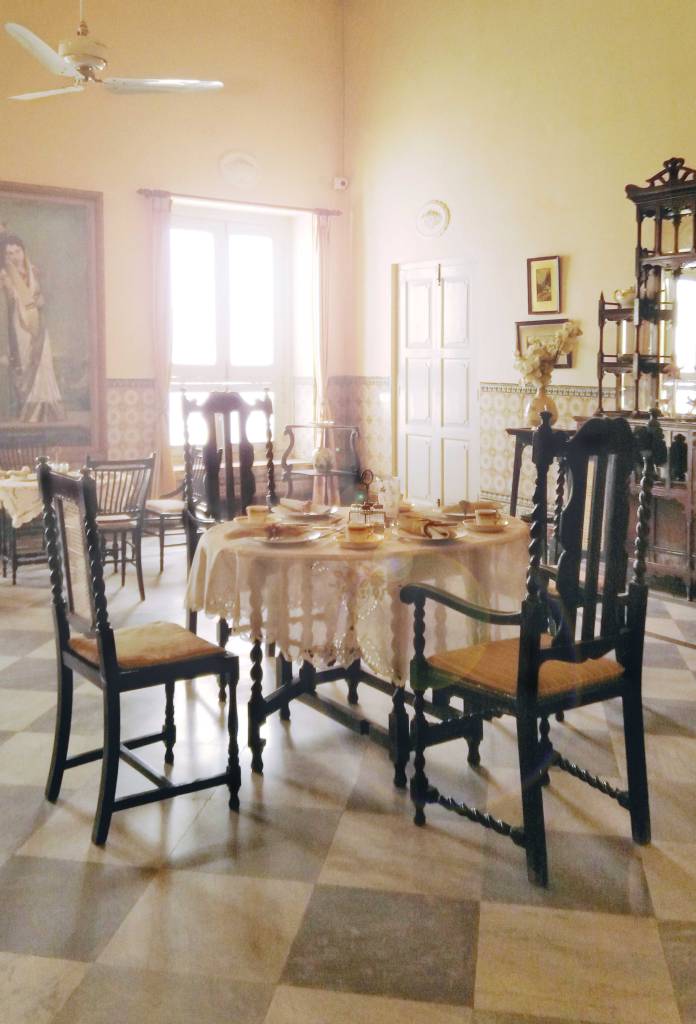
The Breakfast Room showcases informal and formal spaces for the morning meals. The smaller tables suggest a more informal and private setting. Equipped with elaborate crockery and tableware, this space was a place for the Scindia family to spend their mornings over tea and courses of breakfast. Minton’s porcelain, Osler crystal chandeliers, and furniture were a product of the English infusion into this space in the Jai Vilas Palace.

Western-style Banquet Hall has a central table bearing the train track along its surface that would run a silver train with glass-cut wagons that would distribute wine, champagne, cigars and such other delights for guests. This space is still used by the royal family during special occasions.
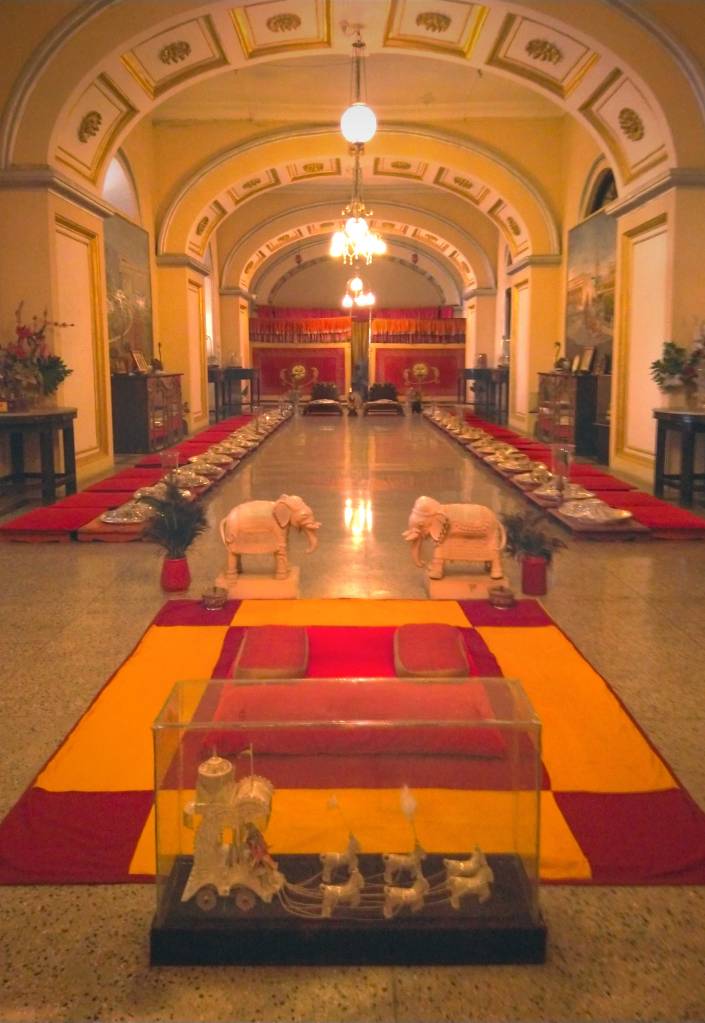
Taat-Paat Bhojan Hall is set for a Royal Maratha dinner. The Taat refers to the cushions or cloth seats on which the silver thal or plate is placed, and the Paat is a low wooden seat meant for cross-legged seating. Though some may consider this informal compared to the chair-seated western-style banquet, it was in fact a formal arrangement where the maharaja and maharani occupied positions on the east side, facing the kulguru or the religious head who sat directly opposite them. The rest of the seats were occupied by sardars and other people of the court and the family. This Indian-style Bhojan Hall is used during Dussehra, Diwali, and marriage ceremonies at the Scindia palace.
LOOK UP!!
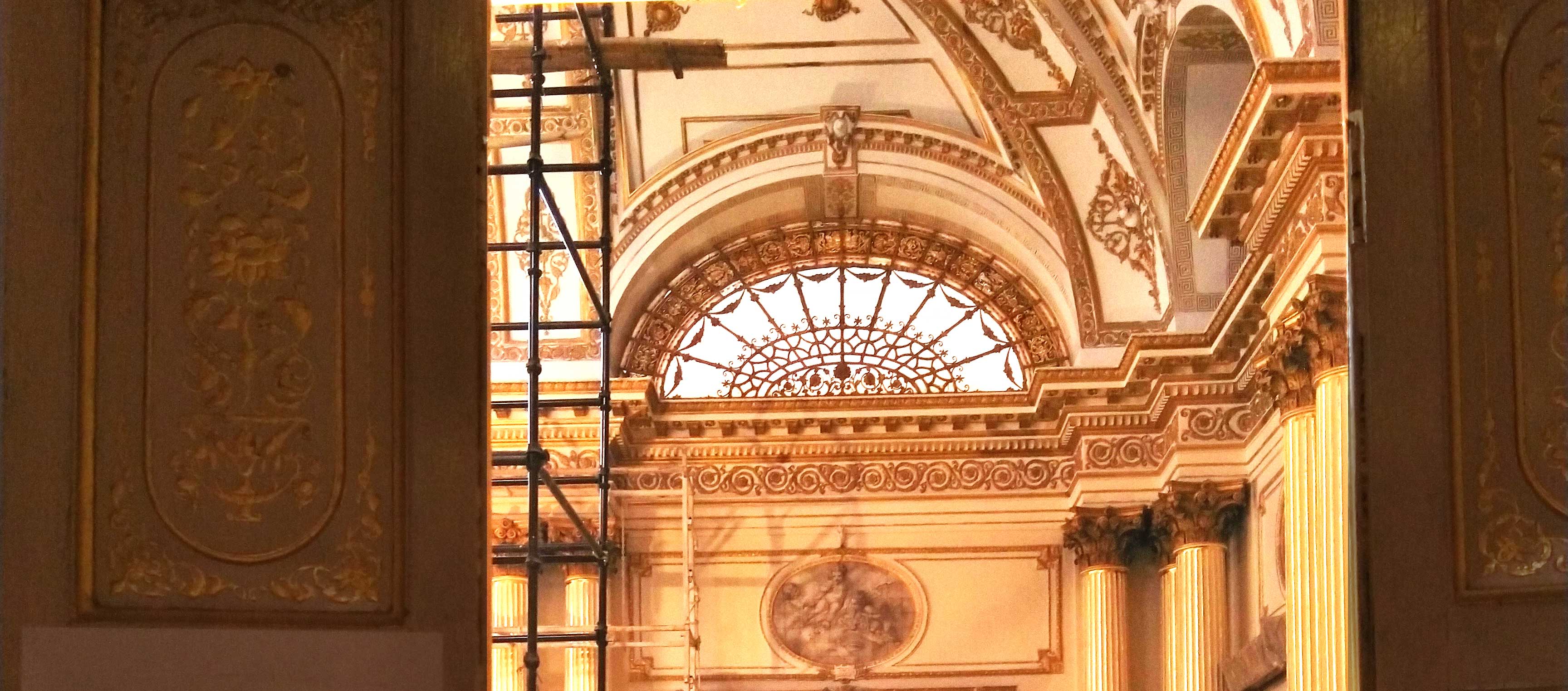
The regal Banquet Hall of Jai Vilas Palace is adorned with intricate gold accents. Its expansive vaults and arches are embelished with bold yet delicate gold patterns’,’ while the entry doors feature a subdued green, embellished with metallic floral designs, probably done in gesso technique. Elements from Classical and Neoclassical styles are evident, including dentils beneath the cornices, medallions adorned with cherubs, and a strict symmetry in the layout. The meandering motifs inside the arches’ vaults (also seen in an image ahead), Corinthian-style capitals atop the columns, and the white-and-gold palette echo the Baroque influence. Semicircular windows with Regency Style gold tracery complete the opulent design, reminiscent of delicate filigree work.
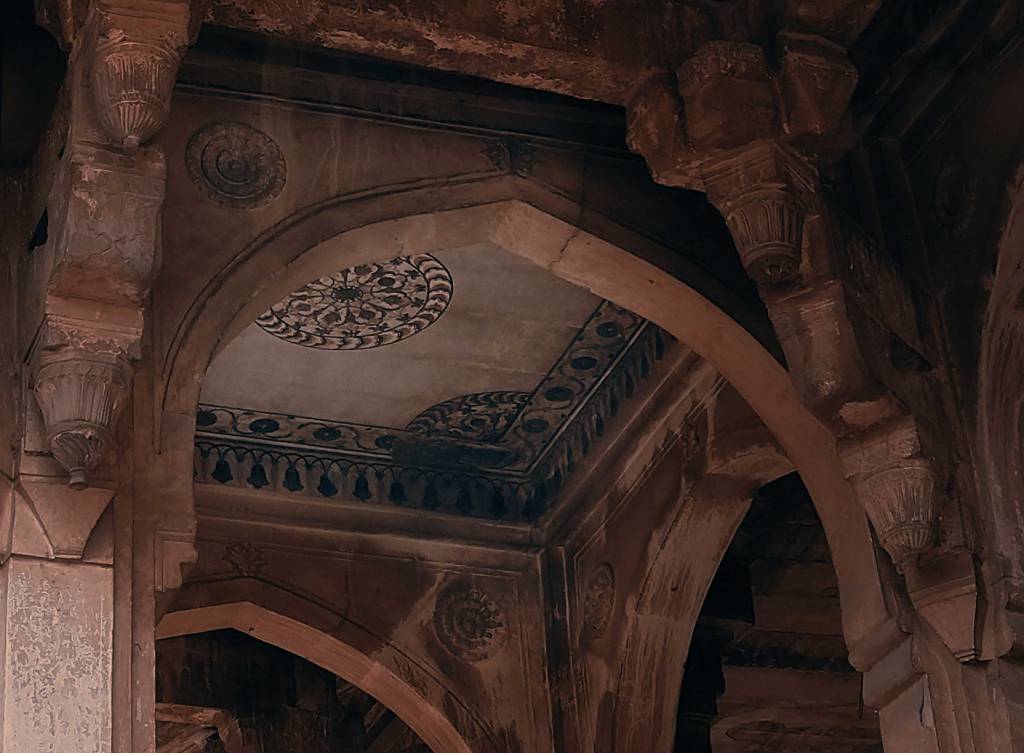
The Tomb of Muhammad Ghaus, a remarkable edifice from the sixteenth century, was erected during the reign of Akbar. It showcases an architectural fusion that blends elements of the designs prevalent in Akbar’s era with those of the Lodhi style. Some aspects of the tomb’s design are inspired by stone renditions of wooden canopies. The ceiling has been paintaied with patterns that have semblence to Mughal and Rajput Miniature Paintings. The arch’s design, adorned with floral medallions and supported by brackets, bears resemblance to the architectural motifs found in Fatehpur Sikri.
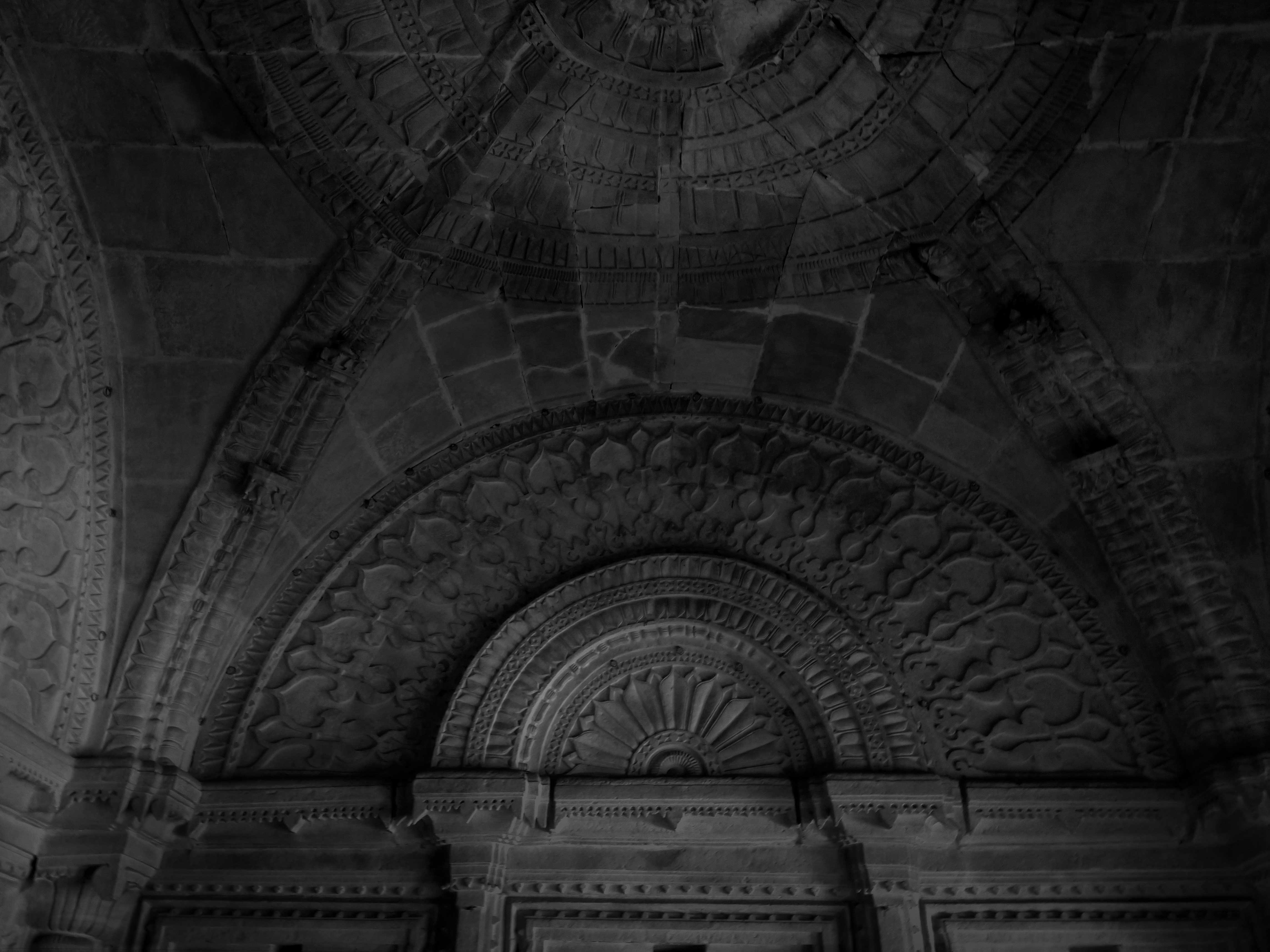
A blend of blind tracery and bas-relief on the walls and the ceiling at the Man Singh Palace at Gwalior Fort. This palace was built by Raja Man Singh Tomar and displays features of Rajput-style architecture. This feature, of the semicircular arch springing between two impost blocks, having carved patterns, visually resembles the tympanums of the medieval Romanesque churches.
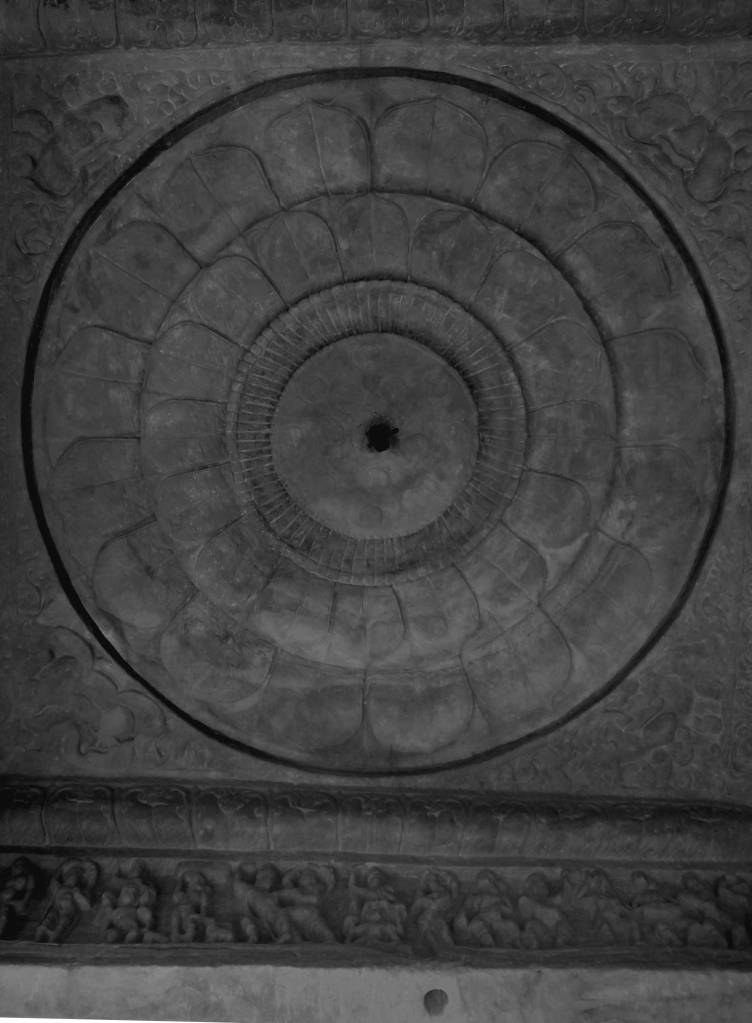
The Caturbhuj Temple, located in proximity to the Lakshman Gate, was constructed circa 875-876 AD. This monolithic temple is dedicated to Lord Vishnu and features a prominent idol of the deity with four arms, symbolizing his chaturbhuj form. Adorning the ceiling just outside the temple is an intricate bas-relief of a lotus, the flower traditionally linked with Vishnu. A series of finely carved figures encircle the space, creating a frieze that depicts various stories in a visual narrative etched in stone.
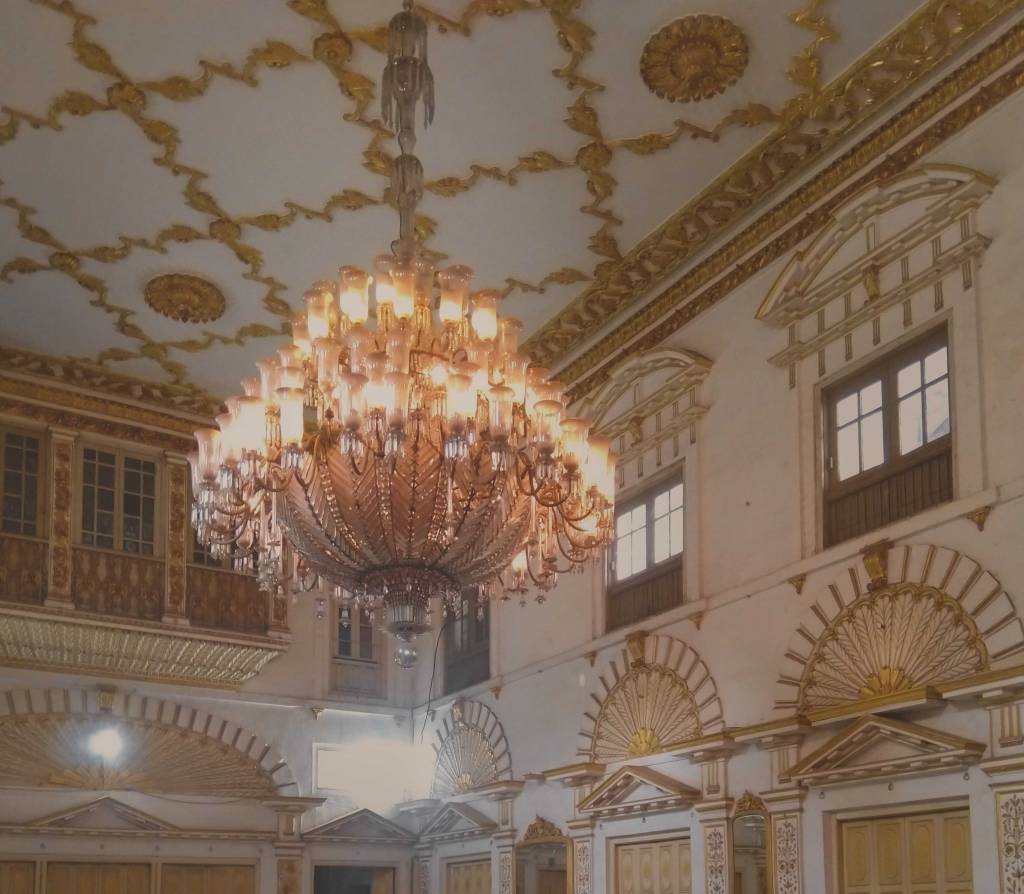
Constructed by Jivajirao Scindia, the Moti Mahal is a historic building in Gwalior, once serving as the administrative hub of the province until Madhya Bharat was integrated into the Indian Government as Madhya Pradesh. The architecture of the building is a tapestry of regional, vernacular, and international classical influences. Echoing the opulent design of the Darbar Hall, the walls of this room are graced with pearl-white hues and gold accents. The grandeur of the space is centered around a magnificent Belgian glass and gold leaf chandelier. This room also features a minstrel’s balcony overlooking the grand hall, neoclassical triangular pediments above each doorway, and a ceiling decorated with regency style patterns arranged diagonally, interspersed with floral medallion motifs that resonate with the Maratha wadas and Mughal-Rajput architectural traditions.
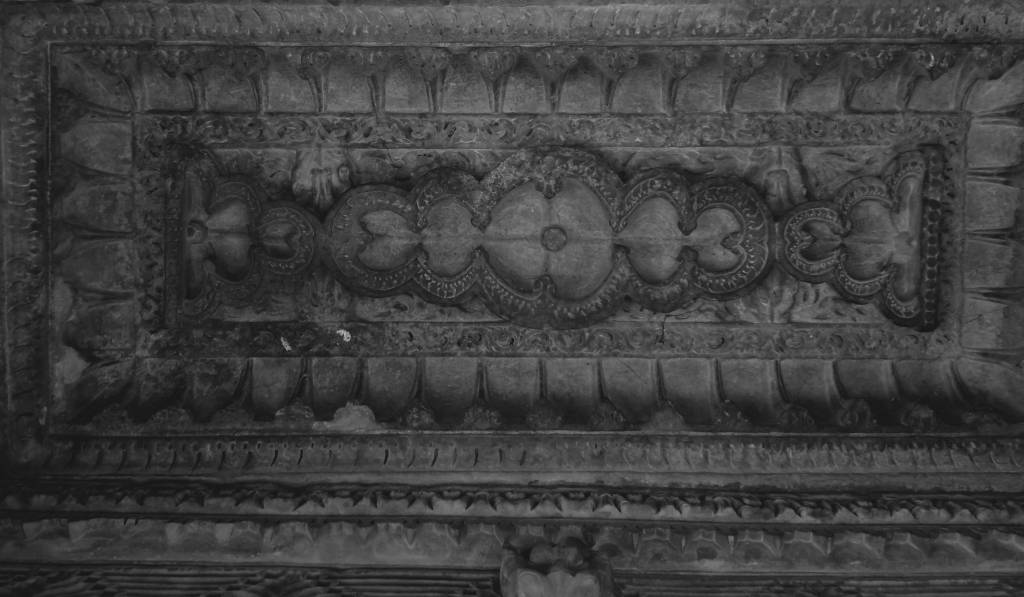
Ceiling panel at the Sas Bahu Temple at Gwalior Fort.
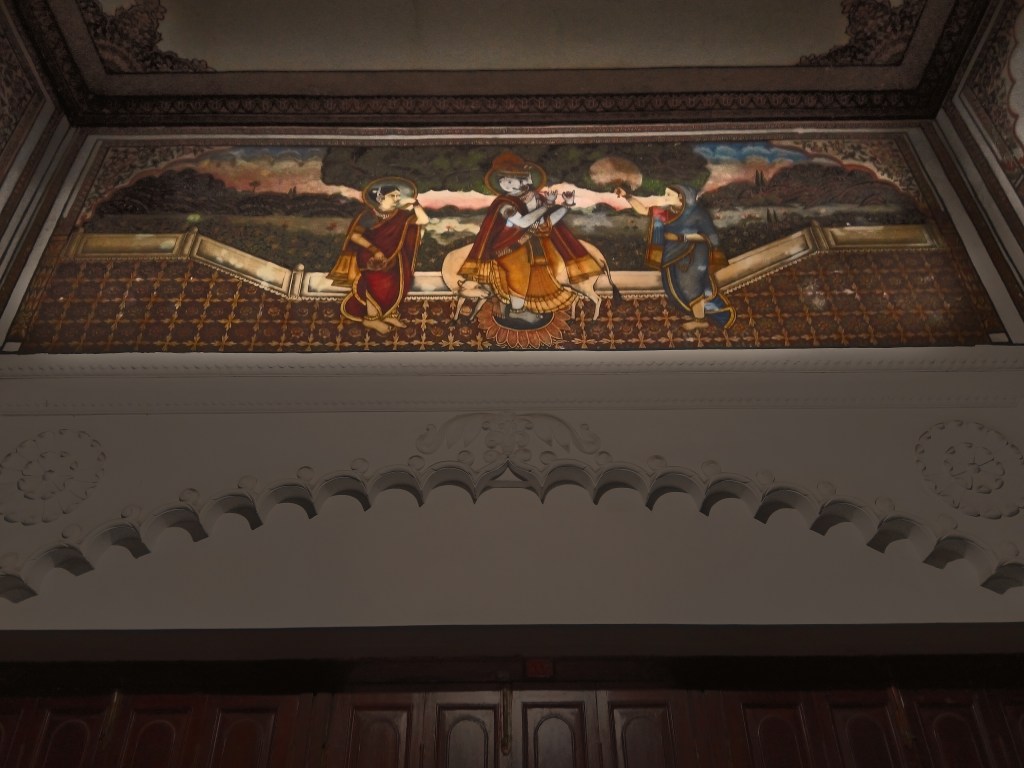
The rooms at the Moti Mahal had been decorated to reflect the eclectic tastes of the royal Scindias of Central India. This space served as a Vidhan Sabha before the capital of the region moved to Bhopal. The panel above the door is located in a rectangular lobby outside one of the many decorated rooms. This mosaic made with colored and enameled glass is one of the many murals depicting the various ‘raags’ and ‘raginis’ and depicts Krishna playing his flute.
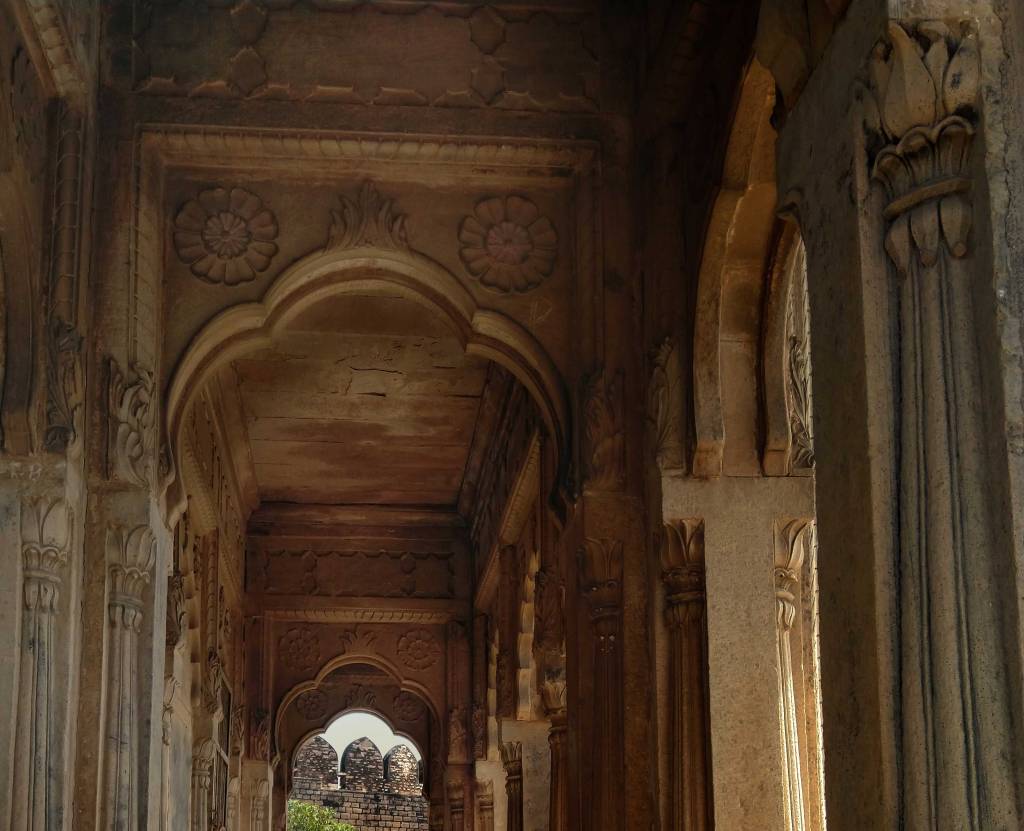
Bhim Singh Rana, the ruler of Gohad, occupied the Gwalior fort from the Mughals. He died in a war with the Marathas. His cenotaph/chhatri is located to the west of Jahangir’s Palace and is just behind the Johar Kund. Overlooking the ramparts of the majestic Gwalior Fort, this colonnade is built around the central garbhagrah. Built in brown and red sandstone on a high platform, this is a three-story structure with a colonnade at the lower level featuring a series of columns and arches that are representative of the Rajput style. The carved pillars with lotus capitals are connected with trefoil/multifoil arches.
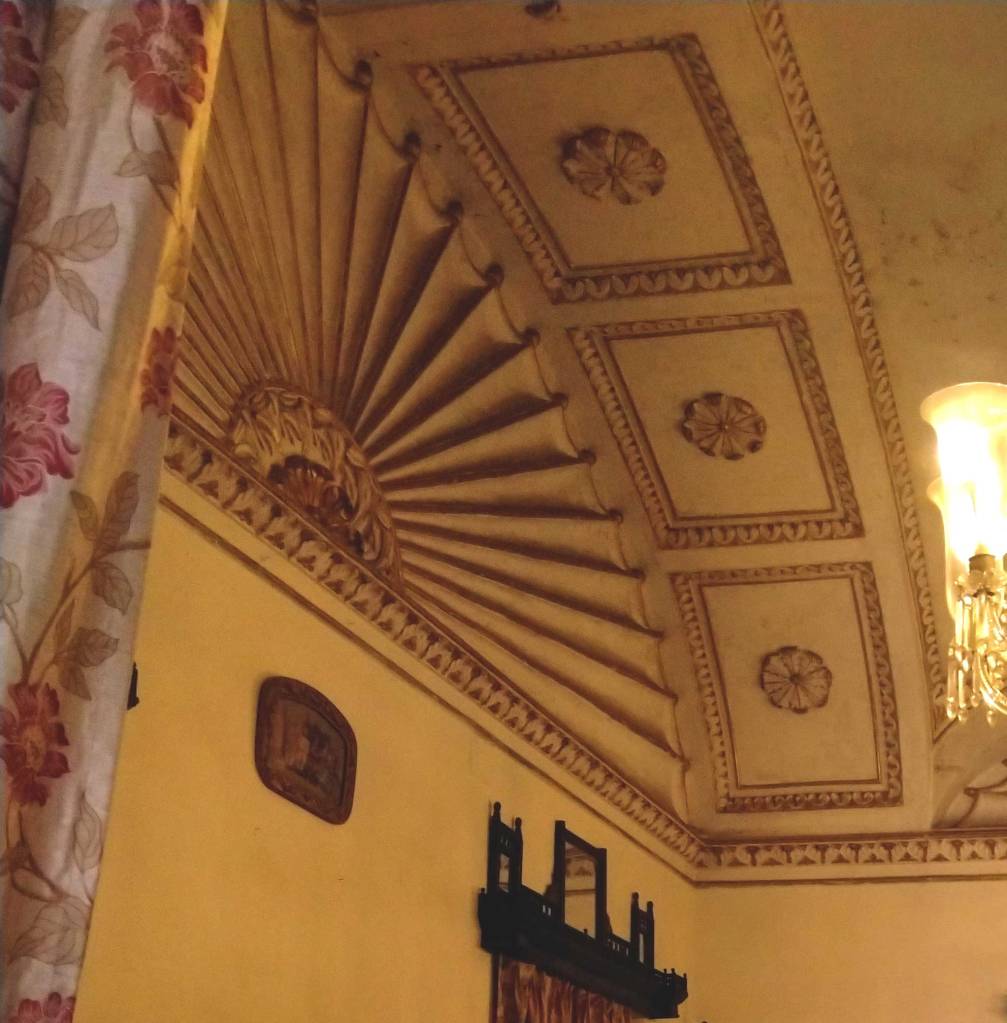
Maharani Gajra Raje’s Drawing Room, echos the ‘Adams Style’ of the Neoclassical Period. It projects boldly, radiating gold detail right under the arch. The rectangular ceiling panels tgracefully frame the arches, each embellished with a motif of fully-bloomed flowers. This design harmoniously aligns with the aesthetic of the Durbar Hall and the previously observed Moti Mahal, creating a cohesive and regal ambiance.

Gazing upward at the corner of the previously observed Durbar Hall, one is met with a rondel adorned with painted tiles featuring the cherub motif, a design element that gained popularity during the Baroque era. Done in painted tile-work this eliptical element displays a scene made of chubby infants. The room’s aesthetic, with its ceilings and walls enveloped in a tapestry of intricate ornamentation, likely draws inspiration from Robert Adam’s ‘Adam Style’, a hallmark of the Neoclassical period.
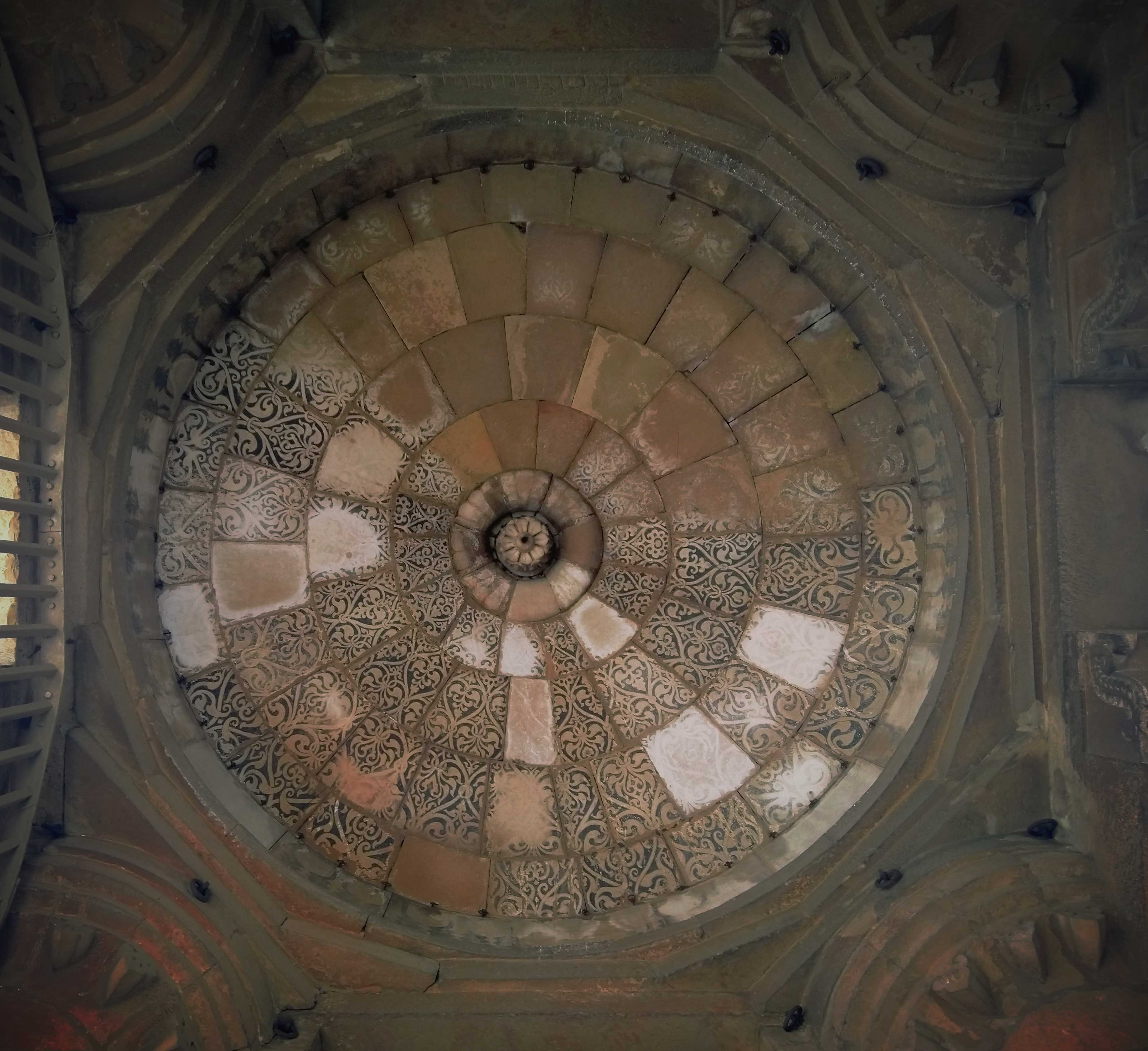
The ceiling of the Hath Gate. This is a gate to Man Singh’s Palace situated atop the Fort of Gwalior. Laid with enameled/glazed tiles, radiating from the central knob, this gate and the edifice it leads to draw inspiration from the Persian tile-craft of Assyria and Babylon.
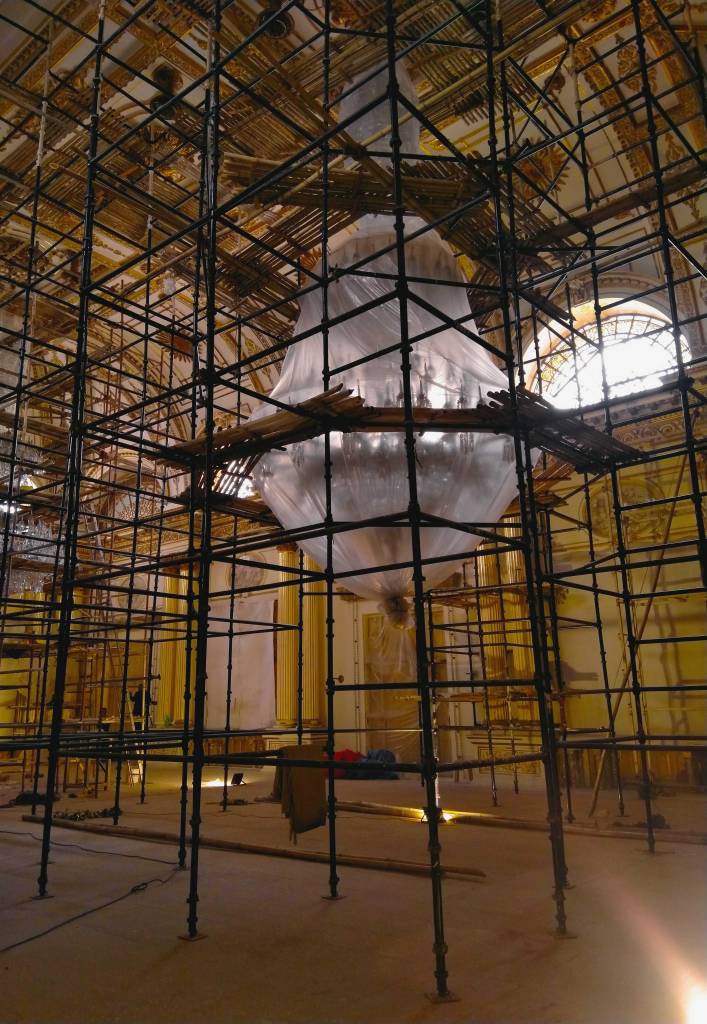
Repairs and Restorations at the regal Durbar Hall at the Jai Vilas Palace.
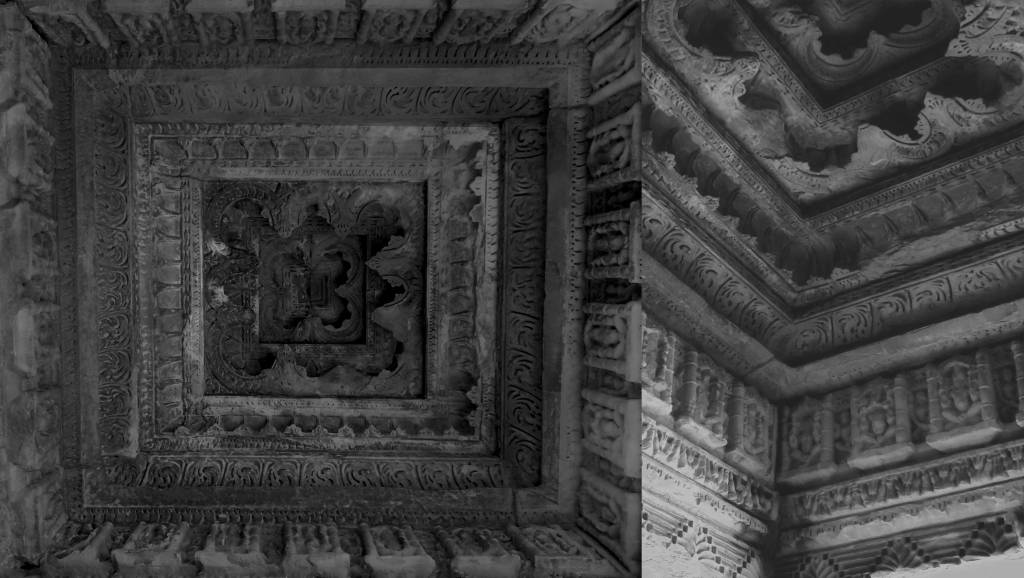
The row of framed images leading up to a layered stepped ceiling. Ceiling panels at the Sas Bahu Temple at Gwalior Fort.
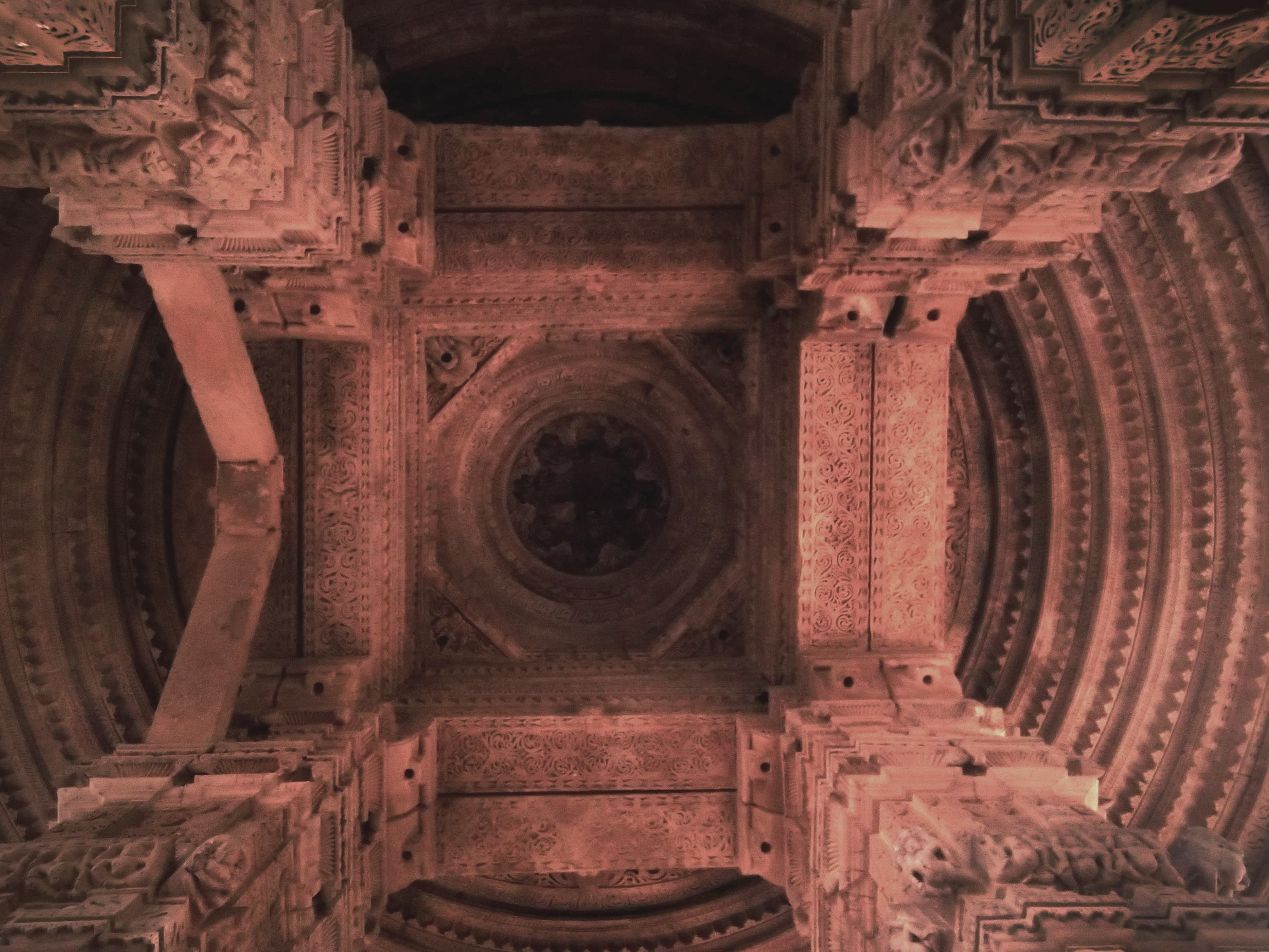
The intricately designed layered ceiling, supported by four massive carved pillars, exudes a sense of grandeur and artistry. The step formation and captivating concentric rings in the ceiling ascend gradually, diminishing in size, creating a lotus-centered mandapa.
HUMAN AND DIVINE LOVERS
Shiv-Shakti, Heer-Ranjha, Radha-Krishna… India has so many stories to tell of lovers.
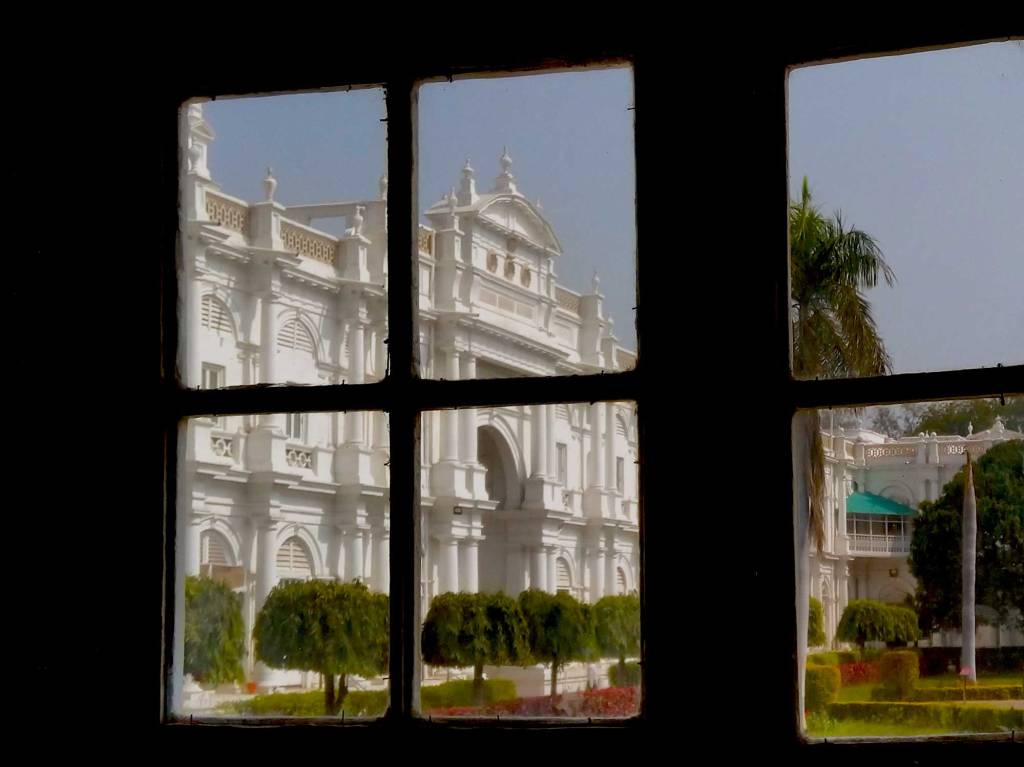
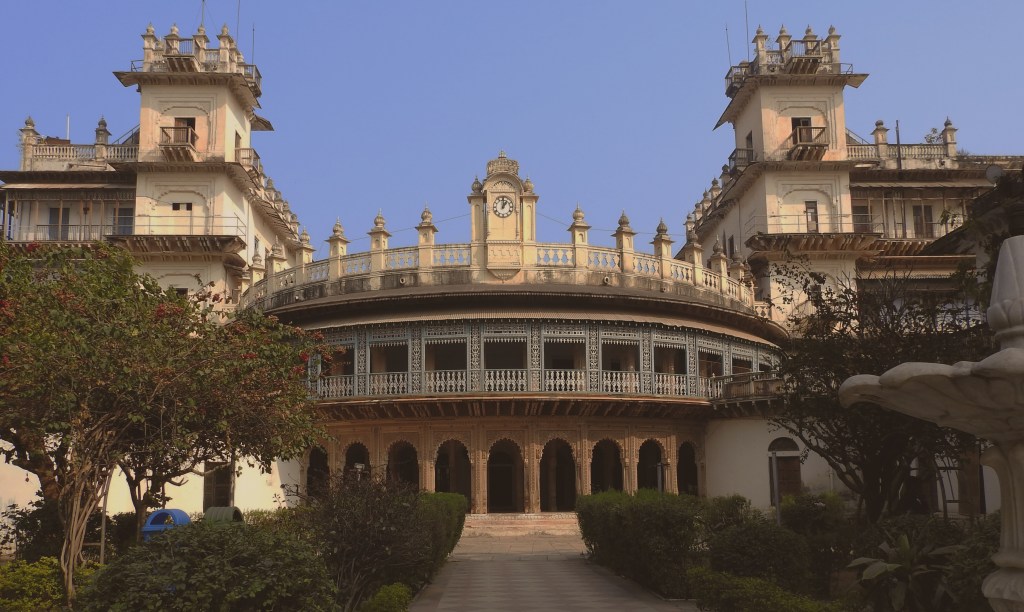
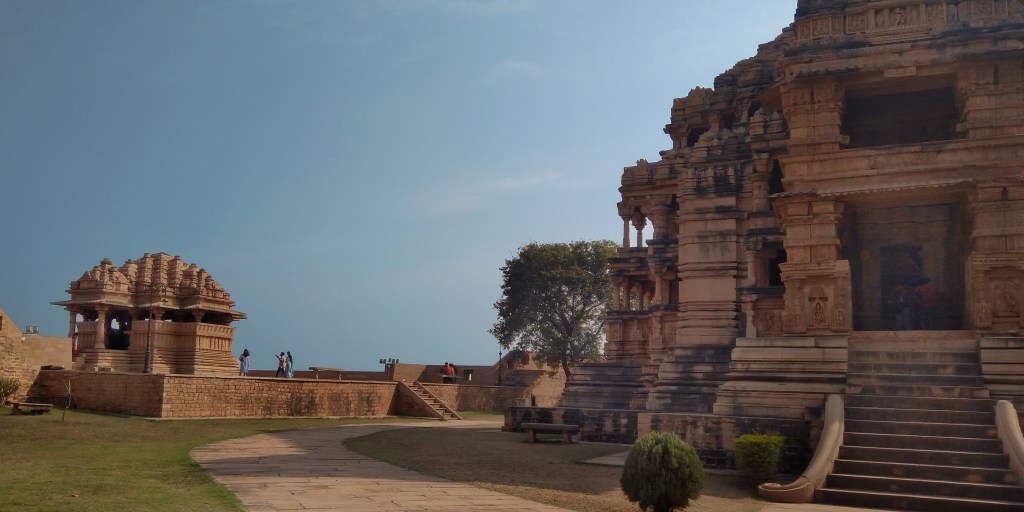
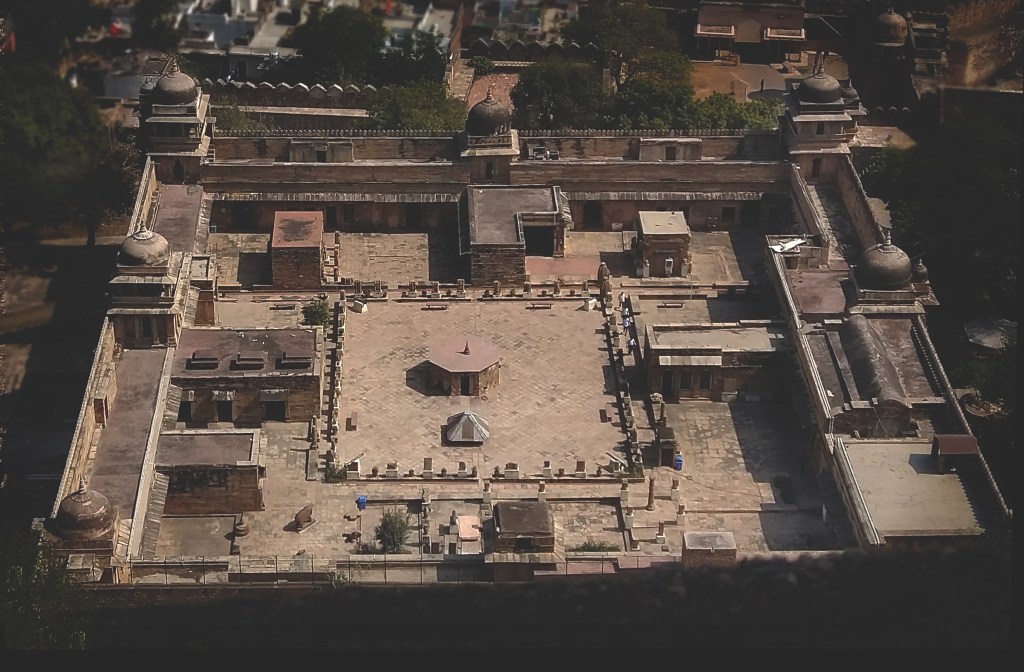
Gwalior has exquisite architectural gems built across various eras and built in different architecural styles. The first two structures here, are from the Lashkar part of the city of Gwalior. They are, Jai Vilas Palace (top left) & Moti Mahal (top-right). The ones at the bottom are the Saas-Bahu Temples (bottom-left) & the Gujari Mahal Archaeological Museum (bottom-right); both these are within the walls of the Gwalior Fort.
In stone, on paper, in paint, on walls. In the temple and in the museum, in the palace and in the fort…
…It was a joy to spot these duos, within the splendors of bygone.
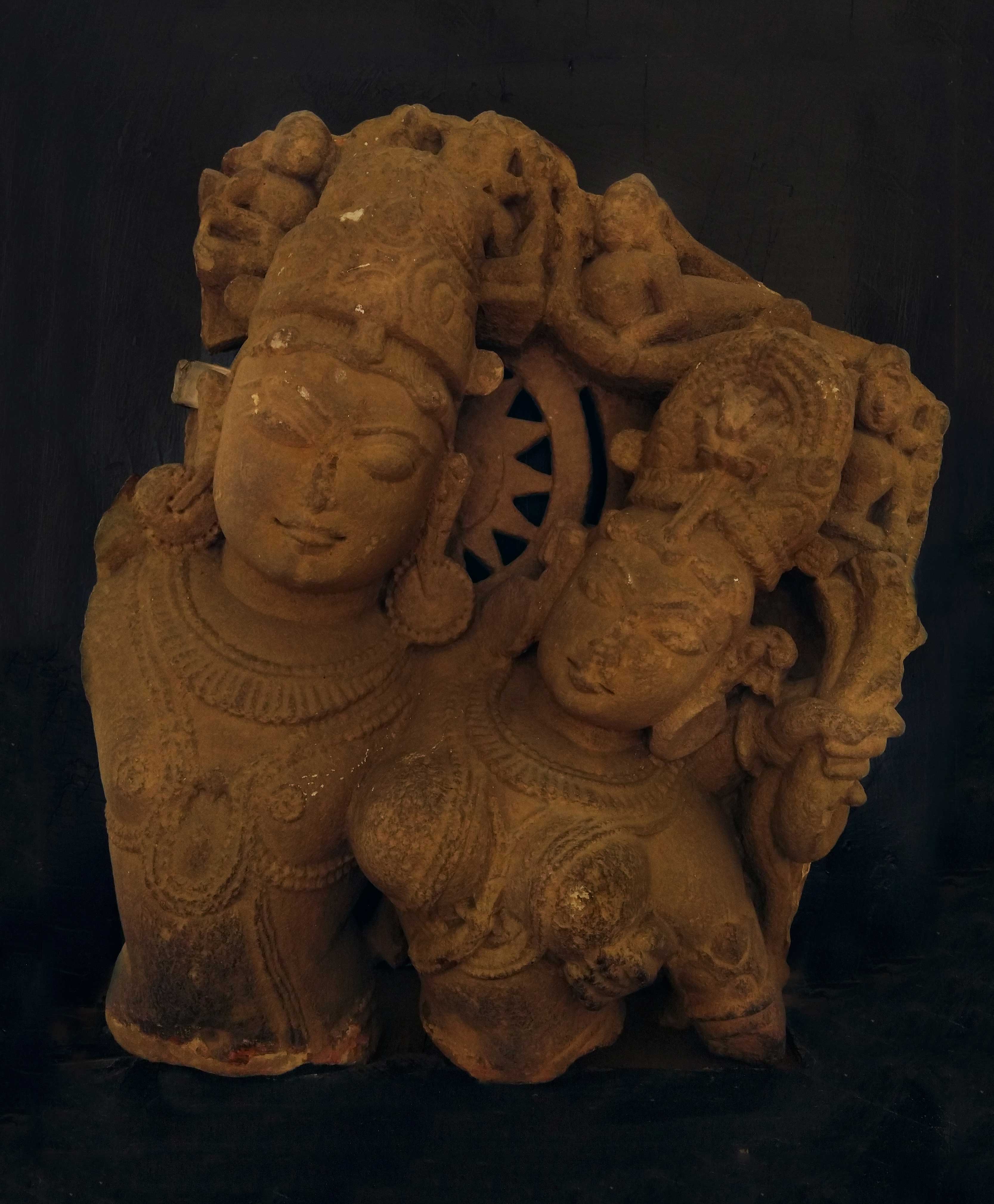
A Regal Embrace.

a tug by the side, a look into the partners eyes.
silent words...

This un-labled object in the Jai Vilas palace, portrays a royal couple in a moment of tender embrace.  Adorned with jewelry and crowned with elaborate headgear, the figures exude nobility. The sun-halo that frames the male figure's head hints at his divine association, reminiscent of deities in Hindu mythology.
Their poised demeanor and the subtle interplay of their gaze suggest a silent, intimate conversation, evoking the timeless grace of Uma-Mahesh and Laxmi-Narayan iconography.
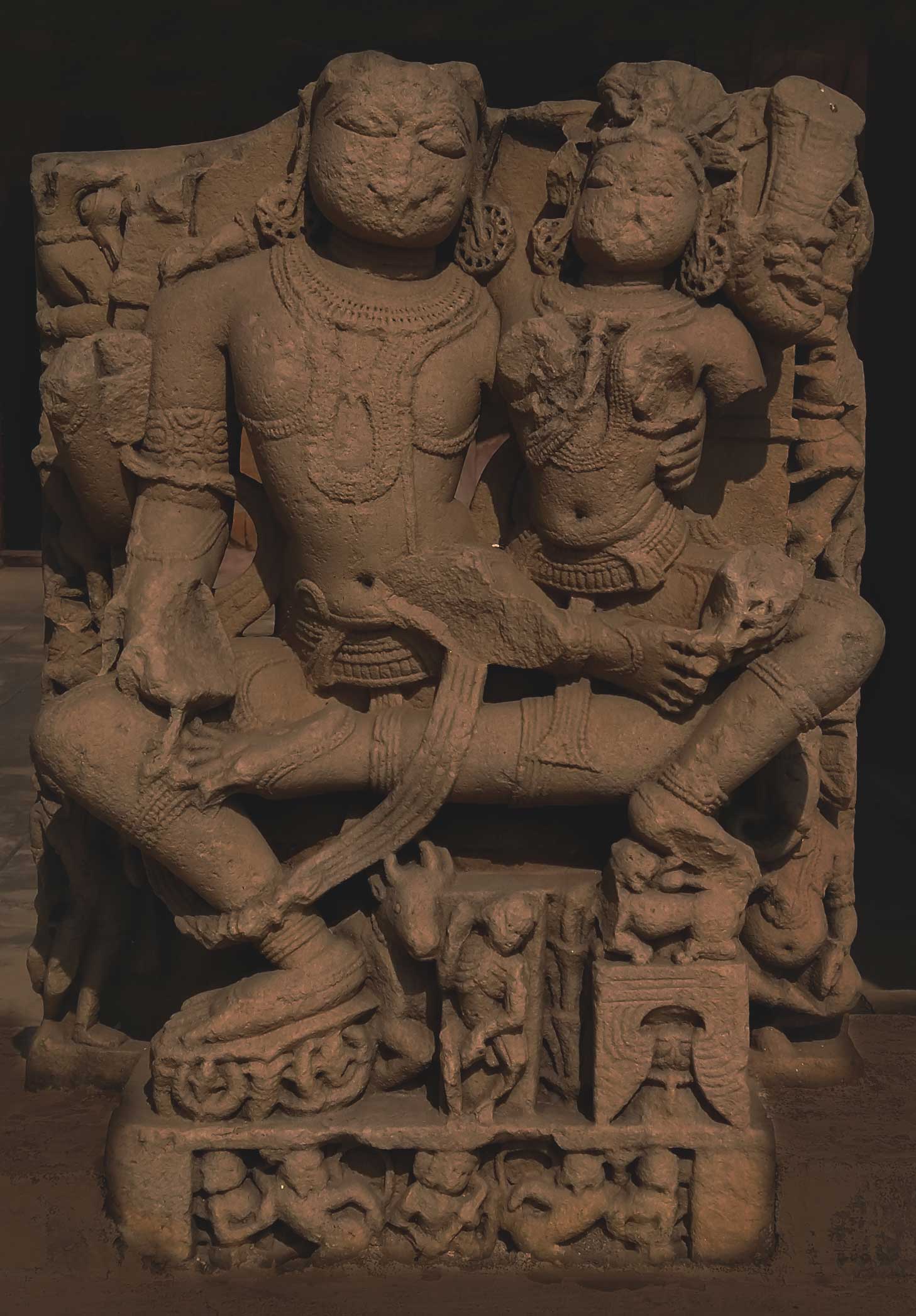
Shiv-Parvati, 12th-13th Century
at the Gujari Mahal Archaeological Museum, Gwalior Fort.

Representing Shiv-Shakti, Purusha-Prakriti; Shiva and Parvati are two principal deities in the Hindu pantheon. The usual iconographical features of this duo that are seen here are:
Seated in the sammukh mudra: facing each other lovingly.
In an aalingan: embrace.
While holding the kuca-sparsha: Shiva caressing Parvati's breast.
As they are in the atikarohana form: Parvati sitting upon Shiva's lap.
Their pendent feet resting upon each of their respective vahanas that crouch underneath them.
Shiva here, is seen holding his serpent in one hand, a body of a corpse is seen standing at the bottom of the composition (this too, a Shaiva association). There is a figure that is depicted at the right-bottom corner in the background. This could be a depiction of Skanda (usually depicted upon Parvati’s lap, but probably depicted here standing in background).
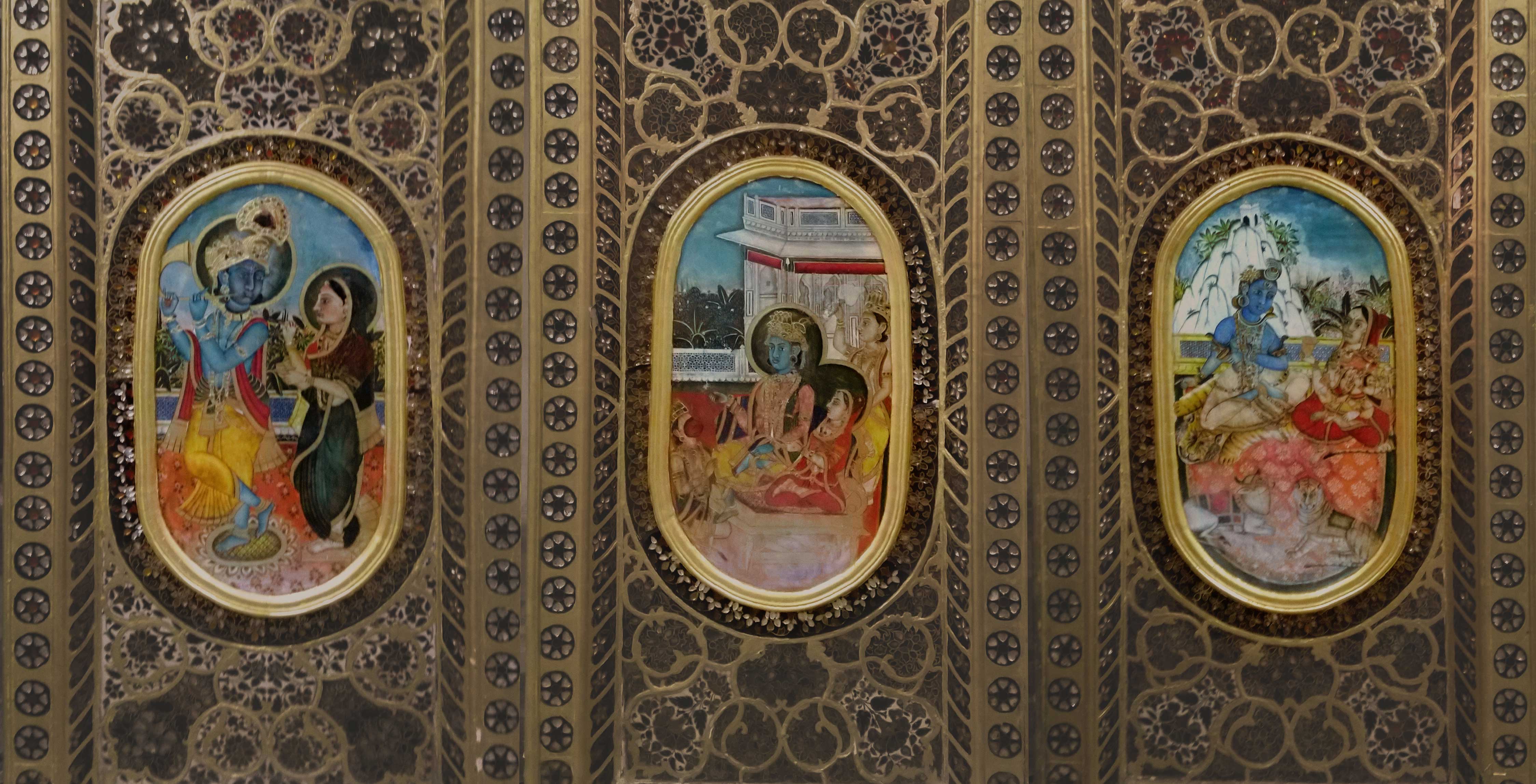
Bejewelled in Enamel Glass.

Panels, on the tall wainscot of the large columns at the Reception Hall of the Moti Mahal. The fourth column, not included here, is of Ganga.
The work on this room is said to have been conducted during the time of Madhavrao Scindia. The enamel glass mosaic work would have been commissioned to craftsmen and artists from Jaipur and reflect a Rajasthani aesthetic.
Krishna, Ram, Shiva; all rendered in blue.
Krishna is depicted with his features of a peacock feather on his crown. He stands with one leg bent in front of the other in the tribhanga posture, upon a lotus. Notice here, the flute is replaced here with an instrument like a trumpet.
Ram is seen, seated with Sita, Lakshman (probably) and Hanuman.
Shiva and Parvati are seen here, with Mount Kailash in the background, and their vahanas (nandi and the tiger, respectively) parked in the foreground.
In all three panels, all other figures are shown slightly smaller than the primary figures of Krishna, Ram and Shiva. The standard anatomical proportions here been tweaked and the heads/faces have been shown as larger than the rest of the body.
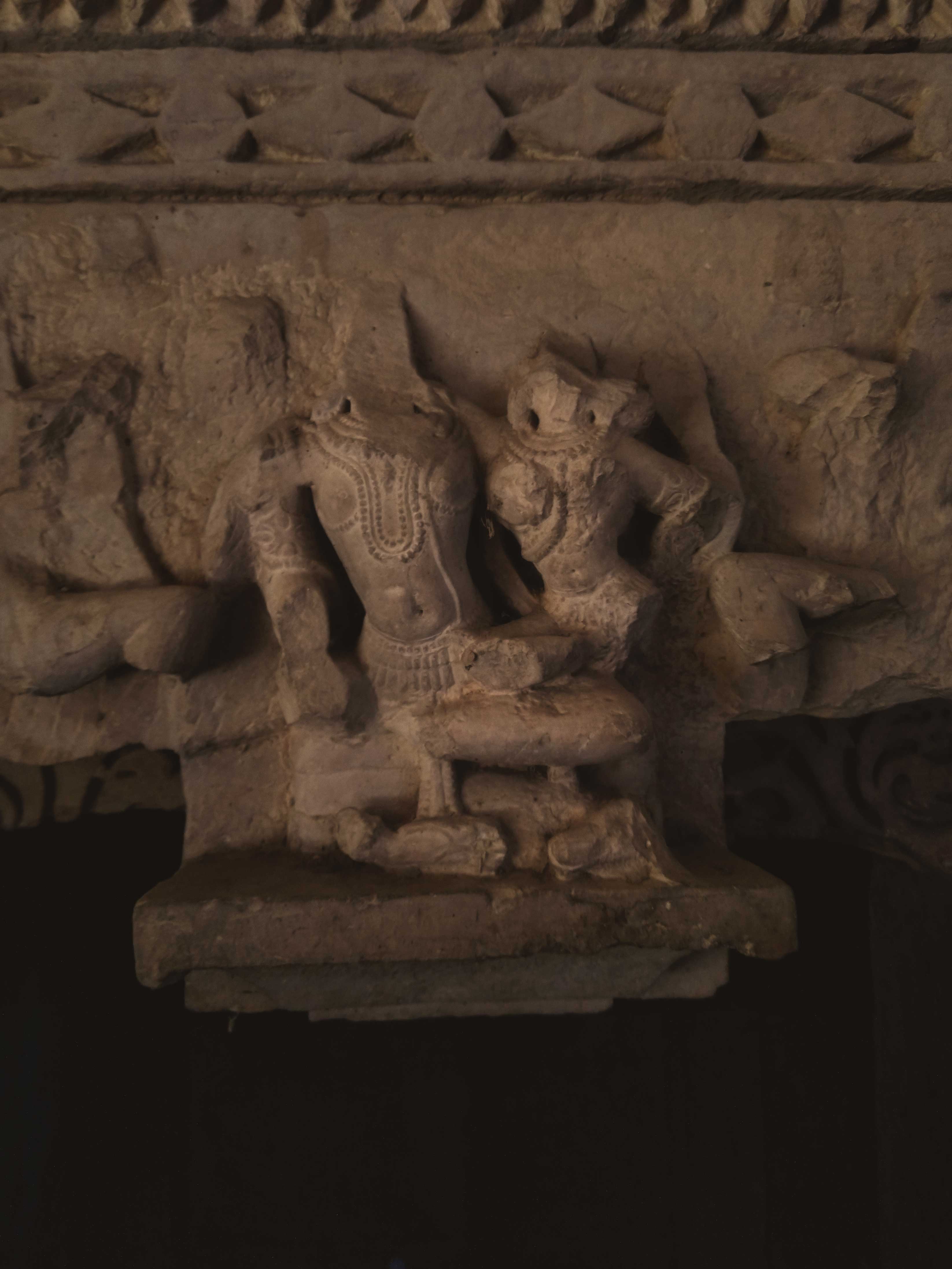
Couple on the door lintel at Saas-Bahu Temple Complex
Though the sculpture has been defaced or mutilated, they appear to be gracefully positioned, and appear to be, almost in a gliding movement...
The twin-temples, popularly known as the Saas-Bahu temple complex is dedicated to Vishnu. So, just like the sculptural depiction seen earlier, of Shiv-Parvati; this could possibly be a depiction of Lakshmi-Narayan.
It is said that the name of the temple, originally was Sahasra Bahu, in reference to the thousand-armed Vishnu. As the temple was built by the mother-in-law - daughter-in-law duo, it became known by the name Saas-Bahu.
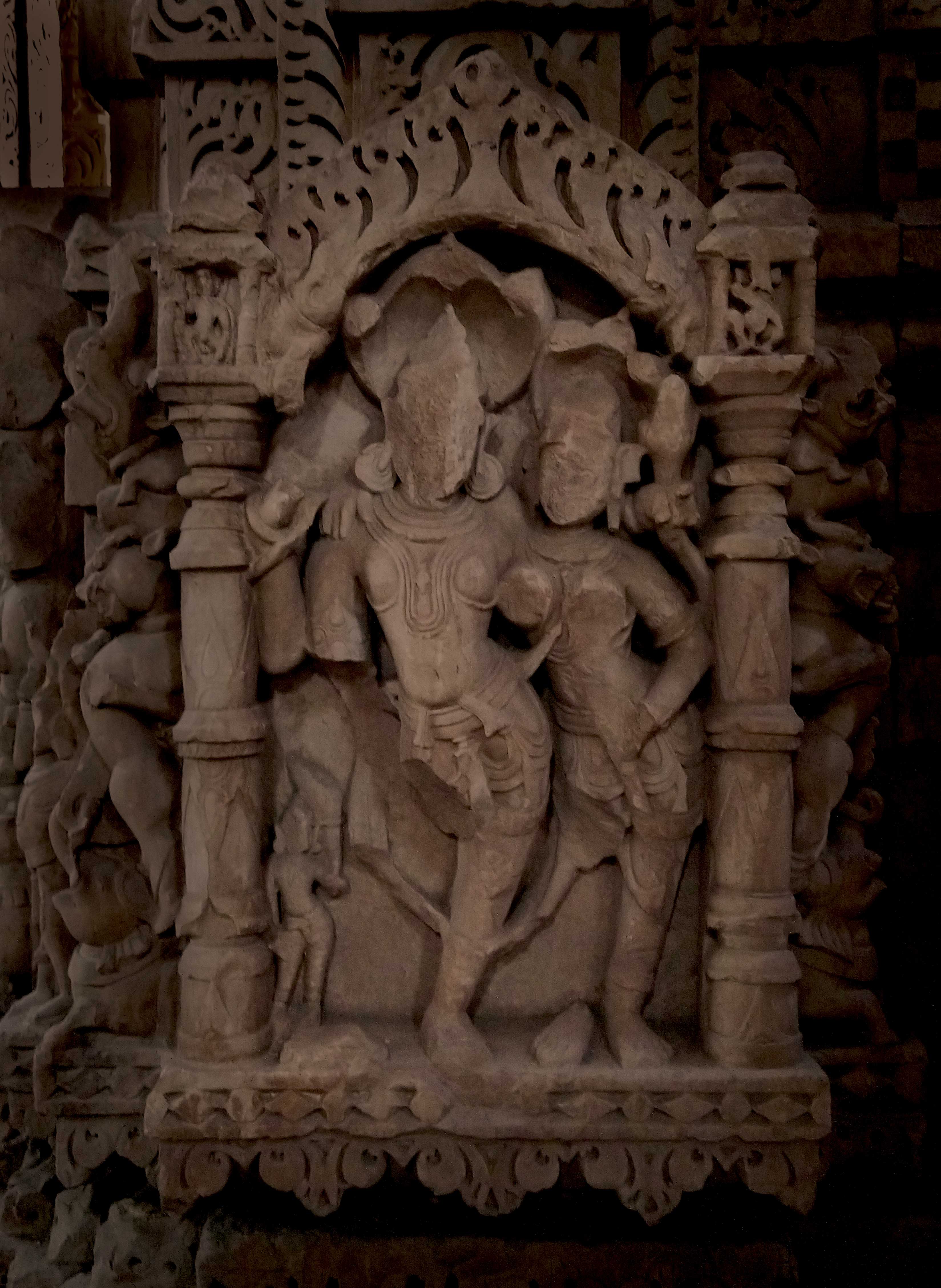
Snake-hooded Couple,
on a column of the Saas-Bahu Temple, Gwalior Fort.
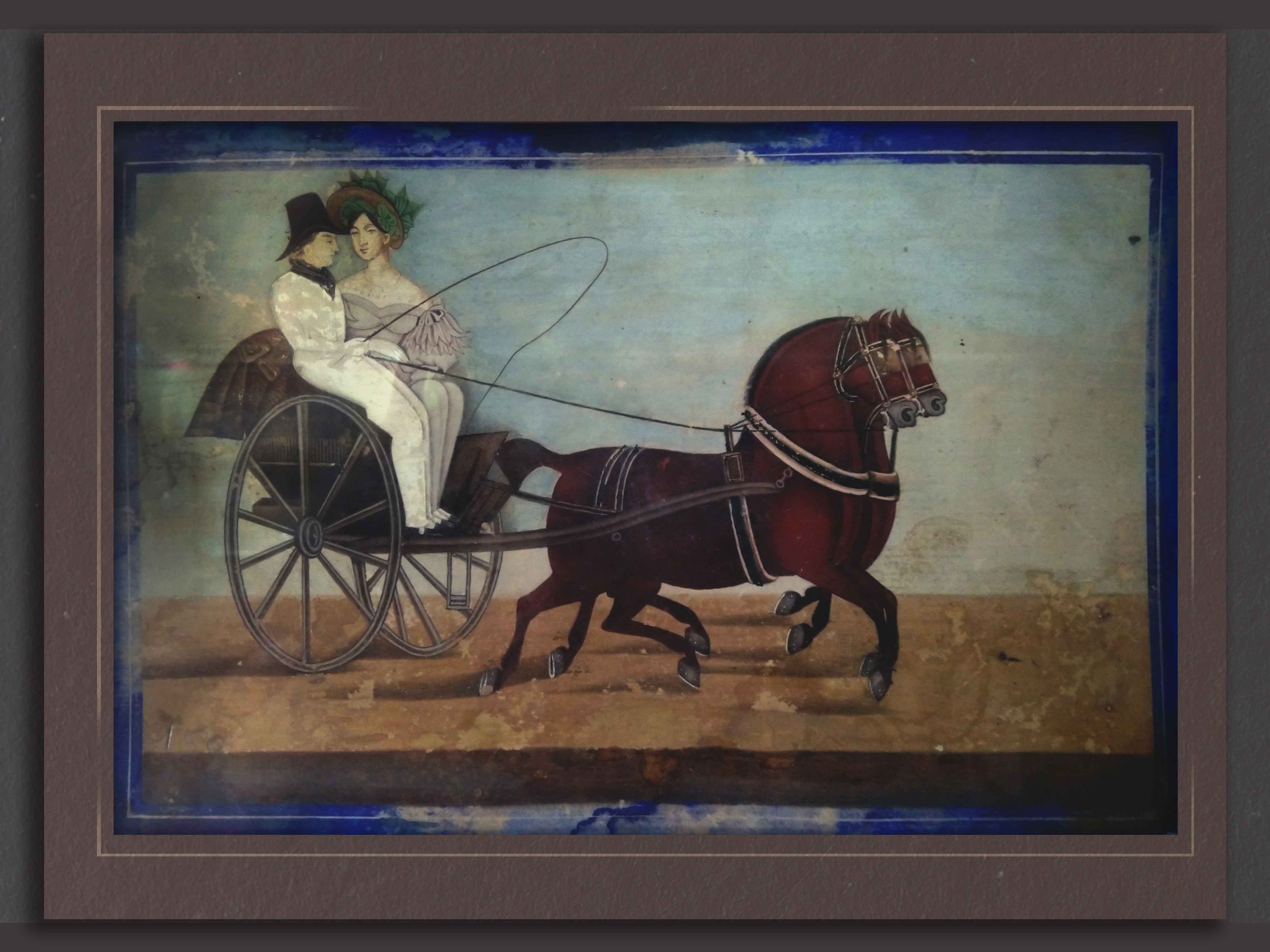
British Couple, 19th Century, watercolor on paper
at the Gujari Mahal Archaeological Museum, Gwalior Fort.

Elegantly seated on a two-wheeled horse-drawn carriage, a European couple; set against the light blue sky.
The style of painting, resembles that of the Company Painting. The Europeans who worked in the East India Company would be patrons for such paintings. These paintings combined elements from the pre-existent miniature painting styles; with the more western treatment and application. The layering of soft transparent textures,  the use of a broad base-plane as ground and the use of liner-perspective that is seen through the wheels and the horses' hoofs.
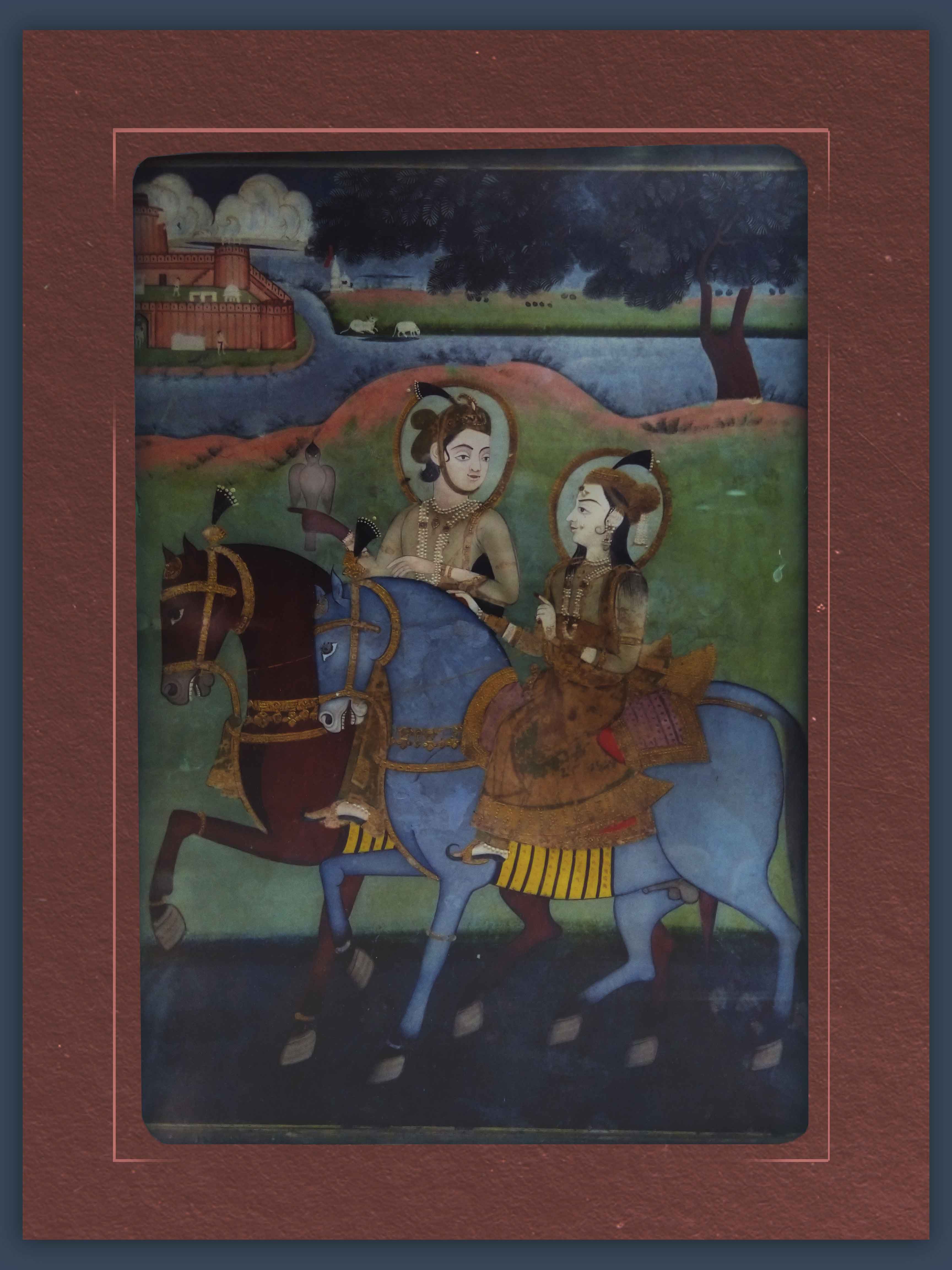
Baaz Bahadur with Rani Roopmati, 18th Century, Malwa School
at the Gujari Mahal Archaeological Museum, Gwalior Fort.

Baaz Bahadur, the very last Sultan of the Malwa Sultanate. He is most known for his romantic relationship with Rani Roopmati, a renowned singer and poet. Both lovers here, are depicted on horseback.
The word ' Baaz' from the king’s name refers to a hawk or a falcon. It is a bird, often associated with great virtue and nobility. The Sultan here, is depicted holding the bird in his hand, which is a symbol of his character as a ruler and a metaphor for his persona as warrior.
The scene in the background, could be that of the royal structure of the medieval city of Mandu, in Madhya Pradesh. Rich in heritage, Mandu has Baaz Bahadur's and Rani Roopmati's palace and pavilions. Raani Roopmati's Pavillion is perched upon a hill above the Narmada River and Baaz Bahadu's quarter has a view of his lover’s pavilion.

Amourous Couple
on the outer walls of the  Saas-Bahu Temple Complex

Kamdev - Rati, 11h - 12th Century, Shuniya District, Morena
at the Gujari Mahal Archaeological Museum, Gwalior Fort.

Kamadev is regarded as the Hindu deity of sensual love, desire, pleasure, and beauty. His companion and feminine counterpart, Rati, is the Hindu goddess of love, passion, and sexual pleasure. Both refer to sensuous satisfaction and sexual love. The root of the word 'Rati' is ram, which indicates happiness or delight. The root of Kamadev is kama, which implies desire or longing.
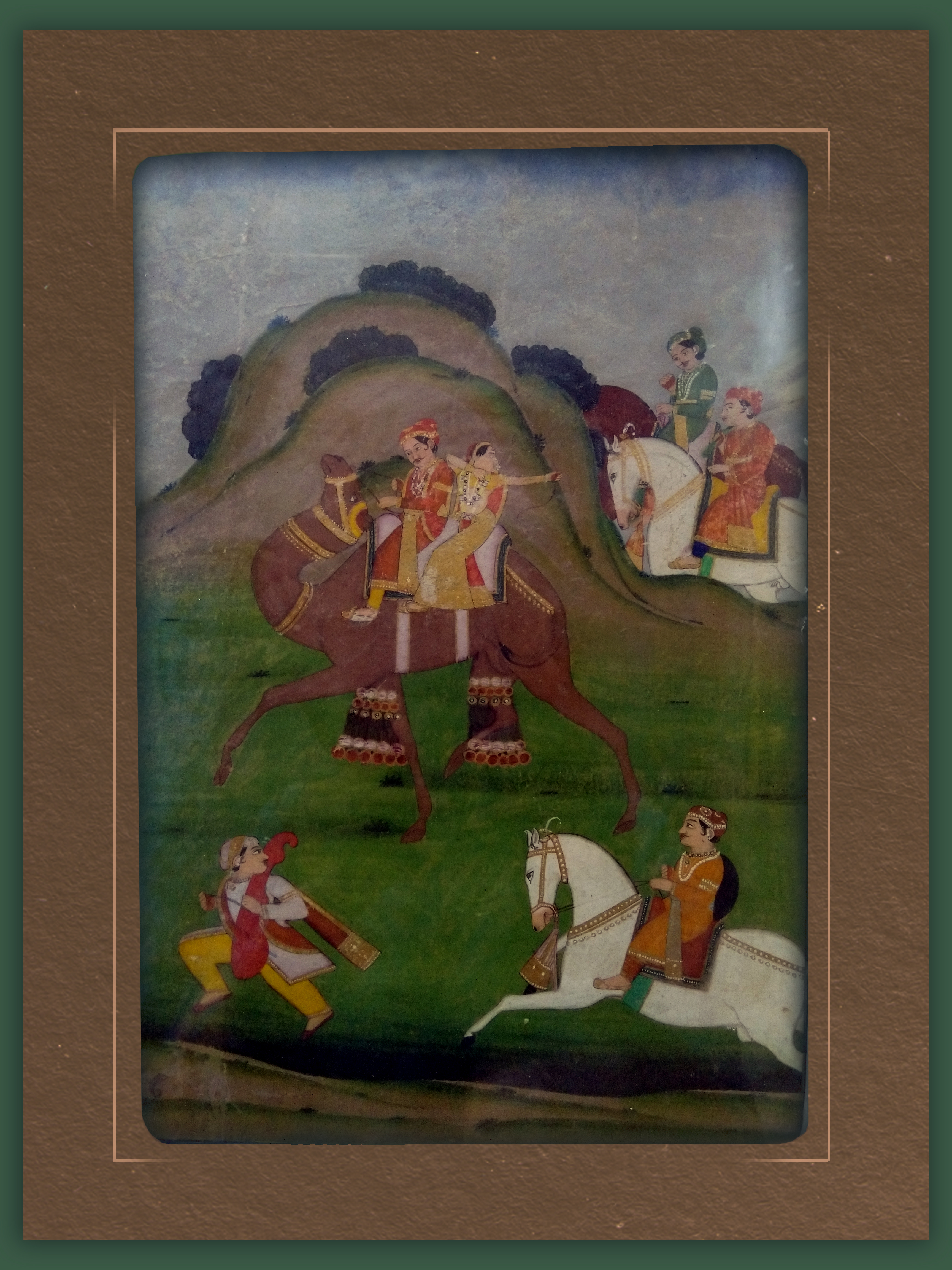
Rani Roopmati and Baaz Bahadur , 18th Century, Malwa School
at the Gujari Mahal Archaeological Museum, Gwalior Fort.

This miniature shows Rani Roopmati and Sultan Baaz Bahadur seated on a camel amid a chase. Rani Roopmati has her hand outstretched shooting a bow-arrow as the rest of the individuals of the scene are on horseback spread across the landscape.

Indian Aesthetic Theory has nine rasas, out of them two – those of Shringar and Veer – are seen through this painting. Shringara Ras is also known as the rasa of love and beauty. It encapsulates the essence of passionate love and aesthetic pleasure, representing the union of the individual and the divine. Veer Ras, on the other hand, is the rasa of courage and valour, distinguished by a fiery zeal and a spirit of heroism. It is related with the energy and fortitude required to overcome obstacles and fights.

The story of both these lovers has had its own ups and downs, and the threads of Shringara and Veer Ras intertwines delicately through their story. The landscapes of Mandu saw the union of their hearts across the cultural divides as they face the many adversities. This painting not just echoes love but stands as a symbol of courage and valour in the face of overwhelming odds.
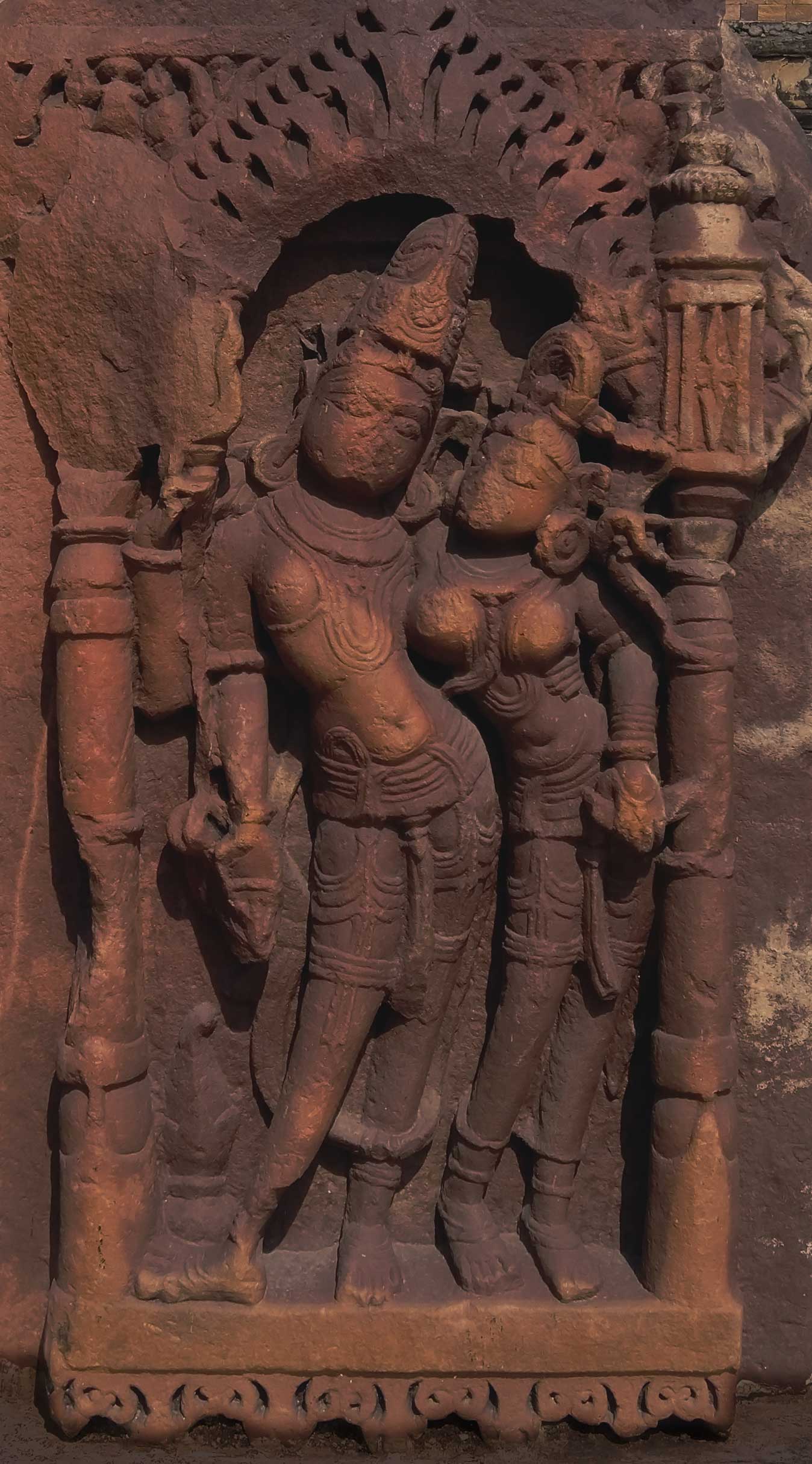
Uma-Maheshwar, 13th Century, Gwalior
at the Gujari Mahal Archaeological Museum, Gwalior Fort.

The standing statue of Uma-Maheshwar depicts the celestial union of Goddess Uma (Parvati) and Lord Maheshwar (Shiva). Maheshwar is four-armed, holding a tident with one hand and patting his vahana nandi with the other. One right hand is on Uma's shoulder, while the other is wrapped around her waist.
Lord Shiva stands calmly, holding a trident, while Goddess Parvati looks fondly at him.
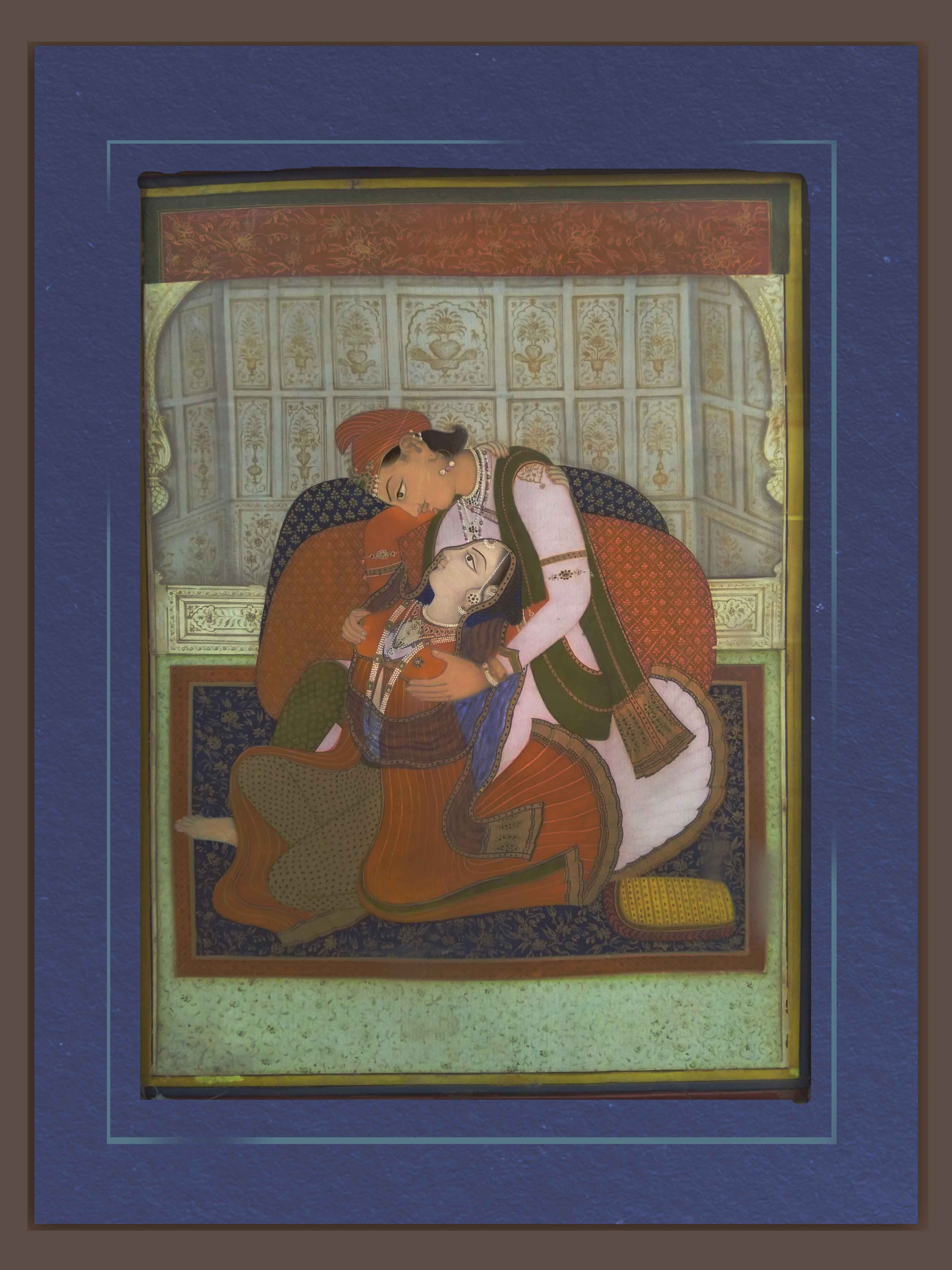
Pair of Lovers, 19th Century, Mughal School
at the Gujari Mahal Archaeological Museum, Gwalior Fort.

Mughal miniature paintings frequently show themes from court life, nature, and mythology, using a unique combination of Indian, Persian, and Islamic traditions.

In this artwork, lovers are in a tender embrace, with the male figure cradling the female breasts and the female reaching out her arms to pull her beloved closer. Both have their gazes fixed on one other as they enjoy this time in a private quarter of a palace. Beautiful Mughal-Rajput-style panels can be seen in the background, similar to those seen in palaces and harems of the time.
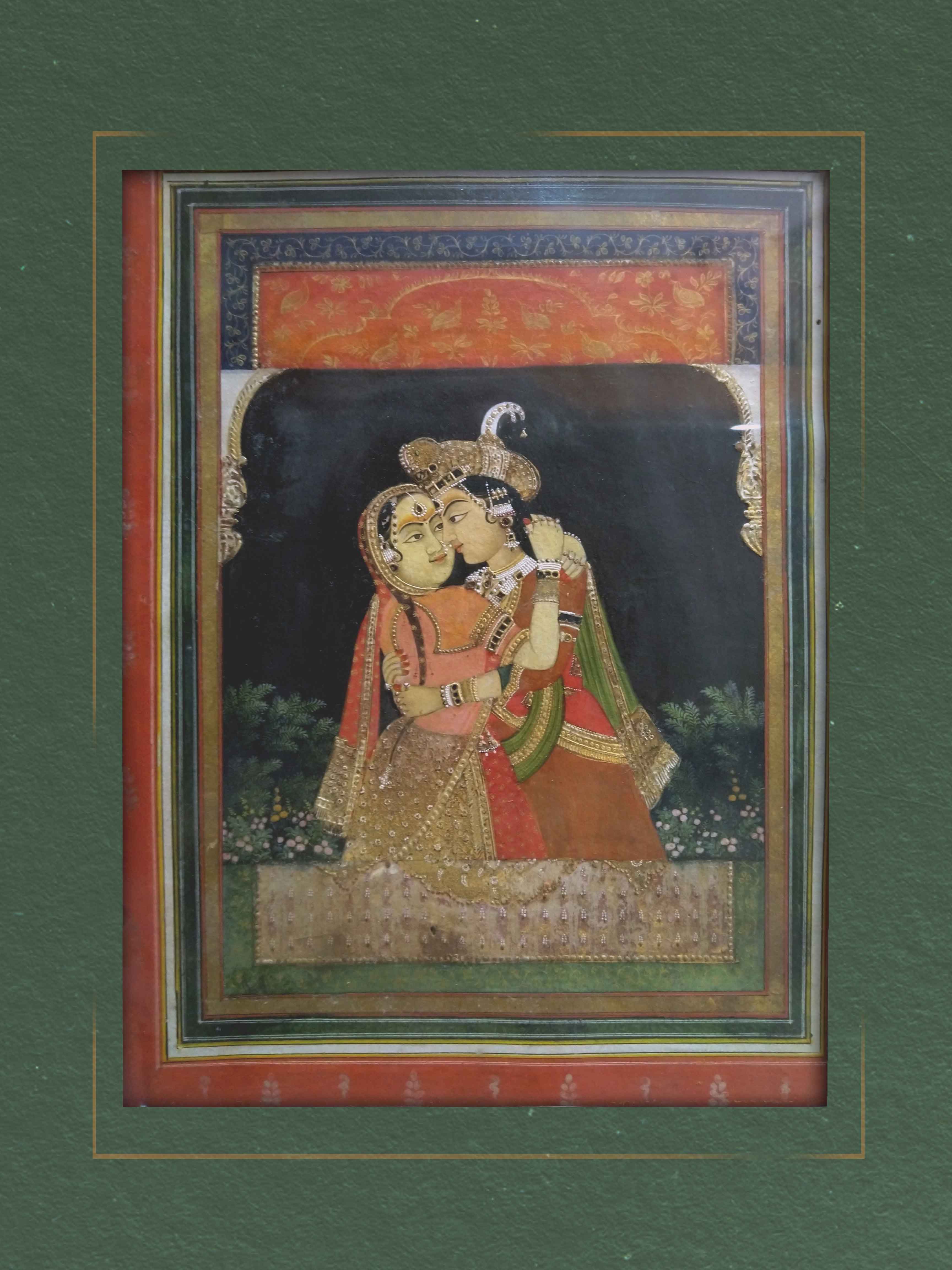
Radha Krishna, 19th Century, Rajput School
at the Gujari Mahal Archaeological Museum, Gwalior Fort.

Considered to be the epitome of love in Hindu mythology; Radha represents the solul's intense longing for the divine, embodied by Krishna.
It is late evening, and  the embelished couple is in an embrace. The Rajput artists were inspired by the Mughal artistry which is scene in the similarity in the compositions of this painting and the 'Pair of Lovers' painting above. The use of intricate details, portrayal of royal and idilic landscapes and the vibrance of the characters portrayed; are all part of the nineteenth century rajput paintings. The addition of the slightly extruded details in gold could be a Rajasthani touch. Radha is considered the embodiment of love in Hindu mythology; she embodies the solul's passionate yearning for the divine, which is represented in Krishna.
It is late evening, and the brilliant couple is in an embrace. The Rajput artists were inspired by Mughal artistry, as seen by the compositional similarities between this painting and the 'Pair of Lovers' painting above. The utilisation of fine details, the depiction of regal and idilic settings, and the vibrancy of the individuals portrayed are all features of nineteenth-century Rajput paintings. The insertion of slightly extruded gold accents may be a Rajasthani touch.
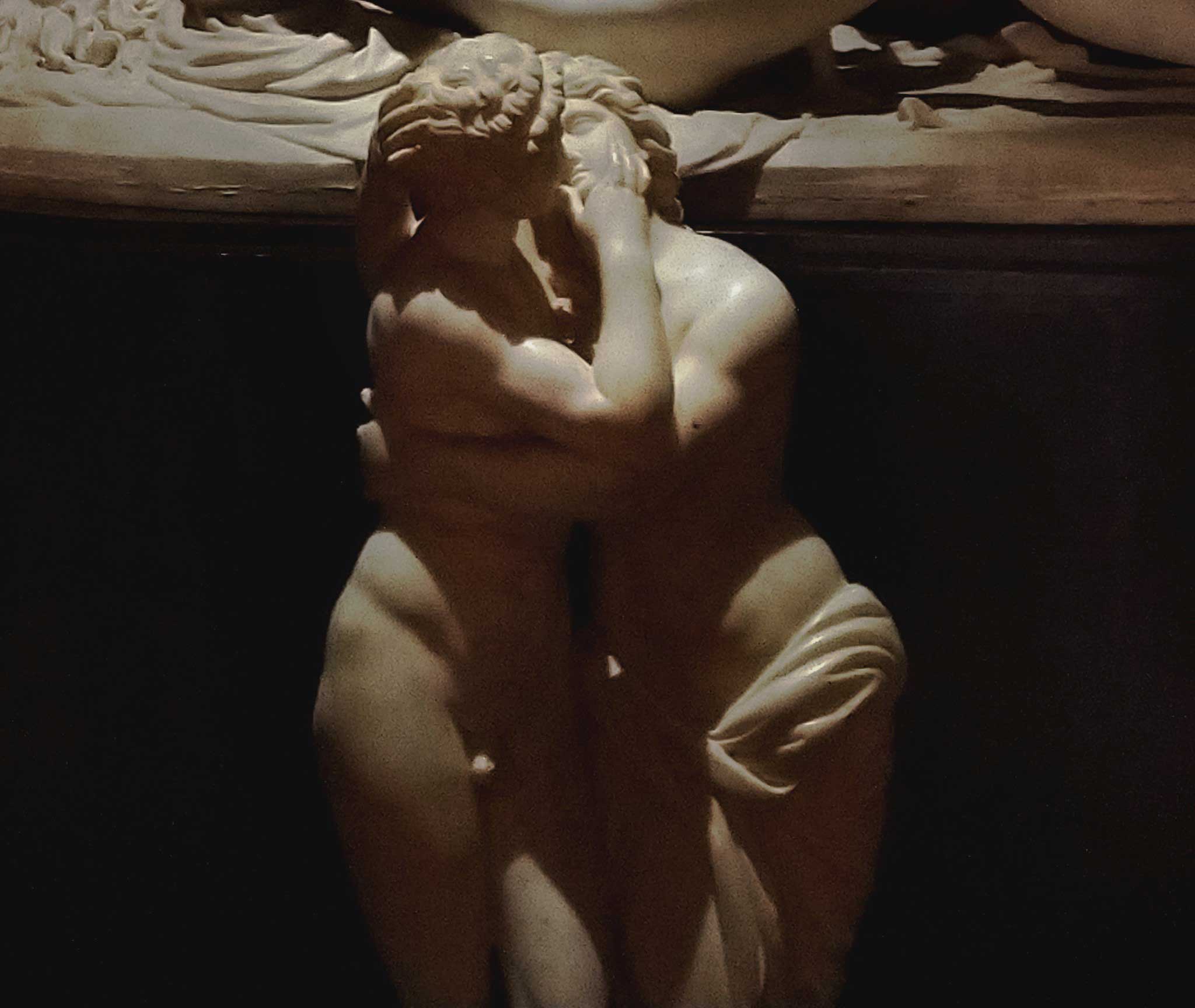
Kiss of Psyche and Cupid, Neoclassical Collection, at the Jai Vilas Palace.
Psyche was so beautiful that Venus got jealous and sent Cupid to curse her. Instead, Cupid fell in love with Psyche. They went through tough times, but in the end, Cupid's kiss woke Psyche up, showing that love is strong and can get through hard times.
Love, Romance, Beauty & Playful Mischief…
…śṛṅgāra rasa in all.
So much for now . . . more to come!


 प्रा
प्रा 