The Hoysala Dynasty, which reigned over medieval Karnataka, left a mark on history through its rich legacy of art, architecture, and temples. The two key sites that stand as testaments to their cultural and artistic prowess are located in Belur and Halebidu. These sites serve as living reminders of the Hoysala Dynasty’s exceptional craftsmanship and aesthetic sensibilities. The intricate carvings, delicate sculptures, and magnificent temples continue to captivate, offering a glimpse into the splendid heritage of the region.
HOYSALA DYNASTY
The Hoysala Dynasty governed regions situated in the southern region of Karnataka state, in southwestern India, from the 10th to the 14th centuries. Their dominion extended even into present-day Tamil Nadu.
During this medieval epoch, the Hoysala dynasty made significant contributions to the advancement of religion, literature, art, and architecture in South India.

The Legend of Sala
Formation of the Empire and the Royal Emblem
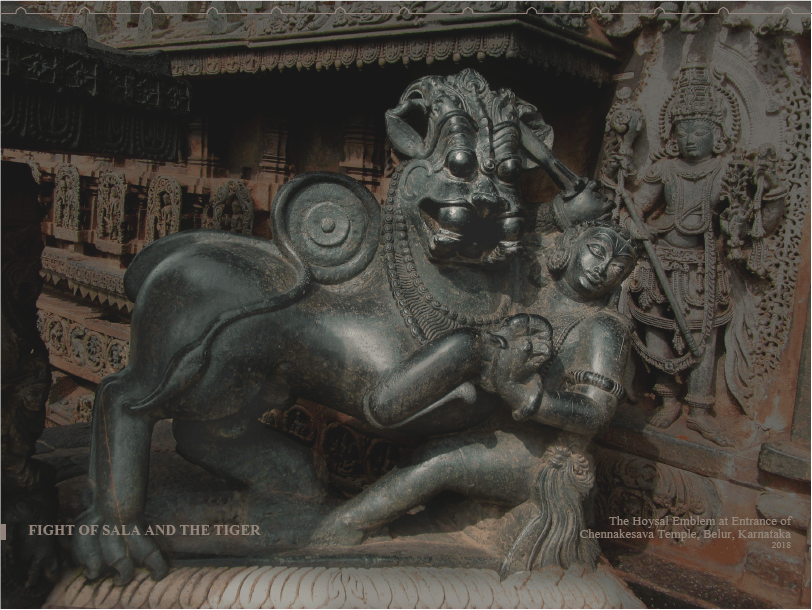
Once upon a time, Sala, the legendary hero and hunter, found himself in the thick of a forest, deep in devotion and penance. Suddenly, his peaceful prayers were rudely interrupted by a fierce tiger.
Without skipping a beat, Sala grabbed a slender rod and his devoted Guru exclaimed, “Poy, Sala!“ or “Hoy, Sala!” (which means “Strike, Sala!“ or “Kill, Sala!” in the Kannada language). And Sala did just that!
The tiger was slayed and Sala went on to establish the mighty Hoysala Dynasty. The tiger in this narrative is also considered to be a Chola symbol and Sala fighting the Tiger signifies the victory of the Hoysalas over the Chola rulers.
This narrative form of ‘slaying of the tiger’ became the royal emblem of the Hoysala Kingdom, appearing in sculptural form in temples across their kingdom. [The image along this section shows one such large statue at an entrance of the Chennakeshava Temple at Belur.]
Sacred Ensembles of the Hoysalas
The “Sacred Ensembles of the Hoysalas” comprises a trio of ‘Hoysala-style’ temples located in South India. Their inclusion in the list of UNESCO World Heritage Sites took place in 2023. Belur, Halebid, and Somanathapur are the three towns whose temples, which date from the 12th and 13th centuries under the time of the Hoysala Empire, constitute this ensemble.
-: Two Hoysala Towns & their temples :-
The Hoysala dynasty is responsible for temple architecture in the state of present-day Karnataka. These are seen at two important places : Halebidu and Belur. Both are now part of the Hassan district.
Halebidu
This place used to be called Dorasamudra/Dwarasamudra, which referred to a large waterbody built by the Rashtrakuta dynasty. It was the Hoysala capital. After it was abandoned, it became known as ‘Halebidu’ or Old Town, because it reminded people of the old royal camp (bidu). It is home to one of the earliest Hoysala Temples dedicated to Shiva.
Belur
Not too far from Halebidu, Belur too once served as the capital of the Hoysala empire. The Hoysala ruler referred to this town as the “earthly Vaikuntha” (Vishnu’s abode) and also as “Dakshina Varanasi” (southern holy city of Hindus). This little town is where the Hoysala rulers built a Vishnu temple complex.
HoysaleshwarA Temple, Halebidu, Karnataka
This is a temple dedicated to Shiva, built by Ketamalla, an officer of Vishnuvardhan around 1121 C.E. The temple complex is called as Hoysaleshwara (Hoysala + Ishwar = Lord or Ishawar of the Hoysala). This name itself marks the royal connection of the temple.
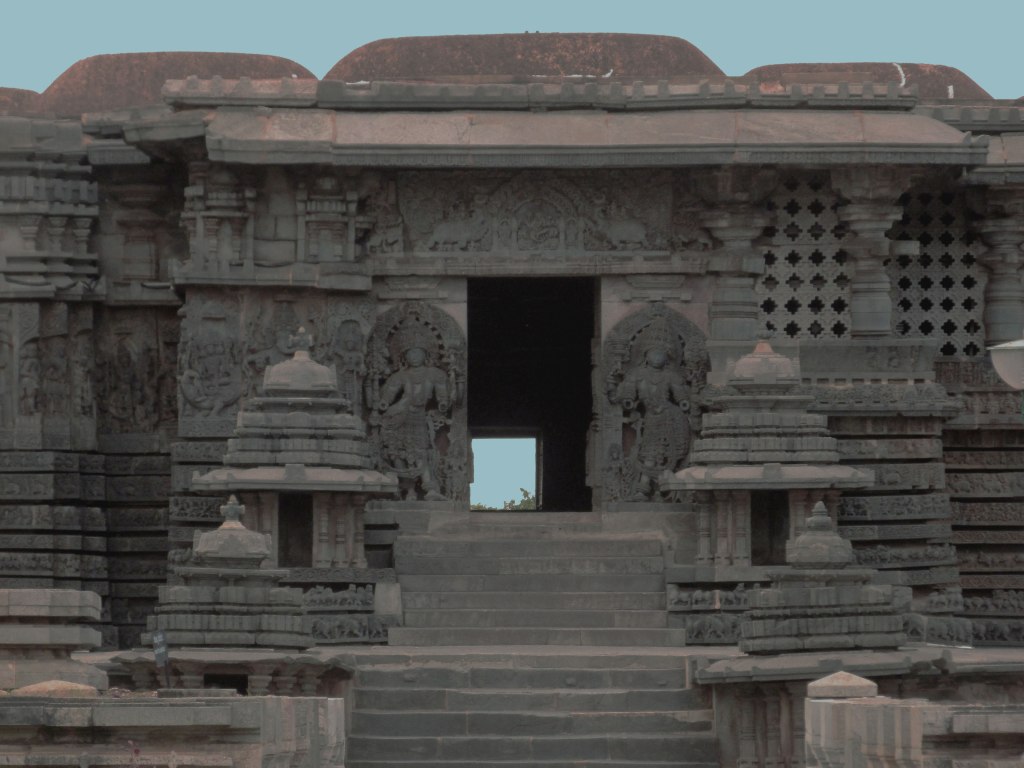
This temple complex contains two sanctums, each with their respective temple components (vestibule, navrang hall, and bull/nandi mandapa). The twin temples are associated with king Vishnuvardhan (Hoysaleshwara) and his chief queen Shantala (ascribing this second temple as Shantaleshwara).
Chennakeshava Temple, Belur, Karnataka
The main temple at Belur is the Chennakeshava Temple built by King Vishnuvardhana to celebrate the victory against the Chola rulers. It was consecrated in 1117 C.E. Vishnu being the central deity this temple is dedicated to his form as Keshava. Chennakeshava literaly means “handsome Keshava”.
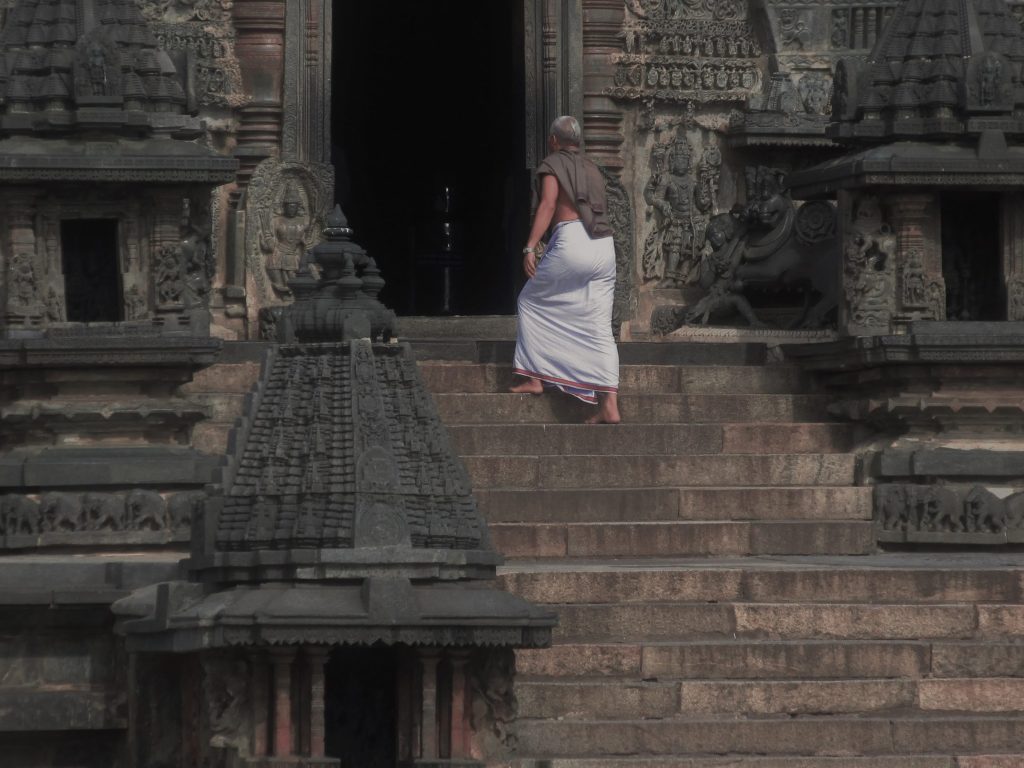
This is an active temple since its consecration and forms an important Vaishnava place of worship. The courtyard of the temple is filled with multiple shrines.
-: Hoysala temple aesthetics :-

The temple consists of the following coponents: (mentioned here, are few; begining from the bottom)
- Adhishtana : The temple is built on a five-feet high base or adhishtana platform or plinth that contours closely around the temple.
- Jagati and Pradakshinapath : The raised platform or jagati foms a place for externally circumambulating the temple forming the pradakshinapath. [As seen in the earlier images of the temples, one flight of steps leads to the raised platform (jagati and the external pradakshinapath) and another flight leads to the temple enclosure or mandapa. Each doorway is flanked by dwarapalaks.]
- Sculptural Friezes : These are in form of horizontal bands that zig-zag around the temple walls. They are a series of sculptural images that include elephants, lions, veins, horses, narratives, makaras, hamsas, and so on (explained in detail ahead).
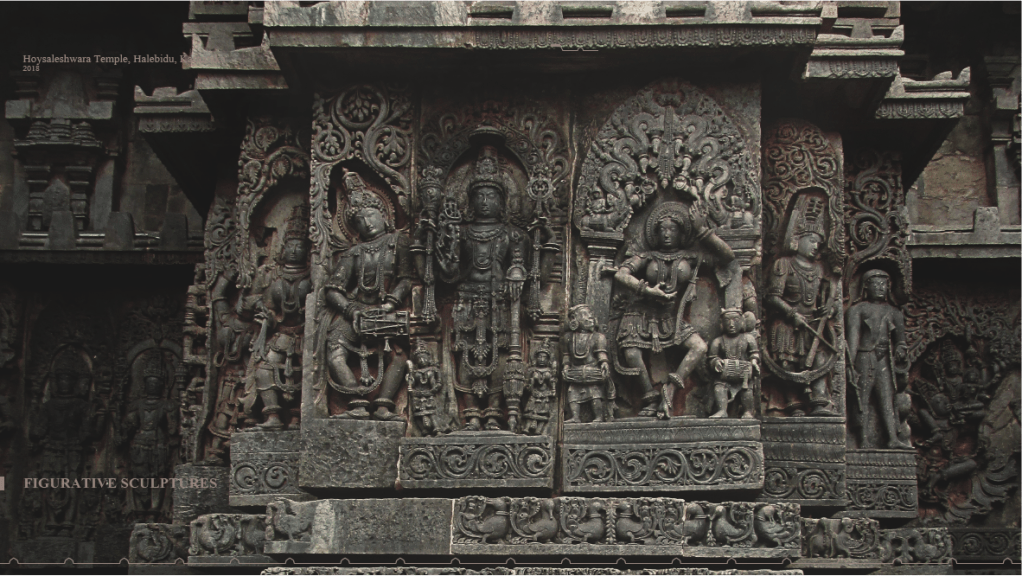
- Figurative Sculptures : A metre and a half of huge figural images of deities, dancers, and celestial beings, each carved in high relief and framed in a distinctive manner.
- Series of Temple Pillars : The uppermost level contains images depicting temple towers, and turrets.
- Temple Eaves : supported by pillars separated by brackets (shown in an image ahead) that support the temple’s eaves.
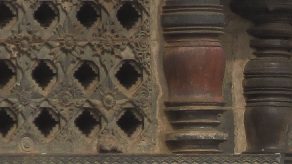
- Lathe Pillars : These bulbous lathe pillars appear on the boundry (and also inside the temple walls).
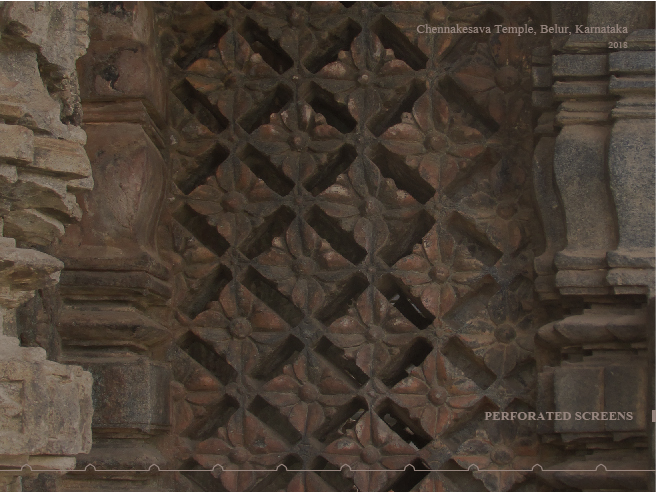
- Perforated Screens: These pillars are interjected by perforated stone screens that let in the sun to the interior spaces.
The temple is made of green schist (soapstone). Soapstone is easy to carve, long-lasting. This stone is soft when it’s first taken from the quarry, but it becomes harder over time. Skilled craftsmen used this property and their expertise to create detailed images.
Sculptural Friezes & Figurative High-Reliefs at the Hoysaleshwara Temple
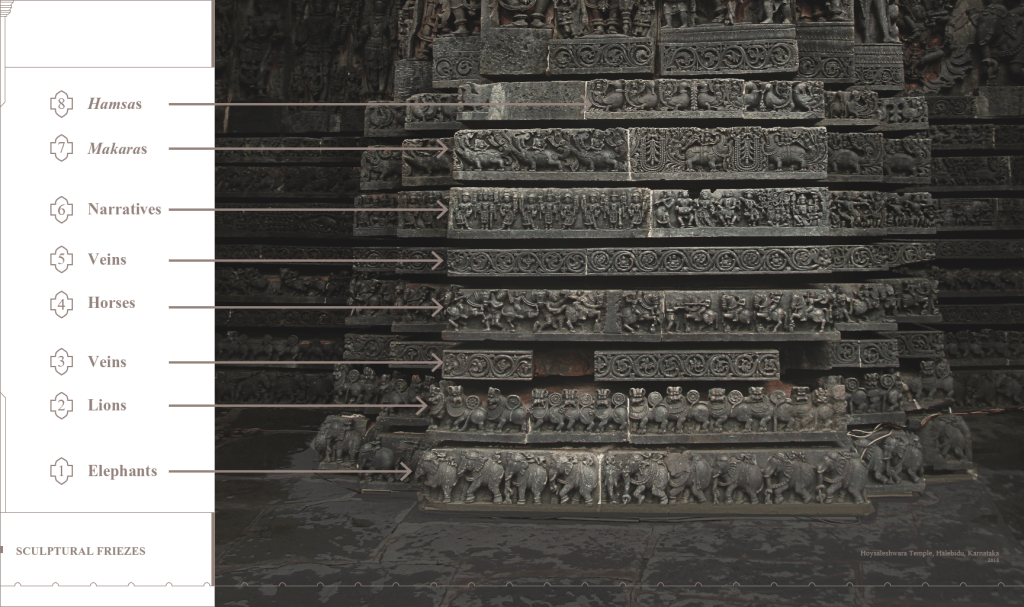
The lowermost band shows a series of marching elephants, the next layer is a series of stylized lions, above which are scrolling vines that twirl across.
The next layer shows a line-up of horses. There are horsemen charging across depicting the cavalry on the battlefield.
The scrolling vines reappear and then the layer of narrative imagery from the Indian epics: the Ramayana, the Mahabharata, and the Bhagvata.
Above this layer of dramatized episodes is a row of makaras, which are mythical sea-creature in Hindu mythology. These creatures are a blend of crocodiles with long trunks and tusks. Makaras are considered to be vahanas of various river godesses in India. This band also contains riders along with fanciful floral patterns.
The topmost horizontal band in the sculptural friezes is a row of swans or hamsas. They symbolize the extraction of good from evil and are also the vahanas of few significant deities.
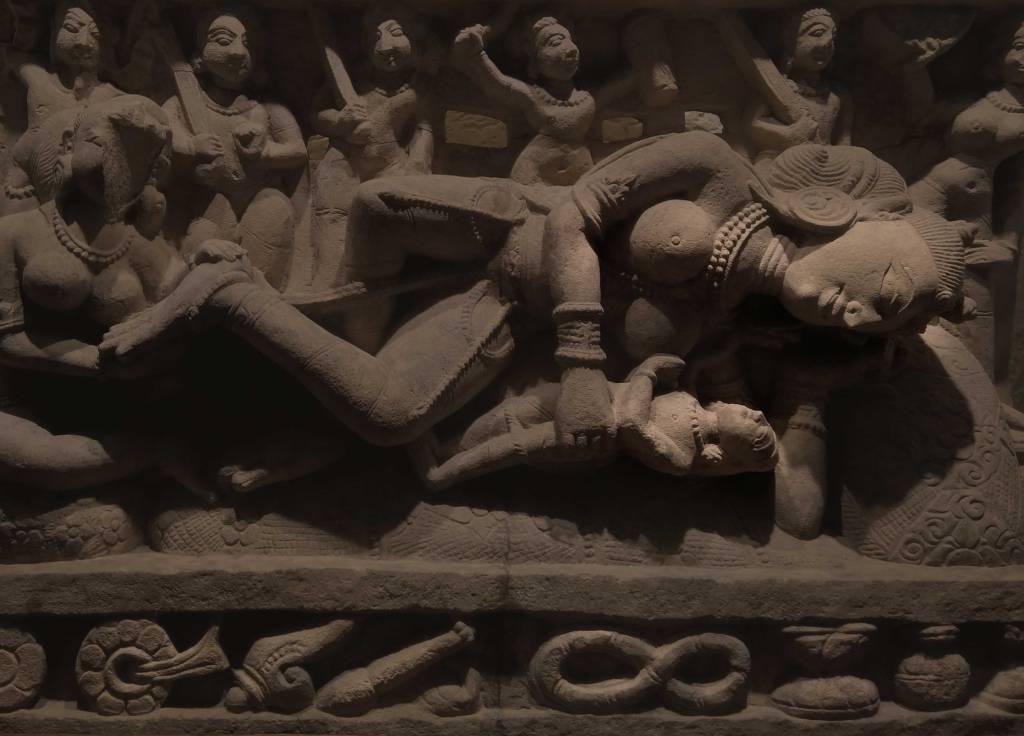
Right above the Sculptural Friezes are the Figurative Sculptures. These are large slabs of stones, sculpted in high-relief. They have the scrolling vines at their base and display depictions of gods, goddesses, musicians, dancers, and depict various stories. These sculptures are heavily ornamented with icons and intricately carved jewelry. They adorn various head-gears, postures, beads, long tassels, malas in the neck and on the chest, girdle ornaments, anklets, earrings, bangles and various ayudhas.
The craftsmanship is truly exquisite, reminiscent of the captivating visuals found within the Baroque style.
Stone Screens, Lathe Pillars, Brackets, and the Sculptural Wall Reliefs at the Chennakeshava Temple
STONE SCREENS & lATHE PILLARS
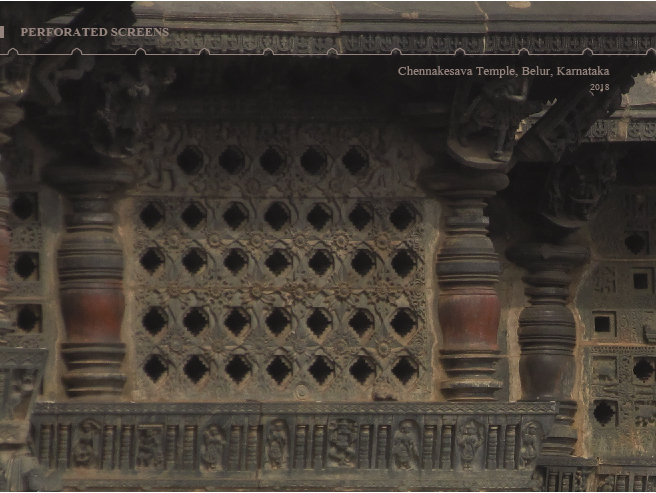
The perforated stone screens at the temple are of various patterns. They contain flowers, petals, leaves, and other motifs that are arranged geometrically.
The pillars on either side of the screens have concentric circular or disc-like carvings. These carvings were done by mounting the stone on a lathe, similar to how wood is carved, and constantly turning it. This is a special and unique feature of Hoysala art.
BRACKETS
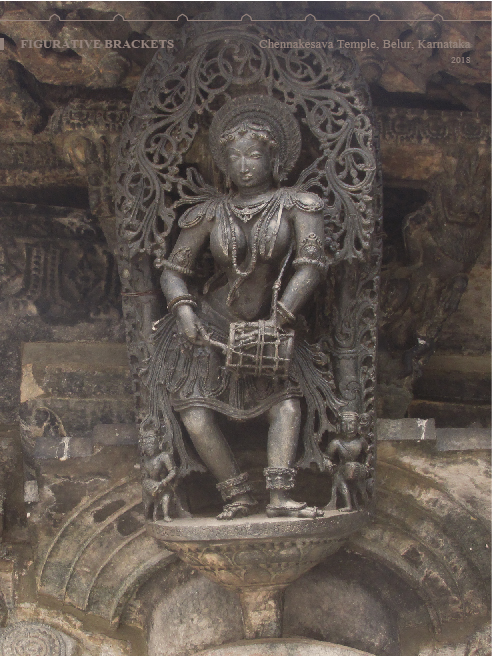
Stone Brackets of graceful kinds feature under the temple eaves. These are considered to be figures akin to Mohini, and are popularly called Mandakini.

They exhibit beauty and grace. Their poses, the charming expressions on their faces, the highly expressive postures and gestures, make them a mark of high craftsmanship. The figures are about two and a half feet tall and have feminine figures dancing, getting dressed, playing music, performing, or admiring themselves in a mirror.
SCULPTURAL RELIEFS
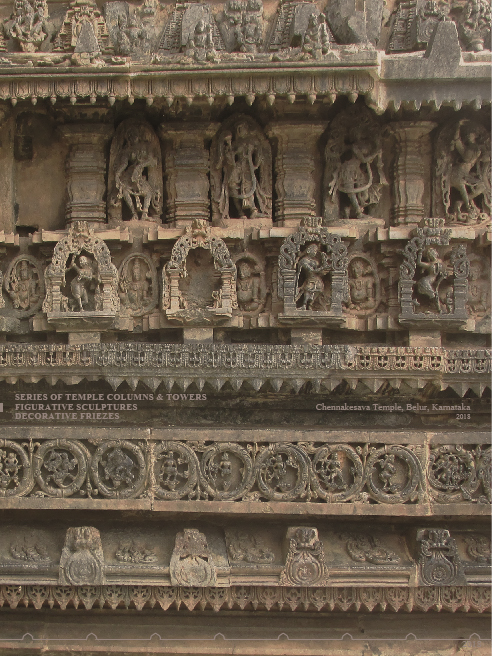
The ornamental scrolls appear on the front of the wall, and here at Chennakeshava Temple they also contain small figures within their convolutions. These are miniature figures of gods, men, and animals. They also contain dancers, musicians, hunters, and other figures.
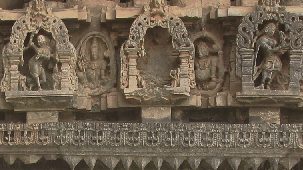
The levels above these have a number of feminine sculptures that are framed within arches formed by stylized creepers. There is an appearance of many figures of Mohini and also in some cases of Vishnu. Above these are ornamental turrets and various architectural, figurative, and narrative depictions that are sculpted in a miniature format. Each of these layers is spaced apart by intricate ornamental tassels and patterns.
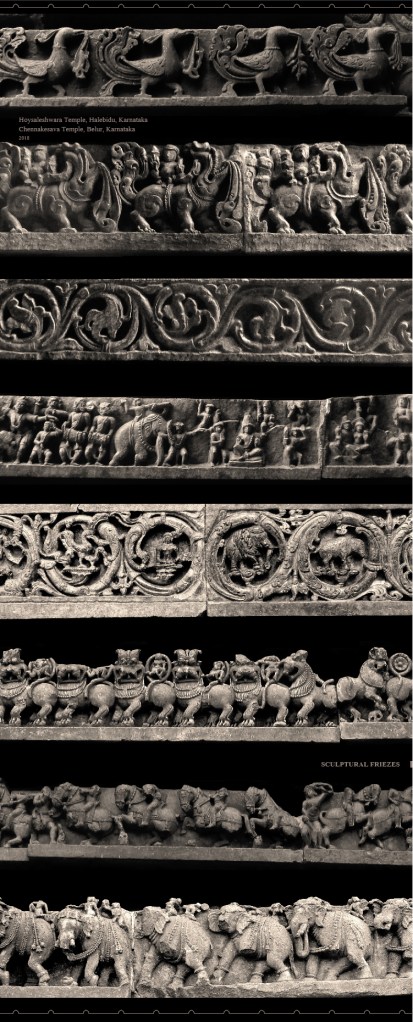
The images on this page are from my trip to the two temples in 2018. The walls of the temple are filled with dramatic postures of figurative sculptures, narratives from mythology and ornamented with delicate sculptural patterns. Seeing the exquisite artistry was not just a visual delight, but opened the mind to the various dimensions that there could be in a work of art (and architecture). This display and text alongside is a small attempt to put before you the wonderful legacy that the Hoysala Dynasty has created.
[More from Hoysala Artistry]
You could also look at a sequel to this blog Stories in Stone :: Hoysala Art.
The Hoysala Dynasty ruled medieval Karnataka, leaving a rich legacy of art, architecture, and temples. Two key sites are Belur and Halebidu.


 प्रा
प्रा 