Furniture & Us:
Furniture encompasses us within our living spaces, fulfilling our various needs.
Each piece of furniture tells a story, reflecting the culture, traditions, and aesthetic preferences of the society it belongs to. Every piece contributes to the overall vibe and functionality of a room. Our interaction with furniture goes beyond its practical use; as it also reflects our individuality and style, shaping our living environment and influencing our daily activities. Whether it's for sitting, sleeping, lounging, dining, cooking, working, showcasing, storing, or organizing, furniture is integral to countless facets of our day-to-day existence.
Furniture Names:
Across eras, countries, styles, and cultures; furniture has been developed in unique ways.
Some pieces are recognized under broad categories such as tables, seating, chairs, and beds. Others bear generic labels like armchairs and display units. Then there are those with specific names; for instance, a chaise lounge.
About this Visual
DICTIONARY OF FURNITURE
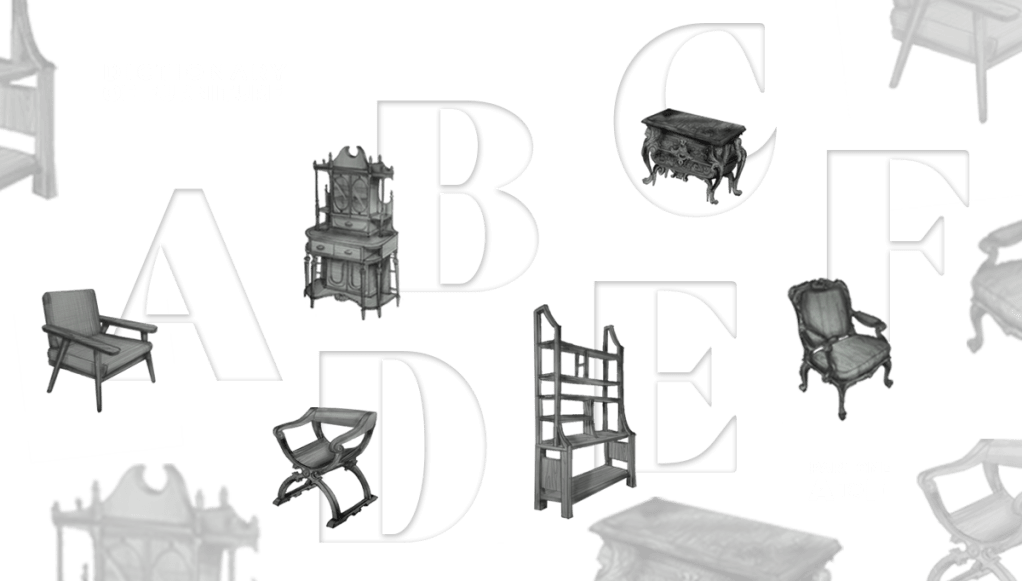
This post is first in a series that catalogues furniture pieces by alphabetical order. Starting with the initial six letters of the alphabet, the current compilation features one furniture item per letter. Upon completing all 26 alphabet, I intend to revisit certain alphabets from earlier pages to to add in more and enrich the curation further. As this is also a Visual Dictionary, it incudes sketches, each paired with a brief descriptive note, about each piece.
DICTIONARY OF FURNITURE :: PART ONE

ARMCHAIR
Historically, seating has been a significant aspect of society, often serving as a marker of status and symbolizing authority. This is reflected in terms such as 'chairperson' and the expression 'to hold a chair.' Over the years, seating and seating systems have become integral to our daily lives.
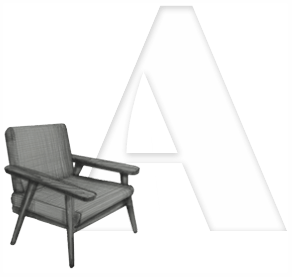
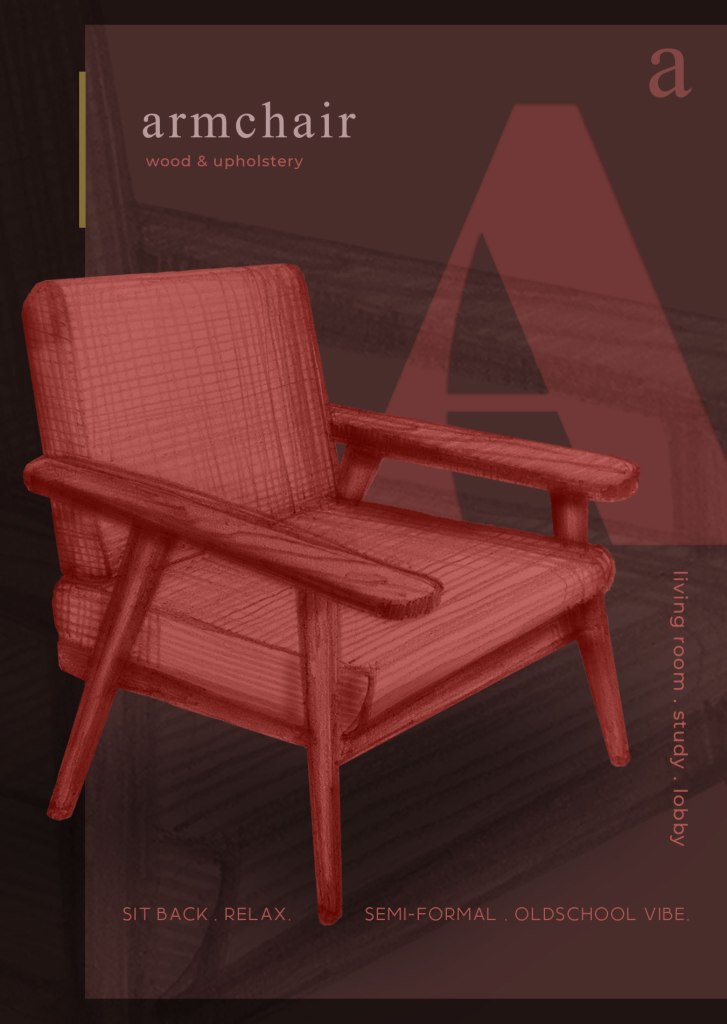
An armchair, designed to support the arms, offers a comfortable position for the body. Typically constructed from wood and upholstered, it is placed in settings where relaxation and firm body support are prioritized. Consequently, an armchair is sometimes referred to as a resting chair or an easy chair.
Like the term 'chairperson' conveys a sense of authority, and from this, we derive the term 'armchair critic.' This phrase describes a person who is opinionated and judgmental, often without actively engaging in the subject at hand.
Furniture Type and Category: Seating
Usual Materials: Wood and Fabric
Places of Use: Living rooms, Lobby areas, Hotel rooms, Study areas

BUFFET
The term 'Buffet' originates from French and refers to a sideboard used for serving food and displaying silverware. The modern usage of 'buffet' describes a system of serving food to the public in a designated area.
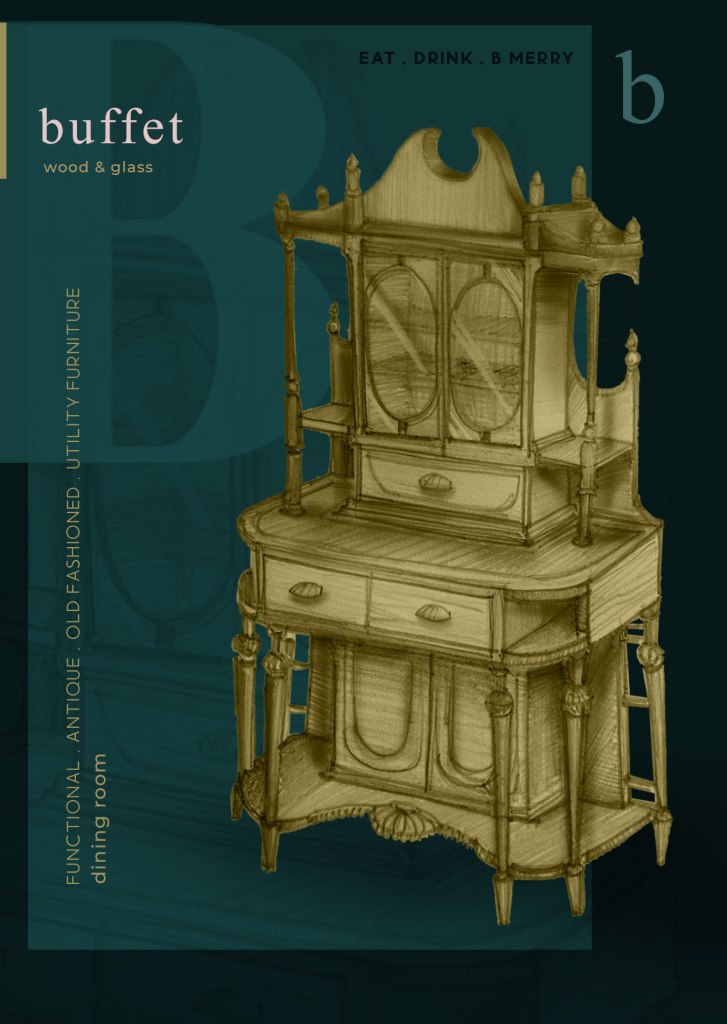
This piece acts as a unit to store and showcase dinnerware, crockery, and cutlery. Typically positioned against a wall, it is often found near areas associated with cooking, plating, serving, and dining. Exquisite crockery is usually displayed in glass-shuttered cabinets and on open shelves. The unit generally includes a tabletop that serves as a space for appetizers and finger foods during serving. Drawers below provide storage for smaller items such as forks, spoons, and knives, while the storage beneath offers shuttered space for organizing and storing larger items.
In dining rooms and kitches in the residential space, such a unit could be also called as a crockery unit or a credenza with a show-case. In banquets and restaurants this could be called as dumb-waiters or serving stations.
The sketch alonside depicts a Buffet with a swan-neck pediment and scallop shell metal mounts and handles, complemented by leaded glass shutters. It is a traditional utility unit that fits well within country-style interior spaces.
Furniture Type and Category: Display & Storage
Usual Materials & Techniques: Wood, Veneer, Marquetry, Inlay, Carved Reliefs, Bronze Mounts, and Glass
Places of Use: Dining rooms, Kitchen, Banquets, Restaurants

COMMODE
Yes, you read that correctly: commode. And no, it doesn't only refer to the fixture we use in the bathroom.
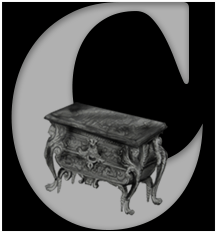
A commode is also a type of mid-rise table, typically featuring large drawers, often ornate and elegantly decorated. It bears a resemblance to a chest of drawers and could also be referred to as a credenza or a console.
Derived from the Latin 'commodus', the term signifies convenience. These tables are designed for storage but, thanks to their highly decorative nature, they also stand out as impressive pieces of furniture in their own right. They are commonly placed prominently against a wall, complemented by an ornate mirror, suitable wall decor, or topped with a lavish floral arrangement in a decorative vase.
The top of a commode is usually adorned with a marble slab, supported by its substantial, rounded body. The surfaces feature gilt-bronze mounts, handles, and locks, all borne on ornately curved legs.
Gaining popularity during the French Baroque and Rococo periods, commodes have graced many palaces, courts, and homes of high style and grandeur. They are a mark of the elegance and pomp of those times.
Furniture Type and Category: Accent & Storage
Materials & Techniques seen here: Wood, Veneer, Marquetry, Inlay, Carved Reliefs, Bronze Mounts, and Tortoise-shell.
Places of Use: Living rooms, Corridors, Hallways, Salons, Parlors, Banquets
Sketch made after French Commode by André Charles Boulle, ca. 1710–20


DANTE
The Renaissance period witnessed the advent of various chair designs, each distinct in style and bearing a unique name. The Renaissance, a time of renewal of classical ideals and a rebirth of artistic styles, is perfectly exemplified by the Dante chair we have before us.
The Dante chair is characterized by its X-frame design, drawing inspiration from the X-frame stools and chairs of ancient Egyptian and Classical styles. It features curved arms and legs that intersect at a central disk, connected by a wooden backrest. This backrest is molded with a slant and curvature to provide comfort and support for the back. In some instances, the backrest was adorned with leather. The seat of the Dante chair is secured between rails by a broad band of leather that follows the contour of the arms.
Crafted during the Italian Renaissance, this chair was produced in large quantities and embellished with the era's prevalent techniques. A foldable version of this chair was also developed, known as the Savonarola chair.
Furniture Type and Category: Seating
Materials & Techniques: Wood and wooden embellishment & tooled Leather.
Places of Use: Living rooms, Corridors, Hallways, Salons, Parlors, Banquets
Sketch made after Hip-joint armchair (Dantesca type), Italian, 16th century


etagere
This tall, frame-structured shelving unit is designed to display ornamental objects. It is typically composed of shelves varying in length, height, and depth, and sometimes includes enclosed cabinets at the base.
Commonly referred to as a display rack or shelving unit, an étagère's frame can be crafted from materials such as wood or metal, while the shelves may be veneered or made of glass. Although traditionally constructed from wood, modern étagères often feature a mix of materials.
An étagère can be placed against a wall or used as a room divider, accessible from both sides. It typically houses a collection of knickknacks and decorative items that reflect the owner's style. The overall design and degree of ornamentation of an étagère are influenced by the decor of the space it occupies, ranging from elaborately ornate, curved frames to simple, streamlined grid frames.
The overall form and the level of ornamentation completely depends upon the style of the space it is placed within. étagères range from highly ornate curved framed pieces to simple stramlined grid-framed ones.
Derived from the French 'une étagère,' which translates to 'a shelf,' the étagère is a versatile piece that adds both functionality and elegance to a room; and could be modulated to suit the design language of the space.
Furniture Type and Category: Display
Materials & Techniques: Wood.
Places of Use: Living rooms, Dining areas


FAUTEUIL
Fauteuil chair, with its ornate framework, is an upholstered, open-armed seat that originated in sixteenth to seventeenth-century France. These chairs are crafted with exposed, carved, and gilded wooden frames, complemented by luxurious fabric upholstery.
Typically adorned with Rococo-style motifs and ornamentation, the Fauteuil chair features delicate rocaille, scallop shells, foliage, and other intricate designs. These are tastefully carved onto the crown of the backrest, the armrests, the knees of the cabriole legs, the front rail of the seat, and the feet of the chair, all harmonizing with the period's style.
The upholstery of a Fauteuil chair is traditionally made from rich materials such as damasks, silks, woven wools, and velvets.
Typically, Fauteuil chairs are created as part of a set and celebrate the delicate and fanciful ornamentation of the Rococo style. Often gilded in gold to evoke a sense of opulence and luxury.
Furniture Type and Category: Seating
Materials & Techniques: Carved and Gilded Wood & Silk and Wool Upholstery.
Places of Use: Living rooms, Hallways, Salons, Parlors, Banquets
Sketch made after Armchair (fauteuil à la reine) (part of a set), Various artists/makers, ca. 1754–56
Happy to share, PART 2 has been uploaded here!

Until then, you could flashback Part 2 of the Dictionary of Furniture :: G to L here.
Hoping to explore the next set of alphabets in the Visual Dictionary of Furniture soon!



 प्रा
प्रा 